Every month holds a different blessing. This complete guide helps you choose the perfect time for your sacred journey based on spiritual significance, weather, crowd levels, and cost.
- 12 Months Umrah is open year-round
- Hajj Reward of Umrah in Ramadan
- 45°C Peak summer temperature in Makkah
- 4 Sacred Islamic months for Umrah
- 3–6 hrs Average time to complete Umrah rituals
Short answer: Umrah can be performed in any month of the Islamic year. For maximum spiritual reward, perform Umrah in Ramadan. For fewer crowds and lower costs, travel in Muharram, Safar, or Rabi al-Thani. For comfortable weather, the Gregorian months of November through February (winter) are ideal. For a balance of all three, Dhul Qa’dah (one of Islam’s four sacred months) is widely considered the sweet spot.
Umrah the blessed minor pilgrimage to the holy cities of Makkah and Madinah is a journey that transforms hearts, renews faith, and draws the believer closer to Allah (SWT). Unlike Hajj, which follows a fixed Islamic calendar schedule, Umrah is open to Muslims throughout most of the year, offering pilgrims the beautiful freedom to choose when their sacred journey takes place.
But not all months are equal. Some months carry extraordinary spiritual weight Ramadan above all. Others offer practical advantages: cooler weather, thinner crowds, or more affordable packages. Understanding these differences can be the difference between a peaceful, spiritually immersive pilgrimage and a stressful, overcrowded, expensive one.
At Uniworld Travel & Tours one of Karachi’s most trusted Umrah service providers we have guided thousands of Pakistani families, couples, seniors, and solo pilgrims through every month of the year. This comprehensive guide shares everything we know about choosing the right time for your Umrah, so you can focus on what truly matters: your connection with Allah.
In This Guide
- Understanding the Islamic Calendar
- Month-by-Month Umrah Guide
- Full Comparison Table
- Umrah in Ramadan: The Holiest Time
- The Four Sacred Months
- Makkah Weather by Season
- Who Should Go When?
- Our Umrah Packages
- Booking & Preparation Tips
- Frequently Asked Questions
Understanding the Islamic (Hijri) Calendar & Umrah
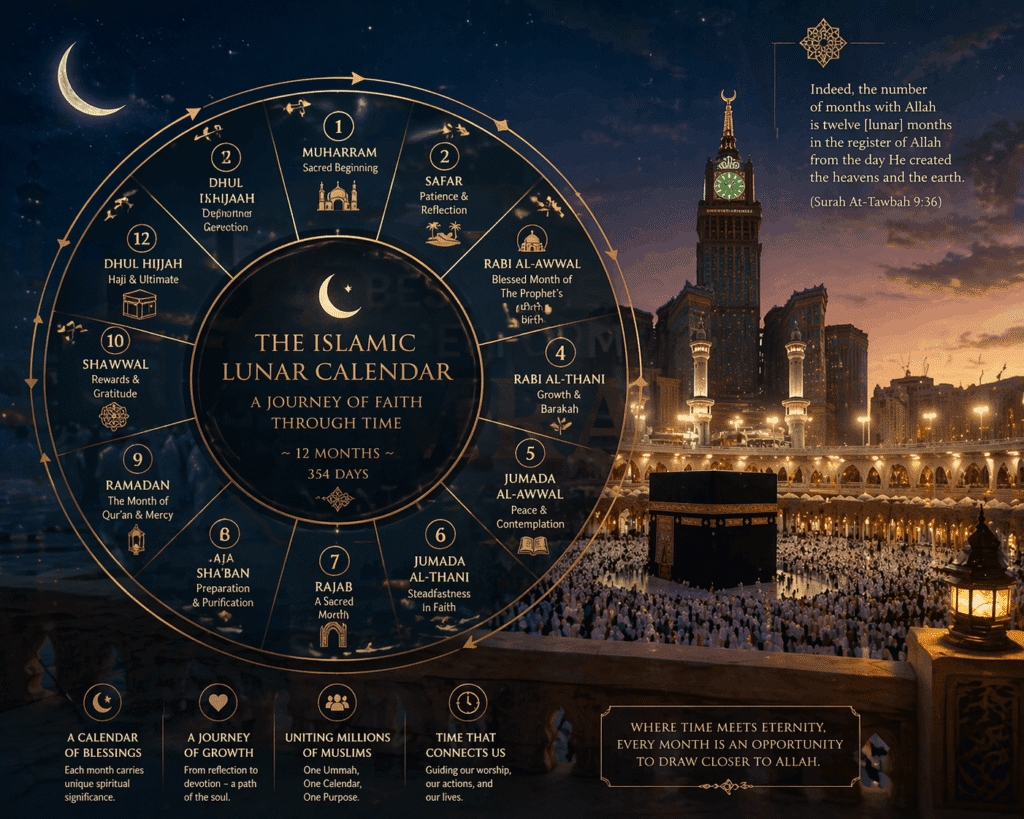
The Islamic Hijri calendar is a lunar calendar consisting of 12 months, each beginning with the sighting of the new crescent moon. A Hijri year is approximately 354 days about 11 days shorter than the Gregorian solar year. This means Islamic months shift backward through the Gregorian calendar each year, completing a full cycle roughly every 33 years.
This has a crucial practical implication: Ramadan and other significant Islamic months fall at different Gregorian times each year. A year when Ramadan falls in December brings cooler Makkah weather to the most spiritually elevated month. When it falls in summer, the heat is intense. Always check the current Hijri calendar when planning your Umrah journey.
The 12 Islamic Months (and Their Umrah Significance)
The Islamic Calendar at a Glance
- 1. Muharram Sacred month · New Islamic Year · Quieter crowds · Spiritually elevated
- 2. Safar Historically quieter · Low season · Budget-friendly
- 3. Rabi al-Awwal Month of the Prophet’s (PBUH) birth · Moderate activity · Mawlid period busy
- 4. Rabi al-Thani Calm, off-peak · Excellent value · Peaceful environment
- 5. Jumada al-Awwal Low-moderate season · Good weather window depending on Gregorian overlap
- 6. Jumada al-Thani Similar to above · One of the quieter months
- 7. Rajab Sacred month · Moderate-high activity · Special spiritual significance
- 8. Sha’ban Pre-Ramadan buildup · Increasing crowds · Prepare and purify
- 9. Ramadan Highest spiritual reward · Most crowded · Most expensive
- 10. Shawwal Post-Ramadan · Still elevated spiritually · Moderate crowds
- 11. Dhul Qa’dah Sacred month · Moderate crowds · Excellent balance
- 12. Dhul Hijjah Hajj season · Umrah restricted during Hajj days (8–13 Dhul Hijjah)
Month-by-Month Umrah Guide the Complete Breakdown
Below is a detailed assessment of every Islamic month for Umrah performance, covering crowd levels, temperatures (approximate Gregorian overlap for 2026), costs, and our expert recommendation for each.
1. Muharram: Islamic New Year (1st Islamic Month)
- Crowds: Moderate
- Temperature: Mild-Warm
- Cost: Low-Moderate
Muharram is one of Islam’s four sacred months and marks the Islamic New Year. The atmosphere is spiritually charged with many pilgrims seeking fresh starts and forgiveness. Crowds are moderate compared to Ramadan, making it easier to perform rituals with focus. The 10th of Muharram (Ashura) sees a slight increase in visitors.
Best Time for:
- Spiritually motivated first-timers looking for significance without Ramadan-level crowds.
- Recommendation: Book 6-8 weeks in advance for a peaceful experience.
2. Safar: Quiet Season (2nd Islamic Month)
- Crowds: Low
- Temperature: Varies
- Cost: Low
Safar is historically one of the quietest months for Umrah. There are no major Islamic events or holidays during this period, meaning the Haram is significantly less crowded. Pilgrims can perform Tawaf and Sa’i with remarkable ease and closeness to the Kaaba.
Best Time for:
- Budget travelers and anyone wanting an intimate, unrushed Umrah experience.
- Recommendation: Ideal for pilgrims looking to avoid crowds and enjoy the serenity of the Haram.
3. Rabi al-Awwal: Month of the Prophet (3rd Islamic Month)
- Crowds: Moderate
- Temperature: Mild-Warm
- Cost: Moderate
Rabi al-Awwal carries the immense blessing of being the birth month of Prophet Muhammad (PBUH). The spiritual atmosphere is deeply moving and rich. The 12th of Rabi al-Awwal (Mawlid al-Nabi) brings a temporary increase in pilgrims. Visiting the Prophet’s Mosque during this month feels especially poignant and meaningful.
Best Time for:
- Pilgrims wishing to deepen their love for the Prophet Muhammad and increase their connection to Madinah.
- Recommendation: A deeply emotional time to travel.
4. Rabi al-Thani: Off-Peak Calm (4th Islamic Month)
- Crowds: Low
- Temperature: Mild
- Cost: Low
Rabi al-Thani is one of the calmest, least-crowded months for Umrah. No major Islamic events fall during this period, resulting in a tranquil atmosphere in both Makkah and Madinah. Combined with the typically mild weather (depending on the year’s Gregorian overlap), this is a hidden gem for peaceful pilgrimage at affordable prices.
Best Time for:
- Pilgrims seeking closeness to the Kaaba and a genuinely meditative experience without crowds.
- Recommendation: One of the best-kept secrets for a serene Umrah journey.
5. Jumada al-Awwal & Thani (5th & 6th Islamic Months)
- Crowds: Low-Moderate
- Temperature: Warm-Hot (Varies)
- Cost: Moderate
These two months are quiet Umrah periods with no specific religious events driving pilgrim traffic. Crowd levels remain low to moderate, offering good access to the Kaaba and freedom in the sacred spaces. Weather depends heavily on the Gregorian calendar overlap in some years, these months coincide with cooler winter months, in others, with hot summer periods.
Why Perform Umrah in Jumada al-Awwal & Thani?
- Ideal for experienced pilgrims with flexible dates.
- Recommendation: Always check the Gregorian overlap to plan for the weather appropriately.
6. Rajab (7th Islamic Month – Sacred Month)
- Crowds: Moderate-High
- Temperature: Warm-Hot
- Cost: Moderate-High
Rajab is one of the four sacred months in Islam, and its spiritual significance drives a notably larger number of pilgrims. The 27th of Rajab (Isra wal-Mi’raj the Night Journey of the Prophet ﷺ) makes this period particularly spiritually charged. Performing Umrah during this sacred month carries additional blessings, and many pilgrims specifically target Rajab for this reason.
Why Perform Umrah in Rajab?
- Great for spiritually motivated pilgrims willing to handle moderate crowds in exchange for a sacred-month blessing.
- Recommendation: Book 2–3 months ahead to secure the best experience.
7. Sha’ban (8th Islamic Month – Pre-Ramadan)
- Crowds: High (Late Sha’ban)
- Temperature: Warm-Hot
- Cost: Moderate (Rising)
Sha’ban is the month immediately preceding Ramadan and is spiritually linked to preparation and purification. The Prophet Muhammad (PBUH) himself frequently fasted in Sha’ban. The first half of Sha’ban is relatively quiet, but the second half sees rapidly increasing crowds and prices as Ramadan approaches. The Night of Sha’ban (Laylat al-Bara’ah, 15th night) draws many pilgrims.
Why Perform Umrah in Sha’ban?
- Early Sha’ban is excellent for those who want pre-Ramadan spiritual energy without paying Ramadan prices.
- Recommendation: Avoid booking during the final 10 days crowds and costs spike sharply.
Ramadan (9th Islamic Month – Most Blessed)
- Crowds: Maximum
- Temperature: Varies by Year
- Cost: Highest
Ramadan is the pinnacle of Umrah timing. The Prophet Muhammad (PBUH) declared that Umrah in Ramadan is equivalent to Hajj in reward. The last 10 nights including Laylat al-Qadr (the Night of Power, better than a thousand months) draw millions of pilgrims from across the world. The Haram is transformed into an ocean of devotion, tears, and supplication. Despite the crowds, many pilgrims describe Ramadan Umrah as the most spiritually overwhelming experience of their lives.
Why Perform Umrah in Ramadan?
- Perfect for those seeking maximum spiritual reward.
- Recommendation: Book 4–6 months in advance. Expect 3–5x normal prices. Worth every penny for those seeking immense spiritual reward.
8. Shawwal (10th Islamic Month – Post-Ramadan)
- Crowds: Moderate (Declining)
- Temperature: Warm-Hot
- Cost: Moderate (Falling)
Shawwal begins with Eid al-Fitr a joyful time that many pilgrims choose to celebrate in Makkah itself. The first few days of Shawwal see elevated pilgrim numbers (Eid), but crowds decline rapidly as the month progresses. The spiritual atmosphere remains elevated post-Ramadan, and prices drop meaningfully from their Ramadan peaks. Performing the 6 voluntary fasts of Shawwal while in Makkah adds additional blessing.
Why Perform Umrah in Shawwal?
- Excellent choice for pilgrims who missed Ramadan packages but still want an elevated spiritual atmosphere at more manageable prices.
- Recommendation: Book early for the best availability.
Dhul Qa’dah (11th Islamic Month – Sacred Month)
- Crowds: Moderate
- Temperature: Mild-Warm
- Cost: Moderate
Dhul Qa’dah is one of the four sacred months and is widely regarded as the ideal balance between spiritual significance and practical manageability. Crowds are moderate, prices are reasonable, and the sacred-month blessing adds extra weight to your worship. This month was when the Prophet (PBUH) himself performed multiple Umrahs. Pre-Hajj visitors begin arriving towards the end of the month, so early Dhul Qa’dah offers the sweetest combination.
Why Perform Umrah in Dhul Qa’dah?
- Top recommended month for most pilgrims sacred month blessing, manageable crowds, good weather, and fair pricing. A perfectly balanced choice.
- Recommendation: Ideal for those seeking a peaceful pilgrimage.
Dhul Hijjah (12th Islamic Month – Hajj Season)
- Crowds: Extreme
- Temperature: Hot-Very Hot
- Cost: Very High
Dhul Hijjah is the Hajj month. Umrah is restricted or completely suspended from approximately the 8th to the 13th of Dhul Hijjah to allow Hajj pilgrims to focus on Hajj rituals without congestion. Outside these restricted days particularly the first 7 days and after the 13th Umrah can be performed. The first 10 days of Dhul Hijjah are among the most blessed in the Islamic calendar, and many pilgrims choose to perform Umrah before Hajj restrictions begin.
Why Perform Umrah in Dhul Hijjah?
- If you plan Hajj, you can perform Umrah upon arrival (Tamat’u or Qiran pilgrimage).
- Recommendation: For Umrah-only travel, avoid the 8th–13th Dhul Hijjah. Always confirm current Saudi regulations.
Full Month-by-Month Umrah Comparison Table
Use this at-a-glance reference table to compare all Islamic months across the key factors that matter to pilgrims planning their Umrah journey from Pakistan.
| Islamic Month | Spiritual Weight | Crowd Level | Avg. Makkah Temp* | Package Cost | Best For |
| Muharram | (Sacred Month) | Moderate | Mild–Warm | Low–Mid | Spiritual fresh start, first-timers |
| Safar | (Regular) | Low | Varies | Lowest | Budget travelers, intimate experience |
| Rabi al-Awwal | (Prophet’s ﷺ Birth) | Moderate | Mild | Moderate | Devotion to Prophet ﷺ, Madinah focus |
| Rabi al-Thani | (Regular) | Low | Mild | Low | Peaceful immersion, close to Kaaba |
| Jumada al-Awwal | (Regular) | Low–Moderate | Warm–Hot* | Low | Flexible pilgrims, off-season value |
| Jumada al-Thani | (Regular) | Low | Warm–Hot* | Low | Quiet, budget-conscious pilgrims |
| Rajab | (Sacred Month) | Moderate–High | Warm–Hot* | Moderate–High | Sacred month seekers, Isra wal-Mi’raj |
| Sha’ban | (Pre-Ramadan) | Moderate (rising) | Warm–Hot* | Moderate (rising) | Pre-Ramadan spiritual prep |
| Ramadan | (= Hajj Reward) | Maximum | Varies* | Highest | Maximum reward seekers, Laylat al-Qadr |
| Shawwal | (Post-Ramadan) | Moderate (declining) | Warm–Hot* | Moderate | Eid in Makkah, post-Ramadan glow |
| Dhul Qa’dah | (Sacred Month) | Moderate | Mild–Warm* | Moderate | Best overall balance recommended |
| Dhul Hijjah | (Hajj Season) | Extreme (Hajj) | Hot–Very Hot* | Very High | Hajj pilgrims, pre-Hajj Umrah only |
Temperatures shift each year based on the Gregorian calendar overlap with the Hijri year. Always check current forecasts when booking.
Umrah in Ramadan The Pinnacle of Pilgrimage
“Umrah in Ramadan is equivalent to performing Hajj with me.” Prophet Muhammad ﷺ (Sahih al-Bukhari & Sahih Muslim)
No discussion of the best time for Umrah is complete without giving Ramadan its full, rightful prominence. This blessed month when the Quran was first revealed, when the gates of Heaven are opened and the gates of Hell are closed, and when shayateen are chained is the most spiritually potent time for any act of worship.
During Ramadan, the entire atmosphere of Makkah and Madinah transforms into something that pilgrims describe as otherworldly. Millions of believers, eyes glistening with tears, hearts cracked open by fasting and night prayers, gather around the Kaaba and in the rows of Masjid al-Nabawi. The recitation of Quran fills every air-conditioned corridor. Iftar tables stretch for hundreds of meters around the Haram. The last 10 nights especially Laylat al-Qadr, the Night of Power worth more than 83 years of worship bring an intensity of devotion unlike anything in the calendar.
Practical Realities of Ramadan Umrah
The spiritual rewards come with practical challenges that every pilgrim must prepare for honestly:
Key Challenges of Ramadan Umrah
- Extreme crowds: The Haram can hold several million pilgrims simultaneously during Ramadan’s final nights the largest human gatherings on Earth
- Higher costs: Flights, hotels, and Umrah packages cost 2–5× more during Ramadan versus off-peak months
- Limited availability: Hotels near the Haram sell out months in advance book 4–6 months early minimum
- Heat risk: Depending on Gregorian overlap, summer Ramadan periods can be extremely hot (38–44°C), especially challenging while fasting
- Physical demand: Performing Tawaf in dense crowds while fasting requires preparation especially for elderly pilgrims and those with health conditions
Tips for Making the Most of Ramadan Umrah
- Book your Umrah package from Karachi at least 4–6 months in advance
- Perform Tawaf in the early hours of the morning (2am–4am) when crowds thin slightly
- Stay in a hotel within walking distance of the Haram to rest between prayers
- Prioritize the last 10 nights especially the odd nights (21st, 23rd, 25th, 27th, 29th) for Laylat al-Qadr
- Carry a small water bottle and mist spray during the day for cooling
- Travel with a trusted agency like Uniworld that has pre-confirmed hotel bookings and local support
Book Your Umrah Package for Any Month
From Ramadan to Rajab, Dhul Qa’dah to Muharram Uniworld has the perfect Umrah package for your chosen time of year. Let us handle every detail of your sacred journey.
The Four Sacred Months Extra Spiritual Weight for Umrah
Allah (SWT) designated four months as sacred (Al-Ashhur al-Hurum) in which the rewards of good deeds are multiplied and sins carry greater weight. Performing Umrah during any of these months adds a spiritual dimension beyond the regular calendar.
The Four Sacred Months in Islam
- Dhul Qa’dah (11th month) Widely considered the most balanced choice for Umrah outside Ramadan. Sacred blessing + manageable crowds + reasonable pricing.
- Dhul Hijjah (12th month) Hajj month. Umrah permitted in early days (1–7) and after the 13th. The first 10 days are among the most blessed in the Islamic year.
- Muharram (1st month) Islamic New Year month. Spiritually elevated, moderate crowds, and a wonderful time for intention-setting and renewal.
- Rajab (7th month) Contains Isra wal-Mi’raj (27th Rajab). Moderate-high pilgrims, but a deeply spiritually charged atmosphere worth experiencing.
Scholars of Islam note that performing Umrah in a sacred month carries the advantage of both the worship itself and the sanctified nature of the time. It is like praying in the front row of the mosque versus the last the act is the same, but the positioning multiplies its spiritual resonance.
Makkah Weather by Season What Pilgrims Need to Know?
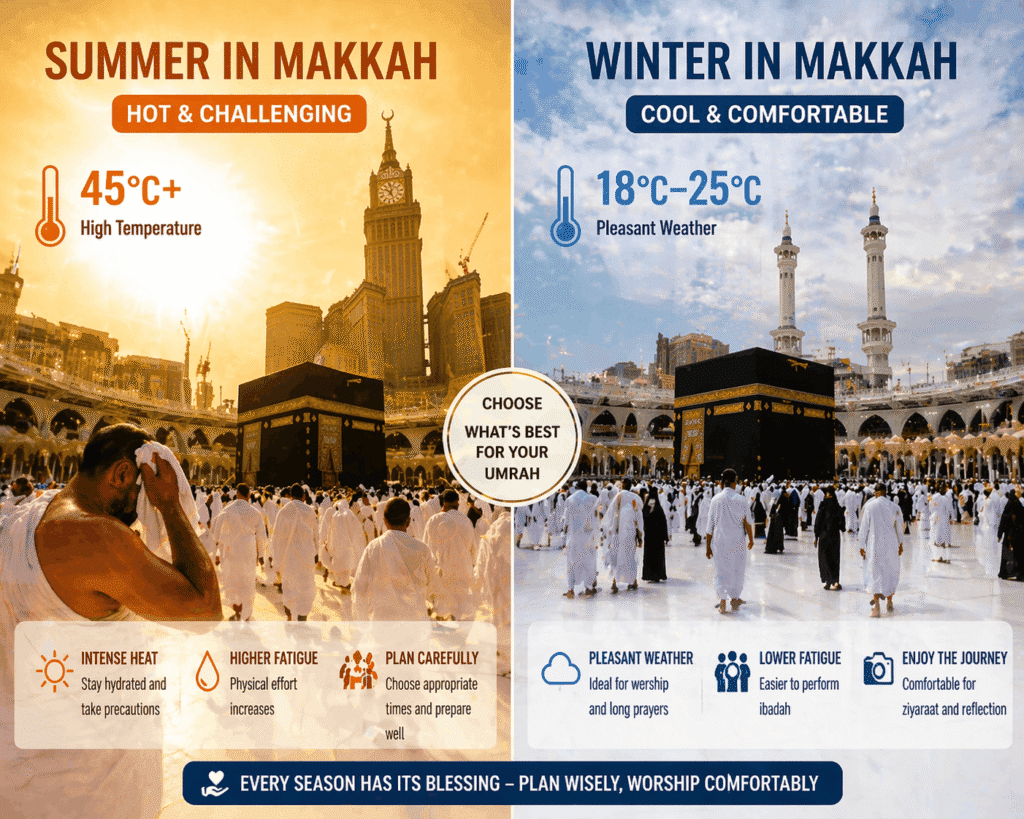
Makkah sits in the Hejaz region of western Saudi Arabia a hot desert climate with very high temperatures, minimal rainfall, and intense sun for most of the year. Understanding the weather is essential for planning a safe and comfortable Umrah, particularly for elderly pilgrims, families with young children, and those with medical conditions.
Summer (June–September)
Temperatures regularly reach 40–46°C during the day and rarely drop below 30°C at night. Humidity can spike suddenly near the Red Sea coast. Performing outdoor rituals like walking between Safa and Marwah or the walk to/from the Miqat requires careful heat management. The Saudi government provides cooling misting fans, cold water distribution points, and air-conditioned corridors throughout the Haram complex, but the heat is still genuinely demanding.
Summer Umrah Heat Safety
- Carry a personal water bottle at all times stay hydrated constantly
- Apply unscented sunscreen (post-Ihram state) when outside
- Wear light, breathable cotton Ihram and Umrah clothing
- Avoid peak midday heat (12pm–4pm) for outdoor movements
- Elderly pilgrims and those with heart or kidney conditions should consult a doctor before summer Umrah
- Use umbrellas (available near the Haram) for outdoor walks
Autumn (October–November)
Temperatures begin moderating significantly in October and November, dropping to a much more manageable 25–35°C. This coincides with some of the quieter Islamic months (Rabi al-Awwal / Rabi al-Thani depending on the year), making autumn an increasingly popular window for Pakistani families and first-time pilgrims. The evenings become genuinely pleasant.
Winter (December–February)
Winter is the most comfortable weather window for Umrah in terms of physical ease. Daytime temperatures sit between 20–30°C, and evenings can drop to 15–20°C pleasantly cool by Makkah standards. This is when Pakistani families, senior citizens, and those performing Umrah for the first time find the physical demands most manageable. The entire experience of long Tawaf sessions and Sa’i becomes significantly more comfortable in the cooler air.
Spring (March–May)
Temperatures begin rising in spring, reaching 28–38°C by May. March remains quite comfortable and is an excellent month for Umrah. April and May grow progressively hotter, though still significantly cooler than peak summer. Depending on the year’s Hijri calendar alignment, spring months may overlap with Rajab, Sha’ban, or even the opening days of Ramadan making this a very active Umrah season.
Who Should Go When? Personalized Recommendations
Every pilgrim’s situation is different. Below are our expert recommendations based on traveler type, budget, and priority:
For Families with Young Children
- Best months: Winter (Gregorian Nov–Feb) aligned with Muharram, Rabi al-Awwal, Rabi al-Thani, or Jumada months
- Children need cooler temperatures and manageable crowds for safety
- Avoid peak summer and the final 10 nights of Ramadan (overwhelming crowds)
- Consider a 15-day Umrah package for adequate time without rushing
For Senior Citizens & Those with Health Conditions
- Best months: November, December, January, February any Islamic month that overlaps these Gregorian dates
- Cooler temperatures drastically reduce health risks during Tawaf and Sa’i
- Early-morning Tawaf (2–5am) offers the thinnest crowds and most manageable conditions
- Choose 4-star or 5-star accommodations directly adjacent to the Haram for minimal walking
For Budget-Conscious Pilgrims
- Best months: Safar, Rabi al-Thani, Jumada al-Awwal, Jumada al-Thani
- These months offer the lowest Umrah package prices from Karachi year-round
- Hotels near the Haram are at their most affordable and available
- Consider our economy 3-star Umrah packages complete journey at the best price
- Fewer crowds means more peaceful, longer access to pray near the Kaaba
For Those Seeking Maximum Spiritual Reward
- Best choice: Ramadan the last 10 nights especially. The reward is equivalent to Hajj.
- Second choice: One of the four sacred months (Muharram, Rajab, Dhul Qa’dah, or early Dhul Hijjah)
- Book with Uniworld’s dedicated Umrah team well in advance 4–6 months for Ramadan, 2–3 months for sacred months
- Consider extending to a 21-day or 28-day package for immersive spiritual retreat
For First-Time Pilgrims
- Best overall recommendation: Dhul Qa’dah or early Muharram in a winter Gregorian period
- Sacred month blessing + cooler weather + moderate crowds = ideal first-time conditions
- First-timers benefit from less crowd pressure to absorb the rituals with proper focus
- Read our complete How to Perform Umrah guide before traveling
- Our 7-day and 10-day packages are perfectly suited for confident first-time pilgrims
Our Umrah Packages from Karachi; For Every Month & Budget
At Uniworld Travel & Tours, we offer a complete range of Umrah packages designed for Pakistani pilgrims traveling from Karachi and across Pakistan. Each package is carefully crafted to ensure a smooth and spiritually fulfilling journey.
All packages include:
- Umrah visa processing
- Return air tickets
- Hotel accommodation near the Haram
- Airport transfers
- Dedicated customer support throughout your journey
1. Umrah 7 Days Package
Best for: First-time pilgrims and short trips
Perfect for those with limited time. Complete your Umrah rituals comfortably with guided support and essential services.
2. Umrah 10 Days Package
Best for: Balanced spiritual experience
Enjoy extra time for prayers, Ziyarat, and reflection in both Makkah and Madinah.
3. Umrah 15 Days Package
Best for: Families and relaxed travel
A well-paced journey with ample time for worship, sacred site visits, and spiritual connection.
4. Umrah 21 Days Package
Best for: Deep spiritual retreat
Spend three weeks immersed in the holy cities and experience a truly transformative journey.
5. Umrah 28 Days Package
Best for: Maximum devotion (ideal for Ramadan)
A complete month-long spiritual experience, perfect for those seeking the full essence of Umrah.
Also Planning Hajj?
Explore our complete range of Hajj packages from Pakistan available in 14, 20, 25, 38, and 40-day durations, with options to combine your Hajj journey with Umrah for a complete sacred experience.
Essential Booking & Preparation Tips for Umrah from Pakistan
How Far in Advance to Book?
Booking timeline is one of the most important factors in securing the right Umrah package at the right price. Here is our recommended advance booking framework:
| Travel Period | Recommended Booking Lead Time | Reason |
| Ramadan (last 10 nights) | 5–6 months ahead | Hotels sell out completely; flight prices surge |
| Ramadan (early weeks) | 4–5 months ahead | Still very high demand across all accommodation tiers |
| Rajab / Sha’ban | 2–3 months ahead | Moderate demand; pre-Ramadan crowd begins building |
| Sacred months (Muharram / Dhul Qa’dah) | 6–8 weeks ahead | Moderate demand; good availability with early planning |
| Off-peak months (Safar / Rabi al-Thani) | 4–6 weeks ahead | Low demand; flexible availability, best prices |
| Dhul Hijjah (pre-Hajj restriction) | 3–4 months ahead | Complex coordination with Hajj travel systems |
Documents Required for Umrah from Pakistan
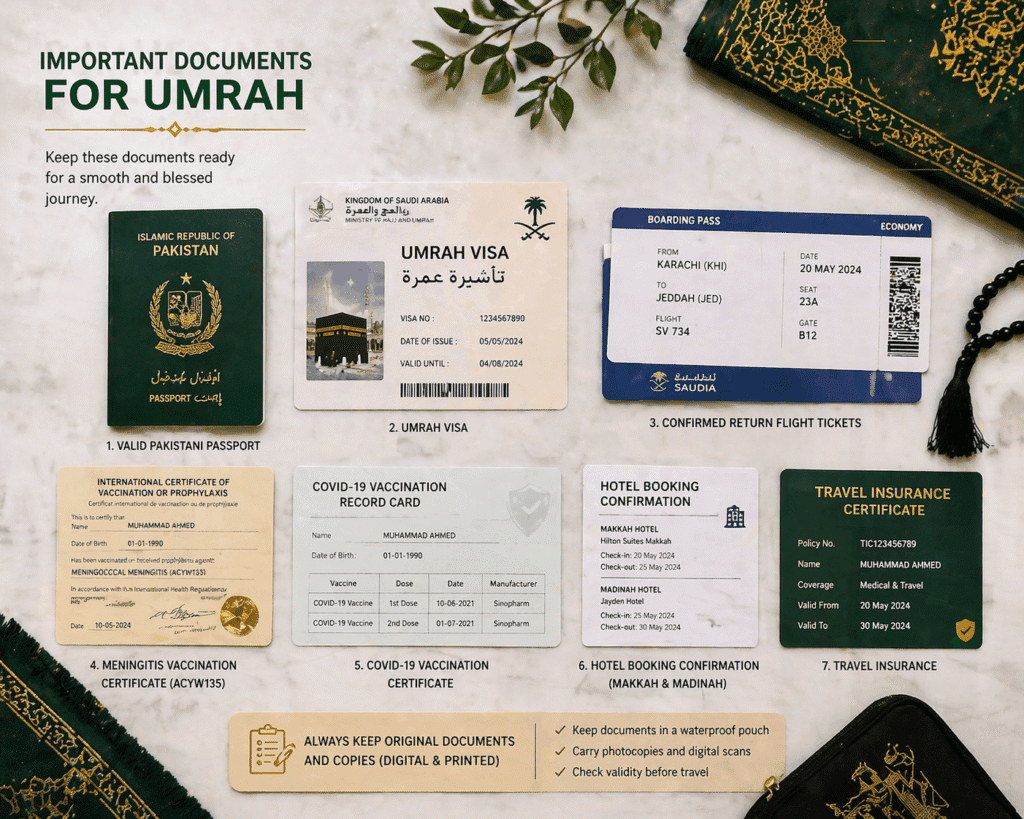
Umrah Visa & Documentation Checklist
- Valid Pakistani passport minimum 6 months validity from date of travel, at least 2 blank pages
- Umrah visa applied through authorized Umrah service providers like Uniworld Travel & Tours
- Confirmed return flight tickets
- Hotel booking confirmation in both Makkah and Madinah
- Meningitis vaccination certificate (ACYW135) mandatory requirement by Saudi Arabia
- COVID-19 vaccination records check current Saudi requirements before travel
- Mahram documentation for female pilgrims (if required under current Saudi regulations)
- Passport-sized photographs with white background
- Travel insurance strongly recommended for medical coverage
What to Pack for Umrah
A well-prepared bag makes the difference between a comfortable spiritual journey and unnecessary distraction. For a complete packing checklist and ritual preparation, read our detailed How to Perform Umrah guide covering Ihram requirements, Tawaf preparation, Sa’i guidance, and the spiritual significance of every step.
Frequently Asked Questions Best Time for Umrah
Q1: What is the best time to perform Umrah?
Ans: The best time to perform Umrah depends on your priorities:
- For maximum spiritual reward:
Ramadan especially the last 10 nights is unmatched. The Prophet (PBUH) said that Umrah in Ramadan equals Hajj in reward. - For fewer crowds and lower costs:
Muharram, Safar, Rabi al-Thani, and Jumada al-Awwal offer a peaceful and budget-friendly experience. - For comfortable weather:
November to February (winter season) is ideal, depending on the Islamic calendar overlap. - For a balanced experience:
Dhul Qa’dah is highly recommended due to moderate crowds, reasonable pricing, and sacred significance.
Q2: Is Ramadan really the best month for Umrah?
Ans: Yes from a spiritual perspective, Ramadan is the best time.
- Umrah in Ramadan carries a reward equivalent to Hajj (as mentioned in authentic Hadith).
- The atmosphere in the Haram, especially during the last 10 nights, is deeply spiritual and emotional.
However, consider the challenges:
- Higher costs (2–5x compared to normal months)
- Extremely large crowds
- Physically demanding, especially in hot weather
Tip: Book at least 4–6 months in advance and prepare both physically and financially.
Q3: Which months are cheapest for Umrah from Pakistan?
Ans: The most affordable months are:
- Safar
- Rabi al-Thani
- Jumada al-Awwal
- Jumada al-Thani
These are off-peak months with:
- Lower flight prices
- Affordable hotel options near Haram
- Less crowded environments
Ideal for budget-conscious pilgrims seeking a peaceful journey.
Q4: Can I perform Umrah in Dhul Hijjah (Hajj month)?
Yes, but with restrictions:
- Allowed: 1st–7th Dhul Hijjah (before Hajj)
- Restricted: 8th–13th Dhul Hijjah (during Hajj)
- Allowed again: After the 13th
Always confirm current Saudi regulations before booking.
Q5: What is the weather like in Makkah during winter?
Winter (November–February) is one of the best times for Umrah.
- Daytime: 20–30°C
- Night: 15–20°C
Benefits:
- Comfortable for Tawaf and Sa’i
- Ideal for elderly pilgrims and families
- Less physical strain
Q6: How long does an Umrah trip from Pakistan take?
- Umrah rituals: 3–6 hours
- Total trip duration: Usually 7 to 28 days
Pilgrims extend their stay to:
- Offer more prayers
- Perform Ziyarat
- Spend time in Makkah and Madinah
Q7: Do women need a Mahram for Umrah from Pakistan?
Ans: Traditionally, women are required to travel with a Mahram (male guardian such as husband, father, or brother).
However:
- Saudi regulations have evolved in recent years
- Women may travel without a Mahram in organized groups, depending on conditions
Always check the latest Saudi visa policies before planning your trip.
Answer the Call Book Your Umrah with Uniworld
Whatever month calls to your heart, we have the Umrah package to take you there. Trusted by thousands of Pakistani pilgrims. Complete care from Pakistan to the Haram and back.
Umrah is one of the most profound gifts a Muslim can give themselves. It is a reset of the heart, the soul, and the relationship with Allah. Whether you travel in the sacred blessing of Ramadan, in the gentle quiet of Safar, or under the elevated skies of Dhul Qa’dah, every sincere step toward the House of Allah carries immeasurable reward.
The best time to perform Umrah is always the time when your heart is ready and your intention is pure. But armed with the practical knowledge in this guide, you can also choose the month that best serves your physical comfort, your budget, and your spiritual goals making your sacred journey as beautiful and transformative as it was always meant to be.