
Pakistan’s Hajj Policy 2027–2030 introduces the biggest regulatory reforms for private Hajj operators in recent years. The new framework changes how private Hajj companies are licensed, how pilgrim payments are handled, how operators are monitored, and what protections are available if something goes wrong.
If you’re planning to perform Hajj through a private operator, understanding these changes is just as important as completing your registration. Before reading further, make sure you’ve completed the Hajj 2027 Registration Guide:
Table of Contents
- Why Pakistan’s Hajj Policy 2027–2030 Matters
- Who Can Operate Private Hajj Packages?
- SECP Registration & Licensing Requirements
- Financial Requirements for Private Hajj Companies
- 2,000 Pilgrim Minimum Requirement
- How the PHMP Digital Portal Works
- How the New Payment System Protects Pilgrims
Why Pakistan’s Hajj Policy 2027–2030 Matters for Every Pilgrim
Every year, thousands of Pakistani pilgrims choose private Hajj operators instead of the government scheme because they offer different package durations, accommodation choices and additional services.
In previous years, private Hajj bookings often relied heavily on individual operators for payment handling, licensing transparency and complaint resolution. This created uncertainty for many pilgrims when operators failed to meet their commitments.
The Pakistan Hajj Policy 2027–2030 introduces a much stronger regulatory framework by establishing stricter licensing requirements, digital monitoring and improved financial safeguards for pilgrims. According to the policy, private Hajj operators must now meet defined legal, financial and operational standards before they can offer Hajj services.
If you’re still comparing different travel options, you can also explore our Hajj Packages from Pakistan to understand available package durations, accommodation categories and services before making your booking decision.
Who Can Operate Private Hajj Packages Under the New Policy?
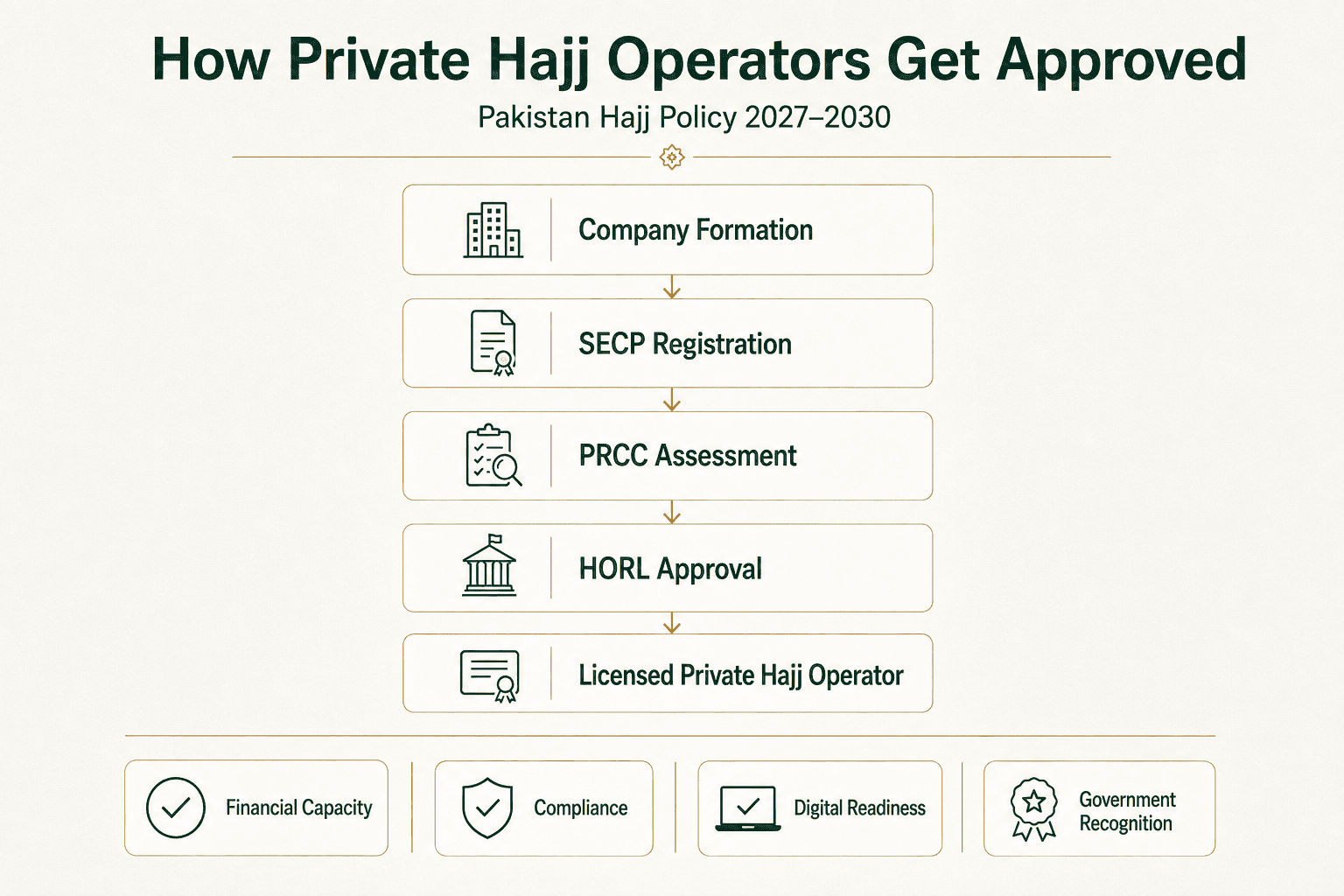
One of the biggest changes introduced under the new policy is that not every travel company can legally sell private Hajj packages.
Only companies that satisfy the government’s legal, financial and compliance requirements can operate as licensed private Hajj operators (Munazzam). This significantly reduces the risk of dealing with unqualified or financially unstable companies.
SECP Registration and Licensing Requirements
Under the new framework, every private Hajj operator must:
- Be incorporated under the Companies Act, 2017.
- Be registered with the Securities and Exchange Commission of Pakistan (SECP).
- Hold a valid licence under the Hajj and Umrah (Regulation) Act, 2024.
Unlike previous years, licences are no longer considered permanent. Operators must continue meeting compliance standards, financial obligations and operational requirements for licence renewal.
Before booking any Hajj package, always verify that the company holds a valid SECP registration and Ministry licence. A genuine operator should be able to provide both documents without hesitation.
If you’re comparing different travel options, browse our Hajj Packages before finalising your booking.
Financial Requirements for Private Hajj Operators
The new policy also introduces strict financial eligibility requirements.
Private Hajj operators must demonstrate sufficient paid-up capital, authorised capital and financial guarantees before they are permitted to sell Hajj packages.
For operators serving approximately 2,000–3,000 pilgrims, the policy outlines significant capital requirements together with performance guarantees designed to protect pilgrims from financially weak operators. These measures create a much higher entry standard and reduce the chances of companies failing after collecting bookings.
2,000 Pilgrim Minimum Requirement: What It Means
Another major reform is the introduction of a minimum operational threshold.
Private operators are expected to serve at least 2,000 pilgrims to remain operational under the policy.
If an operator fails to reach this minimum:
- It is declared non-operational for that Hajj season.
- Pilgrims are automatically transferred to another eligible operator through the PHMP system.
- Half of the operator’s security deposit is forfeited.
These rules are intended to protect pilgrims from disruptions caused by underperforming or financially unstable operators.
Private Hajj Management Portal (PHMP): How the New Digital System Works
The Private Hajj Management Portal (PHMP) becomes the central digital platform for managing private Hajj operations in Pakistan.
Every pilgrim receives a Unique Hajj Identification Number, allowing registrations, payments and operator records to be digitally tracked.
The PHMP is integrated with multiple government institutions, including:
- SECP
- NADRA
- State Bank of Pakistan
This digital integration helps improve transparency, reduce manual processing and strengthen verification throughout the booking process.
Anyone planning to perform Hajj should first understand the complete Hajj Registration Process before selecting a private operator.
How the New Hajj Payment System Protects Pilgrims
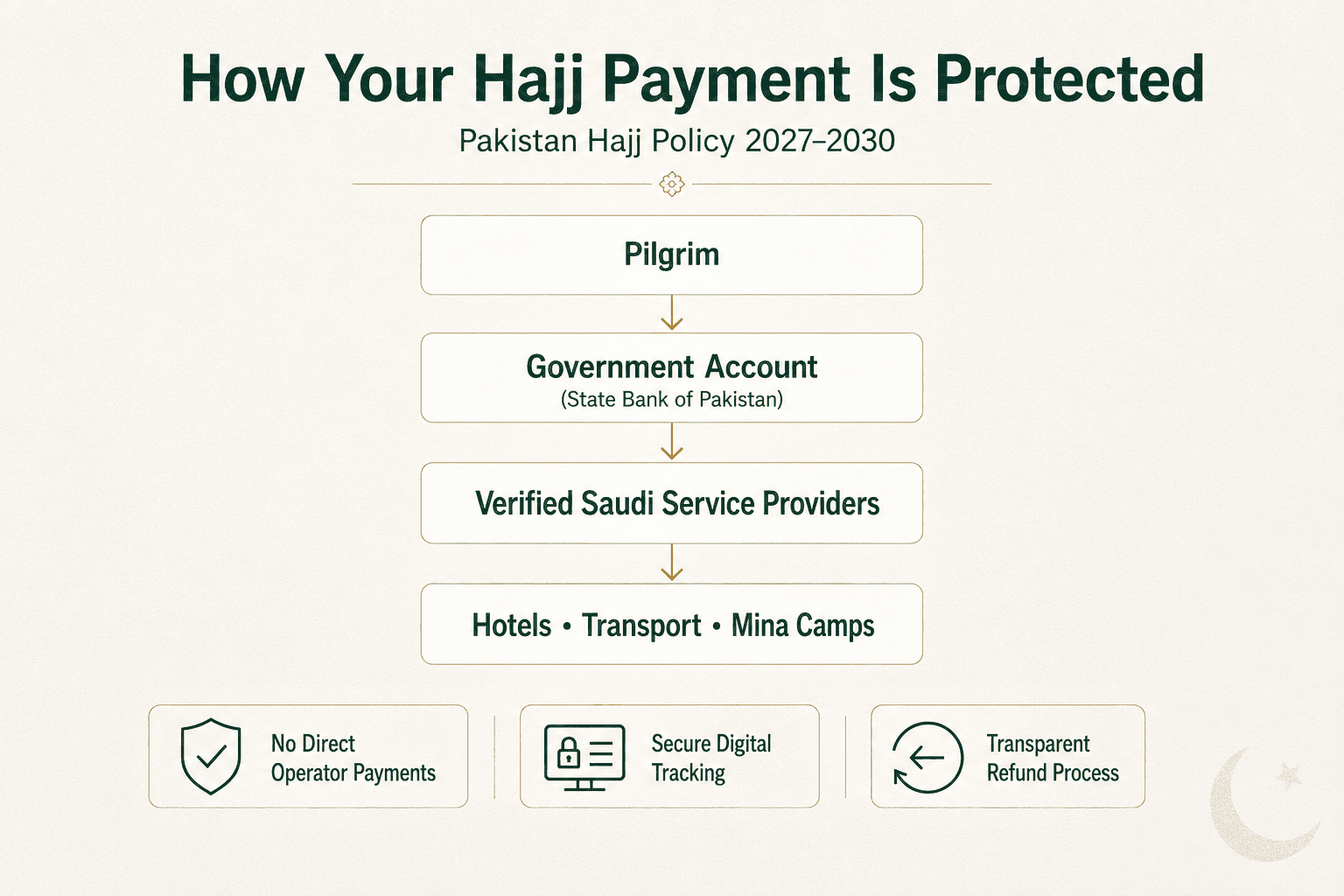
Perhaps the most significant reform introduced under the new policy relates to how pilgrim funds are managed.
Previously, many pilgrims paid operators directly. Under the new framework, payments follow a controlled government-managed process.
The policy states that:
- All pilgrim payments are processed through a Government Account maintained with the State Bank of Pakistan.
- Every payment is digitally linked to both the pilgrim and the licensed operator.
- Funds are transferred directly to verified Saudi service providers.
- Private operators are prohibited from independently collecting, holding or transferring pilgrim funds.
- Refunds are processed through a structured digital mechanism rather than relying solely on the operator.
This payment system significantly improves financial security for pilgrims and reduces the risk of fund misuse or operator default.
When comparing travel companies, always choose licensed operators offering transparent Hajj Packages from Pakistan that comply with the latest government regulations.
New Approval Process for Private Hajj Operators
The Pakistan Hajj Policy 2027–2030 introduces a structured approval process for companies entering the private Hajj sector for the first time. Instead of simply registering and offering packages, new operators must now complete multiple stages of evaluation before they can legally serve pilgrims.
This framework is designed to ensure that only financially stable, operationally capable and compliant companies are allowed to organise private Hajj journeys.
Pre-Registration Clearance Certificate (PRCC)
The first stage is a Pre-Registration Clearance Certificate (PRCC).
During this assessment, authorities evaluate:
- Ownership and company structure
- Financial capacity
- Operational capability
- Digital readiness
- Compliance with government requirements
Only companies that successfully complete this assessment can proceed to the next stage of registration.
Hajj Operations Recognition Letter (HORL)
After passing the pre-assessment, companies must complete formal registration and compliance verification.
Successful operators receive a Hajj Operations Recognition Letter (HORL), allowing them to legally provide private Hajj services.
Existing operators are also required to undergo a re-validation process, during which their financial records, service history and complaint records are reviewed before they receive a Tier-Based Recognition Letter (TRL) confirming their operational status.
Operator Performance Ratings and Compliance Monitoring
One of the most significant long-term improvements in the new policy is the introduction of a digital performance monitoring system.
The Ministry will maintain performance ratings for private Hajj operators based on factors such as:
- Financial discipline
- Service quality
- Compliance audits
- Complaint resolution
- Overall operational performance
These ratings will directly influence future licence renewals, quota allocations and operator recognition.
For pilgrims, this means an operator’s past performance will now play a much bigger role in determining whether they remain eligible to offer Hajj services in future seasons.
How to File a Complaint Against a Private Hajj Operator
Although the new regulations are designed to reduce disputes, the policy also establishes a formal complaint mechanism for pilgrims.
Complaints against licensed private Hajj operators are processed through Complaint Disposal Committees (CDCs) operating in both Pakistan and Saudi Arabia.
If either the pilgrim or the operator disagrees with the committee’s decision, an appeal can be submitted to the Appellate Committee within 15 days, after which the decision becomes final unless overturned by a court.
To avoid unnecessary issues, always keep copies of your booking confirmation, payment receipts and registration details throughout the Hajj registration process.
Rules on Hajj Quota Transfers and Subletting
The Pakistan Hajj Policy 2027–2030 also introduces strict rules to prevent misuse of private Hajj quotas.
Under the policy, operators are prohibited from:
- Trading Hajj quotas
- Selling or transferring quotas to other companies
- Outsourcing allocated quotas
- Participating in anti-competitive practices
Violations may result in licence cancellation, forfeiture of financial guarantees and legal action.
These measures are intended to improve transparency and ensure that only authorised operators manage pilgrim bookings.
Frequently Asked Questions
Q1: Is every private Hajj operator required to be SECP registered?
Ans: Yes. Under the Pakistan Hajj Policy 2027–2030, private Hajj operators must be incorporated under the Companies Act, 2017, registered with the Securities and Exchange Commission of Pakistan (SECP), and licensed under the Hajj and Umrah (Regulation) Act, 2024.
Q2: Do private Hajj operators receive my payment directly?
Ans: No. Under the new policy, pilgrim payments are processed through a Government Account with the State Bank of Pakistan and disbursed to verified Saudi service providers. Private operators are not permitted to independently collect or hold pilgrim funds.
Q3: What is the Private Hajj Management Portal (PHMP)?
Ans: The PHMP is the government’s mandatory digital platform for private Hajj bookings, pilgrim verification and payment processing. It is integrated with SECP, NADRA and the State Bank of Pakistan.
Q4: What happens if a private Hajj operator fails to meet the minimum pilgrim requirement?
Ans: If an operator does not meet the required booking threshold, it is declared non-operational for that Hajj season. Its registered pilgrims are automatically reassigned to another eligible operator, and half of its security deposit is forfeited.
Q5: How can I file a complaint against a private Hajj operator?
Ans: Complaints are submitted through the Complaint Disposal Committee (CDC) process via the PHMP. If required, an appeal may be filed with the Appellate Committee within 15 days.
Q6: Where can I compare Hajj packages before booking?
Before choosing a private operator, compare package durations, accommodation options and included services on our Hajj Packages from Pakistan page.
Final Thoughts
The Pakistan Hajj Policy 2027–2030 marks a significant step towards improving transparency, accountability and financial protection for pilgrims choosing private Hajj operators. With stronger licensing requirements, digital monitoring, regulated payment systems and structured complaint mechanisms, the policy aims to create a safer and more reliable Hajj experience for Pakistani pilgrims.
If you’re planning to perform Hajj, start by understanding the official registration process through our Hajj 2027 Registration Guide, then explore our Hajj Packages from Pakistan to compare accommodation options, package durations and included services. Our experienced team can also help you choose a suitable package and guide you throughout your Hajj journey.