
You can save money while traveling abroad by choosing a destination that fits your total budget, travelling outside peak season, comparing the final cost of flights, booking well-located accommodation and avoiding unnecessary currency, baggage and roaming fees. The key is to calculate the complete trip cost—not simply choose the cheapest flight or hotel.
International travel does not become affordable because of one clever booking trick. Real savings come from making several informed decisions before and during the journey.
This guide explains how Pakistani travellers can build a realistic travel budget, identify hidden expenses and spend less without turning a much-awaited holiday into an uncomfortable experience.
What Is the True Cost of an International Trip?
The true cost of an international trip includes every necessary expense from visa preparation to the journey home. Airfare and accommodation may be the largest expenses, but they are not the only costs that determine whether a trip is affordable.
Use this formula when estimating your budget:
Total trip cost = visa and documents + flights + baggage + accommodation + transfers + local transport + food + activities + connectivity + insurance + taxes and fees + emergency reserve
A cheap flight may become expensive after adding checked baggage, seat selection and airport transfers. Similarly, a low-priced hotel can cost more overall if you need several taxi journeys every day.
Calculate the complete cost before comparing destinations or confirming bookings.
How Should You Set a Travel Budget?
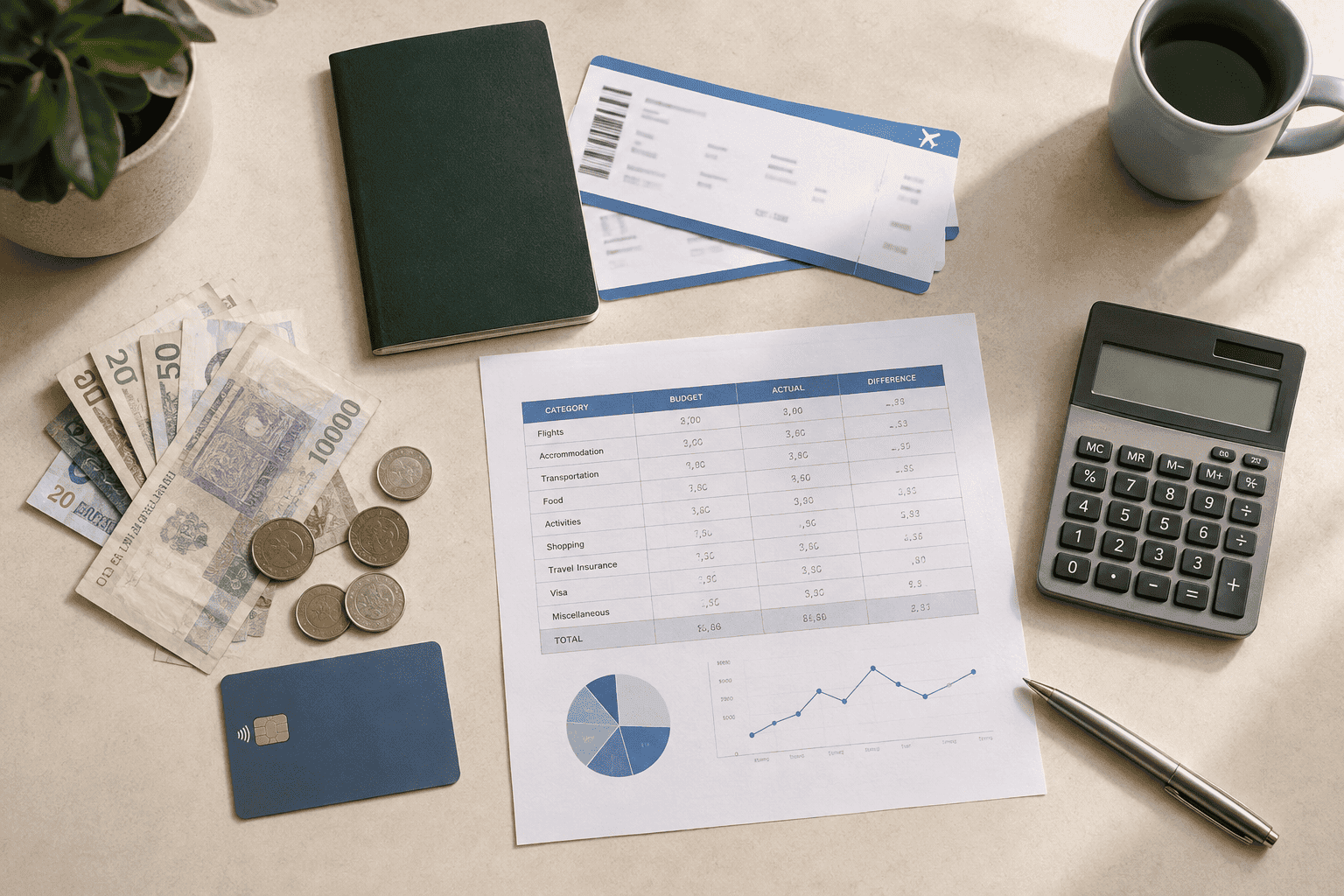
Set the maximum amount you can comfortably spend before choosing your destination. Divide that amount into essential expenses, flexible spending and an emergency reserve.
A practical starting structure is:
| Budget category | Suggested share |
|---|---|
| Flights, visa and documentation | 30–40% |
| Accommodation | 20–30% |
| Food and local transport | 15–20% |
| Activities and sightseeing | 10–15% |
| Shopping and personal spending | 5–10% |
| Emergency reserve | At least 10% |
These percentages are guidelines, not fixed rules. Long-distance destinations may require a larger flight budget, while destinations with expensive hotels may require more for accommodation.
Do not treat your entire available amount as spendable money. Keep the emergency reserve separate so that it remains available for medical needs, transport disruptions or unexpected booking changes.
How Can You Choose an Affordable International Destination?
Compare destinations by total trip cost rather than airfare alone. Visa charges, hotel rates, transportation, food prices, exchange rates and seasonal demand can make an apparently affordable destination expensive.
Before selecting a country, compare:
- Visa and processing requirements
- Return airfare with baggage
- Average hotel rates in suitable areas
- Airport-to-city transportation
- Daily meals and drinking water
- Public transport availability
- Attraction and activity prices
- Tourist or city taxes
- Currency exchange costs
- Travel insurance requirements
A destination with slightly higher airfare may offer cheaper accommodation, food and transport. It could therefore cost less overall than a destination promoted with an unusually low flight fare.
Pakistani travellers should also consider visa complexity. An affordable destination is not necessarily practical if the application requires expensive arrangements, difficult documentation or a high risk of non-refundable losses.
When Is the Cheapest Time to Travel Abroad?
The shoulder season is often the best period for saving money without facing the closures or difficult weather associated with the lowest season. It falls between a destination’s busy peak season and quiet off-season.
During the shoulder season, travellers may find:
- Lower flight demand
- More competitive hotel rates
- Better room availability
- Smaller crowds
- Easier access to attractions
- More flexibility with tours and transfers
Shoulder-season dates differ by destination. Research the local climate, school holidays, festivals, major exhibitions and religious events before booking.
Do not choose the lowest-priced month without checking the reason for the reduced rates. Extreme heat, heavy rain, transport disruption or seasonal closures can weaken the value of the trip.
How Can You Save Money on International Flights?
Save money on international flights by using flexible dates, monitoring fares and comparing the complete ticket price. A low advertised fare is valuable only when its timings, baggage allowance and airport location suit your itinerary.
Search flexible dates
Compare departures across several days instead of restricting your search to one date. Weekend, holiday and event-related demand can increase fares considerably.
If your schedule allows it, compare:
- Weekday and weekend departures
- Morning, afternoon and overnight flights
- Direct and connecting routes
- Nearby departure airports
- One or two alternative travel weeks
Flexibility is useful, but there is no universal rule that one particular weekday will always be cheapest.
Set airfare alerts
Start monitoring fares before you are ready to purchase. Price alerts help you understand the normal range for your route and identify meaningful drops.
Do not wait endlessly for the “perfect” fare. Once the price fits your budget and your visa or travel arrangements are sufficiently secure, delaying the booking can create more risk than value.
Compare the final price
Check what the ticket includes before comparing it with another option:
- Cabin baggage
- Checked baggage
- Seat selection
- Meals
- Payment charges
- Change conditions
- Cancellation conditions
- Transit visa requirements
- Airport transfers during long layovers
A PKR 15,000 saving can disappear after adding baggage and an expensive transfer from a distant airport.
Evaluate connections carefully
A connecting flight may cost less, but it can introduce additional expenses and risks. Consider food during the layover, transit visas, airport changes, hotel stays and missed-connection protection.
Avoid buying separate tickets for tight connections unless you fully understand the consequences. If the first flight is delayed, the second airline may not be responsible for rebooking you.
Compare direct flights by total value
A direct flight can sometimes be the better financial decision for families, senior travellers and short holidays. It may reduce airport meals, hotel stays, transfers, baggage rechecking and the risk of a missed connection.
The cheapest ticket is not always the cheapest journey.
How Can Visa Planning Help You Avoid Unnecessary Expenses?
Correct visa planning prevents repeat application charges, rushed document preparation and losses on non-refundable bookings. Confirm the requirements before paying for flights or hotels that cannot be changed.
Common avoidable expenses include:
- Incorrect photographs
- Incomplete bank documentation
- Unacceptable hotel reservations
- Missing travel insurance
- Incorrect application information
- Unnecessary agent charges
- Rescheduling appointments
- Reapplying after an avoidable refusal
- Losing money on non-refundable bookings
Requirements vary by destination and can change. Use Uniworld’s visa services for Pakistani travellers to review available assistance and confirm the latest document requirements for your destination.
Unless confirmed travel is specifically required, consider refundable or changeable arrangements while the application is in progress. Always check the applicable embassy or visa-centre instructions before submitting documents.
Is a Travel Package Cheaper Than Booking Everything Separately?
A travel package can be cheaper when it combines negotiated hotel rates, airport transfers, transport and tours. Independent booking may be more economical when you have flexible dates, reward points or a simple itinerary.
Compare both options using the same inclusions.
| Travel situation | Option worth comparing first |
|---|---|
| Solo traveller with flexible dates | Independent booking |
| Family requiring multiple transfers | Complete package |
| First international journey | Coordinated travel package |
| Traveller with airline or hotel points | Independent booking |
| Multi-city itinerary | Custom itinerary or package |
| Destination with simple public transport | Independent booking |
| Destination with complex transfers | Package with transportation |
| Fixed holiday dates | Both options should be compared |
Ask for a written list of inclusions and exclusions before comparing a package with self-booking.
Check whether the price includes:
- Return airfare
- Checked baggage
- Visa assistance
- Hotel accommodation
- Breakfast
- Airport transfers
- Intercity transport
- Sightseeing
- Attraction tickets
- Travel insurance
- Taxes and service charges
A package is not automatically expensive, and independent booking is not automatically cheaper. The correct comparison is the final cost of receiving the same services.
How Can You Save Money on Hotels Abroad?
Choose accommodation based on total daily value rather than the lowest nightly rate. Location, breakfast, transport access, taxes and cancellation terms can have a greater impact than a small difference in room price.
Use this calculation:
Actual hotel saving = difference in room price − additional transport cost − other excluded essentials
Suppose one hotel saves PKR 4,000 per night but requires PKR 3,000 in daily taxis and does not include breakfast. The apparent saving may have little value.
Choose the right area
Look for accommodation near:
- A reliable metro or bus route
- The attractions you intend to visit
- Affordable restaurants or grocery stores
- A safe and active neighbourhood
- An airport-transfer stop
- A suitable place of worship, if required
Do not assume the city centre is always best. A well-connected neighbourhood a few stations away may offer better value.
Check the complete hotel price
Confirm whether the displayed price includes:
- Local taxes
- City or tourist taxes
- Resort fees
- Cleaning charges
- Breakfast
- Extra-bed charges
- Security deposits
- Parking
- Early check-in
- Late check-out
Some destination taxes are collected at the property and may not appear clearly in the initial advertised rate.
Read recent reviews strategically
Do not rely only on the overall score. Search recent reviews for recurring comments about:
- Actual distance from public transport
- Cleanliness
- Noise
- Wi-Fi
- Air conditioning or heating
- Neighbourhood safety
- Additional charges
- Breakfast quality
- Room size
- Deposit refunds
A very cheap hotel becomes expensive if its location, cleanliness or hidden policies force you to change accommodation.
How Can You Reduce Transportation Costs Abroad?
Plan your daily routes before travelling and group nearby attractions together. Unplanned backtracking is one of the easiest ways to waste both money and limited holiday time.
Compare airport transfer options
Research the journey from the airport before arrival. Compare:
- Airport train
- Public bus
- Shared shuttle
- Official taxi
- App-based transport
- Pre-arranged private transfer
- Hotel pickup
The cheapest option may not be suitable after a late-night arrival or when travelling with children and several bags. Consider safety, operating hours and luggage rules.
Understand public transport fares
Check whether the destination offers:
- Reloadable transport cards
- Daily fare caps
- One-day passes
- Multi-day passes
- Group or family tickets
- Airport transport bundles
- Free transfers between services
Do not buy an unlimited pass automatically. Estimate how many journeys you will realistically take and compare that cost with individual fares.
Walk when the route is practical
Walking between nearby attractions reduces transport costs and lets you experience local neighbourhoods. However, consider weather, safety, accessibility and the time available.
Saving a small fare is not worthwhile if it leaves the group exhausted before an important activity.
Compare rental-car costs completely
A rental car can be economical for a family or remote itinerary, but calculate:
- Rental charge
- Insurance
- Fuel
- Parking
- Tolls
- Security deposit
- Additional-driver fee
- Child seat
- Cross-border charge
- One-way return fee
In cities with strong public transport and expensive parking, a car may increase the total cost.
How Can You Save Money on Food While Travelling?
Set a daily food allowance and decide in advance which meals are experiences and which are simply necessities. You do not need to avoid local cuisine; you need to spend deliberately.
Practical approaches include:
- Choose accommodation with breakfast when the price difference is reasonable
- Buy water and snacks from supermarkets
- Eat where local residents eat
- Check menus before sitting down
- Avoid restaurants immediately beside major attractions
- Make lunch your main restaurant meal where lunch menus cost less
- Share large dishes when appropriate
- Carry suitable snacks on long sightseeing days
- Choose a room with basic cooking facilities for a longer stay
Do not compromise food hygiene to save a small amount. Medical treatment and lost holiday time will cost considerably more.
How Should You Manage Money Abroad?
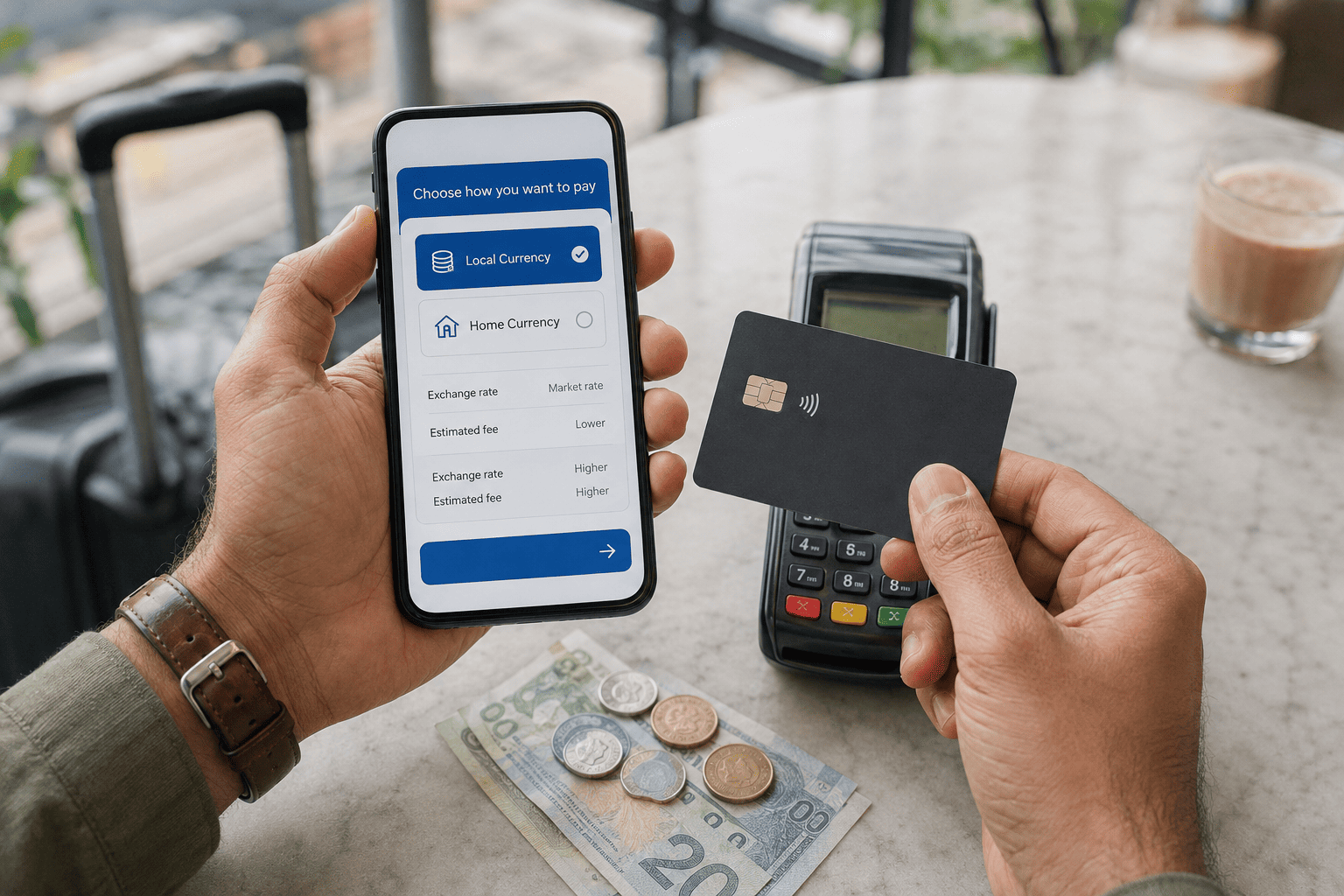
Use a planned mix of payment methods, understand your bank’s international charges and avoid allowing unfamiliar conversion options to determine the exchange rate.
Check card charges before departure
Ask your bank about:
- Foreign transaction fees
- Currency conversion markup
- International ATM charges
- Daily withdrawal limits
- Card activation for overseas use
- Blocked countries or transaction types
- Emergency card-replacement procedures
Do not assume every debit or credit card has the same charges.
Pay in the local currency when appropriate
A card terminal or ATM may offer to charge you in Pakistani rupees instead of the destination’s local currency. This is known as dynamic currency conversion.
The displayed PKR amount may look convenient, but the conversion can include an unfavourable rate or additional markup. In many cases, selecting the local currency lets your own card network or bank perform the conversion.
Read this independent guide to spending money abroad for a broader comparison of cash, debit cards and travel cards. Always confirm the actual charges with your Pakistani bank because products and availability differ.
Avoid repeated small ATM withdrawals
An ATM withdrawal may include charges from both your bank and the ATM operator. Several small withdrawals can therefore cost more than fewer planned withdrawals.
Withdraw a sensible amount, but do not carry all your travel money in cash. Store payment methods separately so that losing one wallet does not leave you without access to funds.
Avoid airport exchange counters for large conversions
Airport counters provide convenience but may offer less competitive rates. Compare authorised exchange options before departure and obtain only the amount of cash you reasonably need.
Never use an unauthorised currency dealer simply to obtain a slightly better rate.
Keep more than one payment option
Carry:
- A primary payment card
- A backup card stored separately
- A reasonable amount of local currency
- Access to emergency funds
Inform a trusted family member of the appropriate emergency procedure without sharing passwords or sensitive banking information.
How Can You Avoid Expensive Mobile Roaming?
Check your network’s roaming prices before leaving Pakistan and compare them with an international roaming bundle, local SIM or suitable eSIM.
Before choosing an option, estimate:
- Number of travel days
- Expected data usage
- Need for local calls
- Need to receive calls on your Pakistani number
- Coverage outside major cities
- Phone compatibility
- SIM-registration requirements
Download essential information before departure, including:
- Offline maps
- Hotel confirmations
- Flight details
- Visa documents
- Translation files
- Transport maps
- Attraction tickets
Turn off automatic application updates, cloud backups and mobile video downloads. These background activities can consume data without your knowledge.
Public Wi-Fi can reduce data usage, but avoid conducting sensitive financial activity on unsecured networks.
How Can You Spend Less on Attractions and Activities?
List your must-do experiences before purchasing tickets. Budget travellers often lose money by either booking too many activities or purchasing a city pass they cannot fully use.
Divide activities into three groups:
- Essential paid experiences
- Optional activities
- Free attractions
Many destinations offer:
- Public parks
- Beaches
- Viewpoints
- Free museum periods
- Religious and historical sites
- Public festivals
- Self-guided walking routes
- Markets
- Free exhibitions
Check whether a city pass includes attractions you genuinely plan to visit. Add the normal admission prices and compare the total with the pass price. Do not count attractions you would visit only because they are included.
Pre-book popular attractions when advance reservations provide a confirmed time or lower price. Leave some space in the itinerary for rest and unexpected discoveries.
Is Travel Insurance Worth the Cost?
Travel insurance can protect you from expenses that are much larger than the premium, including eligible medical emergencies, trip interruption and baggage-related losses.
The cheapest policy is not necessarily the best value. Review:
- Medical coverage
- Emergency evacuation
- Trip cancellation conditions
- Trip interruption
- Baggage delay or loss
- Passport loss
- Flight delays
- Pre-existing condition exclusions
- Adventure activity exclusions
- Deductible or excess
- Destination coverage
- Claim-document requirements
Insurance is not a substitute for careful planning, and every loss is not automatically covered. Read the policy wording before purchasing.
For some destinations, proof of qualifying travel insurance may also be part of the visa application. Travellers planning Europe can review Uniworld’s 10-day Europe trip guide from Pakistan for broader planning and documentation considerations.
How Much Emergency Money Should You Keep?
Keep at least 10% of your total travel budget as an emergency reserve. Travellers with complex itineraries, children, health concerns or separate flight tickets may need a larger buffer.
The emergency reserve can help cover:
- Unplanned transport
- Medical expenses
- Flight or train disruption
- Lost belongings
- Urgent accommodation
- Card failure
- Essential rebooking
- Unexpected visa or entry complications
Do not include shopping in the emergency category. If the reserve remains unused, it becomes money saved after the trip.
What Hidden International Travel Costs Should You Expect?
Hidden travel costs are expenses that are easy to overlook because they do not appear in the initial flight or hotel price.
Check for:
- Visa-centre service charges
- Document translation or attestation
- Travel insurance
- Baggage fees
- Seat selection
- Airport transfers
- Transit visas
- Hotel deposits
- City and tourist taxes
- Resort or cleaning fees
- Foreign transaction charges
- ATM operator fees
- Dynamic currency conversion
- Mobile roaming
- Drinking water
- Tips and service charges
- Public transport cards
- Attraction booking charges
- Parking and road tolls
- Early check-in or luggage storage
- Medicine and health requirements
Create a separate “fees and overlooked costs” category in your budget rather than assuming these expenses will fit into your daily allowance.
What Does a Sample Seven-Day Travel Budget Look Like?
The following example demonstrates how to organise a budget. It is not a quotation or a prediction of current prices.
| Expense | Illustrative budget |
|---|---|
| Return flight with baggage | PKR 140,000 |
| Visa, documentation and insurance | PKR 35,000 |
| Seven nights’ accommodation | PKR 105,000 |
| Airport transfers | PKR 12,000 |
| Local transport | PKR 18,000 |
| Food and water | PKR 42,000 |
| Attractions and activities | PKR 30,000 |
| SIM or eSIM | PKR 5,000 |
| Miscellaneous expenses | PKR 8,000 |
| Emergency reserve | PKR 39,500 |
| Total planned budget | PKR 434,500 |
Actual costs depend on the country, season, exchange rate, departure city, accommodation type and travel style.
A detailed destination guide provides a more accurate estimate. For example, travellers considering Southeast Asia can review Uniworld’s Thailand tour cost from Pakistan before setting their budget.
How Can You Control Spending During the Trip?
Set a daily spending target after paying for flights, hotels and other pre-booked expenses. Record purchases at least once each evening and compare your actual spending with the remaining budget.
A simple daily record can include:
| Date | Food | Transport | Activities | Shopping | Total |
|---|---|---|---|---|---|
| Day 1 | |||||
| Day 2 | |||||
| Day 3 |
If you overspend one day, adjust the next day instead of waiting until the end of the trip.
Use separate limits for necessities and shopping. Combining both into one daily allowance makes it difficult to see where the money is going.
What Should You Check Before Confirming a Booking?
Use this 24-hour booking checklist before making a major non-refundable payment:
- Is every passenger’s name identical to the passport?
- Is the passport sufficiently valid?
- Have you checked the latest visa requirements?
- Is a transit visa required?
- Does the flight include the baggage you need?
- Are all airport codes and locations correct?
- Is the connection protected under one ticket?
- Are the travel dates correct?
- Does the hotel location suit the itinerary?
- Are hotel taxes and additional fees included?
- Have you read the cancellation conditions?
- Are airport transfers included?
- Does the payment card charge international fees?
- Is suitable travel insurance available?
- Is the booking confirmation issued immediately?
- Have you saved copies of every receipt?
For an expensive booking, step away from the payment page and review the details again later the same day. A spelling or date error can cost much more than the saving you worked to secure.
What Are the Biggest Money-Wasting Travel Mistakes?
The most expensive mistakes usually come from choosing the lowest advertised price without checking the complete conditions.
Avoid:
- Booking non-refundable travel before understanding visa risk
- Selecting a destination based only on airfare
- Ignoring checked-baggage charges
- Using an airport far from the city without calculating transfers
- Booking an isolated hotel to save a small amount
- Accepting home-currency conversion automatically
- Withdrawing small amounts from an ATM repeatedly
- Using mobile data without checking roaming
- Taking taxis for every journey
- Purchasing an unsuitable transport or attraction pass
- Planning distant attractions on the same day
- Travelling without insurance or emergency money
- Carrying all cash and cards in one wallet
- Leaving flight, visa and hotel planning until the last minute
The objective is not to eliminate every expense. It is to avoid paying for things that add no meaningful value to the journey.
Final Money-Saving Checklist for International Travel
Before departure, confirm that you have:
- Calculated the total trip cost
- Kept at least 10% for emergencies
- Compared destinations using complete costs
- Checked shoulder-season conditions
- Compared final flight prices
- Reviewed baggage allowance
- Confirmed visa and transit requirements
- Selected a well-connected hotel
- Planned airport transfers
- Grouped nearby attractions
- Established a daily food budget
- Checked bank and card charges
- Arranged more than one payment method
- Selected a suitable SIM, eSIM or roaming plan
- Downloaded offline travel information
- Reviewed travel insurance coverage
- Saved digital and printed booking copies
- Informed a trusted contact of the itinerary
Frequently Asked Questions
Q1: What is the best way to save money while traveling abroad?
Ans: Start by comparing the total cost of different destinations. Flexible dates, suitable accommodation, public transport and avoiding baggage, roaming and currency fees usually produce more meaningful savings than searching only for the cheapest flight.
Q2: How can I travel internationally on a low budget?
Ans: Choose a destination with affordable accommodation and transport, travel outside peak season, limit paid activities and set a daily spending allowance. Always reserve money for emergencies instead of using the complete budget for bookings.
Q3: Is it cheaper to book flights and hotels separately?
Ans: It depends on the destination and itinerary. Separate booking can suit flexible or experienced travellers, while a package may offer better value when it includes transfers, negotiated hotel rates and coordinated transport.
Q4: How far in advance should I book an international trip?
Ans: There is no booking window that guarantees the lowest price. Begin monitoring fares early and book when the total price, conditions and travel dates meet your budget. Consider visa uncertainty before purchasing non-refundable arrangements.
Q5: Should I pay in PKR or local currency abroad?
Ans: When a card terminal offers both options, paying in the destination’s local currency may avoid the exchange rate used by dynamic currency conversion. Confirm your own bank’s foreign transaction and conversion charges before travelling.
Q6: How much cash should I carry abroad?
Ans: Carry enough local currency for small purchases, arrival transport and emergencies, but do not carry the entire travel budget in cash. Use more than one payment method and store your backup card separately.
Q7: How much emergency money is enough for international travel?
Ans: A minimum reserve of around 10% of the total trip budget is a practical starting point. Complex itineraries, family travel and medical considerations may justify a larger reserve.
Q8: Are cheaper hotels always better for a travel budget?
No. A cheaper hotel can increase daily taxi, breakfast and travel-time costs. Compare its total daily cost and location with a slightly more expensive but better-connected property.
Q9: Does travel insurance help save money?
Travel insurance does not reduce ordinary holiday spending, but suitable coverage may protect you from much larger eligible costs caused by medical emergencies, interruption, delays or baggage problems.
Q10:How can a travel agency help reduce travel costs?
A travel agency can compare flight, hotel, visa, transfer and package options as one itinerary. This can help identify missing expenses and determine whether coordinated services offer better value than booking each element separately.
Plan Smarter and Travel With Confidence
Saving money while traveling abroad is not about choosing the cheapest version of everything. It is about paying for the experiences that matter while removing avoidable fees, unsuitable bookings and unnecessary movement from the itinerary.
Calculate the complete cost, protect yourself against unexpected expenses and compare every major booking on equal terms.
Uniworld Travel & Tours can help you coordinate flights, visa assistance, accommodation, transfers and customised international itineraries. Speak with Uniworld’s travel team to compare suitable options before confirming your journey.
Travel prices, visa requirements, exchange rates, insurance conditions and entry rules can change. Confirm current requirements and final costs with the relevant service providers before booking.