A free Haram shuttle can make a more distant Makkah hotel a sensible choice. It can reduce the walking needed between your room and Masjid al-Haram, preserve energy for worship, and leave more of your budget available for a longer stay or a more comfortable room.
But the words “free shuttle to Haram” do not tell you how easy the journey will be. They do not explain how long you will wait, whether you must change buses, where you will get off, or how far you will still need to walk.
The best choice is therefore not always the hotel closest on a map, or the hotel advertising the shortest bus ride. It is the hotel whose complete journey works for your family, your mobility and the way you want to spend your days.
This guide explains how to judge that journey, which hotel shuttle claims are supported by official information, when riding beats walking, and how to compare the real cost before booking.
Hotel information researched on 15 October 2026. Named services below are based on public hotel pages, not a test ride or a direct operational confirmation. Timetables, access arrangements and boarding points must be reconfirmed for your travel dates. All worked examples are hypothetical planning tools, not hotel journey-time measurements or current price quotations.
Are Makkah Hotels with a Free Haram Shuttle Worth It?
A shuttle hotel is worth considering when it meaningfully reduces your physical effort, offers a manageable final walk, and saves enough money to justify the waiting and coordination involved. Walking usually works better when you have a genuinely short, suitable pedestrian route and want frequent, flexible returns to your room.
There are three separate ways a shuttle can “beat walking”:
- Less effort: You ride for part of a journey that would otherwise be tiring.
- Lower total cost: The room saving remains worthwhile after realistic backup transport expenses.
- Better use of energy: You arrive ready for worship and return with enough energy to rest properly.
It does not have to win on speed to be useful. A slower journey with a comfortable seat may suit one traveller better than a faster walk. Another traveller may prefer a predictable walk to waiting for a bus.
When comparing Umrah hotels in Makkah and Madinah, decide which of those benefits matters most before comparing star ratings.
What a Free Haram Shuttle Actually Includes
A Haram Shuttle Is Different from an Airport Transfer
A hotel shuttle normally describes transport between the property and a designated point serving the Haram. Do not assume it includes arrival from Jeddah Airport, transfers from the Haramain railway station, travel to Madinah or Ziarat.
For example, IHG’s official transport page for voco Makkah describes a complimentary Haram service while separately stating that an airport shuttle is unavailable. These are different services, even when both are discussed under hotel transportation.[1]
If you book an Umrah package from Pakistan, have the quotation list airport transfers, intercity transport and the hotel-to-Haram shuttle separately. A package can include one without including every other journey.
Twenty-Four-Hour Service Does Not Mean Immediate Departure
“24-hour” describes the service’s operating span. By itself, it does not establish departure frequency, the length of a queue or seat availability.
The bus may follow a timetable, circulate between stops or depart under an arrangement that varies with demand. Ask which applies. Then ask what happens when the first vehicle is full.
Two hotels can both advertise round-the-clock transport while offering very different experiences for a family trying to travel together before prayer.
Free Does Not Necessarily Describe Every Leg
A hotel may advertise travel via a transport hub. That wording needs clarification: will the same vehicle continue, will passengers change vehicles, and is every connecting leg included?
Do not infer the answer from the word “via.” Request the complete route in writing, including who operates each stage and whether your booking covers it.
Also establish who may use the service. If relatives are staying elsewhere, do not assume they can board with you. Confirm any guest identification, room-card or registration requirement before making a group plan.
How the Journey Works: From Your Room to Your Prayer Area
The useful unit of comparison is room-to-prayer-area time, measured in both directions.
A shuttle journey can involve leaving your room, waiting for a lift, reaching the boarding point, queuing, riding, making a connection, walking from the final stop and reaching an accessible prayer area.
A walking journey also includes lifts, hotel corridors, the usable pedestrian route and movement through the precinct. Comparing a bus’s driving time against a walk’s entire duration produces a misleading result.
The Last Walk Can Change the Decision
“Drops near Haram” is too vague for a booking decision. Ask for a map pin for the actual passenger stop, followed by the pedestrian route from that stop.
You need to know whether that route includes steps, slopes, crossings, lifts or a long exposed stretch. Also ask whether the return boarding point is the same as the arrival stop.
A longer bus ride with a manageable final walk can be better than a shorter ride ending farther from the area your family needs. Conversely, a shuttle that leaves a substantial walk may offer little benefit to someone who struggles with walking or standing.
Do not interpret a stop described as “near the Clock Tower,” “at Kudai” or “near a gate” as guaranteed access to a particular entrance or to the Mataf. Request a precise explanation for your dates.
The Return Trip Deserves Its Own Assessment
Outbound journeys are easier to picture: you wait at your hotel and board its vehicle. Returning requires you to find the correct stop and identify the right service among other passengers and vehicles.
Before your first independent trip, save the hotel name, address and contact number offline. Photograph any current boarding instructions and record a map pin for the return location.
Ask reception how to recognise the bus, whether another property uses similar vehicles, and whom to contact if you cannot locate the pickup point. These details matter more than an attractive photograph of the coach.
Which Makkah Hotels Advertise Haram Shuttles?
The following examples distinguish an explicitly complimentary service from a shuttle whose price still needs confirmation. This is an evidence-based starting shortlist, not a ranking or a guarantee of availability.
| Hotel | What the official information supports | What to establish before paying |
|---|---|---|
| voco Makkah by IHG | Complimentary, 24-hour Haram transfers via Kudai Parking; the transport page also notes limited shuttle services during Hajj | Complete route, connections, departure interval, final walk and arrangements for your dates |
| Mercure Makkah Aziziah | Accor explicitly advertises a complimentary, 24-hour Haram shuttle | Boarding frequency, passenger stop, return arrangements and vehicle accessibility |
| Novotel Makkah Thakher City | Accor advertises shuttle buses to and from the Haram around the clock | Written confirmation that it is free for your reservation, plus timetable and stops |
| M Hotel Makkah by Millennium | Millennium advertises 24/7 shuttle buses to and from the Haram | Whether the service is complimentary, the complete route and any connection |
Sources: official IHG, Accor and Millennium hotel pages.[1][2][3][4]
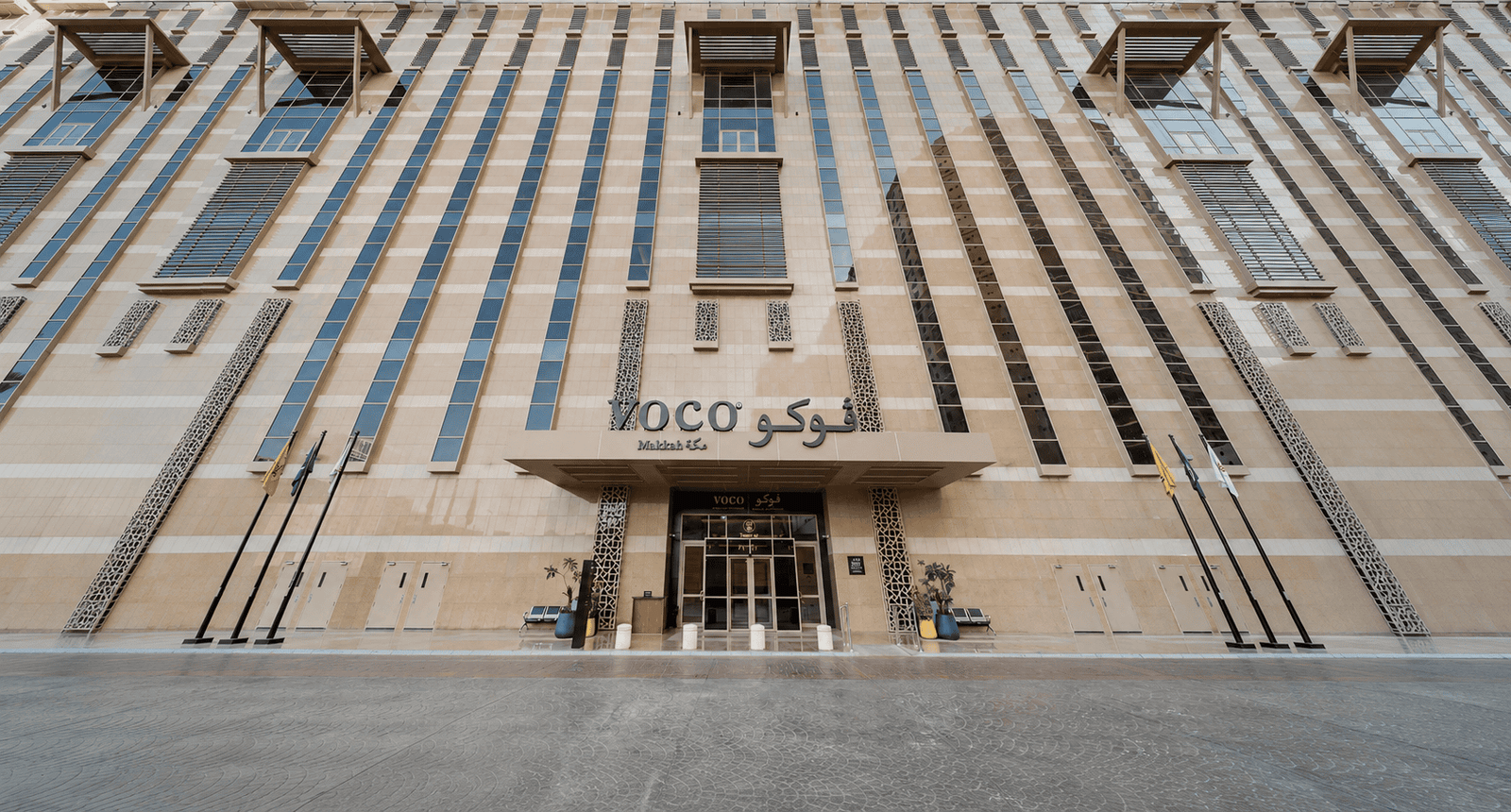
voco Makkah: Clarify the Route via Kudai
The detailed IHG transport page explicitly describes a complimentary, round-the-clock service via Kudai Parking and notes Hajj limitations. However, an IHG overview FAQ checked during research says that no complimentary local-area shuttle is available.[1][5]
That inconsistency should prompt a specific reservation enquiry. Ask the hotel to confirm the Haram service for your dates, including whether a vehicle change is required and where the last bus stops. Do not use a generic FAQ alone to dismiss the detailed transport description, or ignore the contradiction altogether.
For room and property context, the voco Makkah hotel guide can support your comparison. Obtain current operational details from the hotel before committing.
Mercure Makkah Aziziah: Free Service Is Explicitly Advertised
Accor’s page clearly advertises complimentary 24-hour shuttle access. It also uses a ten-minute access description.[2]
Treat that time as the hotel’s description, not a promise that you will leave your room and reach a prayer area in ten minutes. Request the missing timetable, queue and final-walk details. The benefit depends on those practical arrangements, especially if you intend to make several return trips daily.
Novotel Makkah Thakher City: Confirm the Free Element
Accor confirms an around-the-clock Haram shuttle on its hotel page. The wording reviewed does not, by itself, establish that every booking receives it without charge.[3]
Ask for explicit confirmation rather than treating “shuttle available” and “complimentary shuttle” as interchangeable. Once the price is clear, compare the full journey against your intended daily routine.
M Hotel Makkah by Millennium: Separate Availability from Inclusions
Millennium’s official offers page describes 24/7 shuttle buses to and from the Haram, but that statement alone does not settle the price or complete routing.[4]
Have the hotel confirm both. A useful answer should explain how to travel there and back, rather than simply repeat that transport is available.
Read Transport Statements in Their Page Context
Marriott’s Le Méridien Towers Makkah page contains a statement that the hotel does not provide shuttle service within the airport section of its location information.[6]
That placement matters. It should not automatically be treated as a complete answer about a local Haram shuttle. Ask specifically about hotel-to-Haram transport, and verify the exact property name: Le Méridien Towers Makkah and Le Méridien Makkah are separate hotels.
How to Compare Shuttle Time with Walking Time
Use the same start and finish points for both options. The following example shows the method; it does not describe a named hotel.
| Journey stage | Hypothetical shuttle option | Hypothetical walking option |
|---|---|---|
| Room, lift and hotel exit or boarding area | 7 minutes | 7 minutes |
| Waiting and boarding | 12 minutes | None |
| Bus ride or pedestrian journey | 9 minutes | 22 minutes |
| Final movement to the chosen prayer area | 11 minutes | 8 minutes |
| Total one-way time | 39 minutes | 37 minutes |
The shuttle is slightly slower here, but could reduce walking. Whether it is better depends on whether the queue involves prolonged standing and whether passengers can sit during the ride.
Now imagine the return queue adds another twenty minutes. That changes the rest of the day, particularly if children need sleep or someone must return for a meal.
Compare a Normal Journey and a Difficult Journey
Ask two questions: “What should we expect during an ordinary departure?” and “What happens after a busy prayer if the first bus fills?”
The second answer is often more useful. A plan that works only when you catch the first vehicle is fragile. Build your departure around the timetable and a realistic allowance for boarding, walking and access to the prayer area.
Avoid adopting a universal rule such as “leave thirty minutes before every prayer.” Different hotels, stops and circumstances need different allowances. On arrival, ask the hotel about that day’s conditions and adjust after experiencing the route.
Frequency and Capacity Must Be Considered Together
A frequent bus can still produce a long queue if demand exceeds available seats. A less frequent departure may be manageable if your family can plan around it and board comfortably.
You do not need a transport engineering report. Ask whether guests commonly wait for a later vehicle during busy periods, whether families can board together and what assistance is available for passengers who cannot stand for long.
The meaningful answer concerns the next usable seat for your group, not just the next scheduled departure.
When a Free Haram Shuttle Beats Walking
When It Saves Energy for Worship
Walking to the Haram is only part of the day’s physical effort. You also move inside the precinct and during your worship activities. A journey that feels easy when you first leave the hotel may feel very different on the return.
Judge the route against the capacity of the person who finds it hardest. If a shuttle removes a tiring stretch while leaving a manageable final walk, it may be valuable even when it takes longer overall.
However, replace assumptions with details. A bus journey involving a lengthy standing queue may not deliver the comfort you expected.
When the Pedestrian Route Is Uncomfortable or Unsuitable
A map distance does not describe shade, gradients, crossings or the route you can actually use. Check the pedestrian journey rather than drawing a straight line between the hotel and the mosque.
If walking would involve an unsuitable route, a confirmed shuttle can become the more practical option. Do not assume a road or tunnel used by vehicles is appropriate for pedestrians. Ask the hotel for the authorised walking route before considering it as a fallback.
When You Prefer Fewer Hotel Returns
Some pilgrims prefer to make a longer visit and return once for a substantial rest. A shuttle hotel may fit that pattern well because fewer separate journeys mean fewer boarding and waiting cycles.
Others prefer returning to their room between prayers. They should calculate the repeated transport time before choosing a distant hotel.
For example, if a hypothetical shuttle option adds twenty-five minutes to each round trip compared with a nearer hotel, three daily round trips add seventy-five minutes. Over seven days, that is eight hours and forty-five minutes. That arithmetic measures a trade-off; it does not tell every family which choice to make.
When the Accommodation Saving Is Meaningful
A shuttle property can be worthwhile if it gives your group a suitable room configuration at a substantially lower total price. Compare permitted occupancy, actual beds, bathrooms, meals, taxes and cancellation terms together.
Do not accept uncomfortable overcrowding simply because transport is free. A tiring room arrangement can undermine the rest that makes a more distant hotel workable.
For longer stays, such as a 21-day Umrah package, even a modest nightly difference can accumulate. The transport routine also repeats for longer, so both sides of the calculation become more significant.
When Walking Is the Better Choice
When You Need Frequent, Flexible Room Access
A genuinely short pedestrian route can make it easier to return for a child’s nap, change clothes, collect an item or rest briefly. You are less dependent on departure times and boarding arrangements.
This convenience has value even if the room is more expensive. Compare the premium with how often you will actually use that flexibility.
When the Shuttle Removes Little Walking
If the final stop still leaves most of the difficult pedestrian journey, the service may offer limited benefit. Compare the walking that remains after the bus with the complete walking route from an alternative hotel.
The strongest shuttle option is not necessarily the one with the shortest drive. It is the one that removes the part of the journey your family most needs help with.
When Waiting Is Harder than Moving
Some travellers find standing in a queue more uncomfortable than walking steadily. Others become anxious about uncertain departures or returning after dark.
These are legitimate preferences. Choose around the experience your group can manage repeatedly, rather than assuming a vehicle always means an easier journey.
When a Nearer Hotel Has a Suitable Route
Being close on a map still needs checking. Ask which entrance guests use, how the hotel lifts connect to the street or precinct, and whether the route suits your mobility needs.
A central hotel with complex internal circulation may take longer to leave than expected. A nearby address is useful only when its actual access works for you.
The Real Cost: Room Savings, Backup Transport and Time
“Free shuttle” describes the advertised fare. Your overall decision also includes room costs, meals, backup transport and the value of a workable routine.
Start with this calculation:
Net financial saving = accommodation saving − extra transport spending − other additional costs.
Keep time and physical effort visible beside the financial result. There is no need to pretend that every family values an hour of rest at the same monetary rate.
A Worked Seven-Night Comparison
Assume two otherwise comparable hotel options differ by SAR 180 per room per night. For seven nights, the shuttle hotel saves SAR 1,260 per room.
Now reserve an illustrative SAR 240 for occasional backup transport. The remaining saving is SAR 1,020. Neither figure is a current hotel rate or taxi quote.
If your family needs two rooms, the accommodation saving becomes SAR 2,520, but do not automatically double or leave transport costs unchanged. Vehicle capacity and the number of journeys determine the relevant transport allowance.
Also compare breakfast and other meals. A cheaper room-only booking and a more expensive breakfast-inclusive booking are not equivalent products.
Find Your Own Break-Even Point
Suppose the nearer hotel costs SAR 140 more each night and your realistic backup transport allowance for the farther option is SAR 90 per day. The financial difference is then SAR 50 per day before other costs.
You can now decide whether the nearer hotel’s flexibility justifies that remaining difference. This is more informative than comparing room rates alone.
For Pakistani travellers, keep the comparison in SAR initially. Convert the final difference using the exchange rate and payment terms of your actual quotation, including any relevant conversion charges.
Do Not Make Taxis the Entire Contingency Plan
Paying for a taxi does not necessarily secure a closer drop-off or remove access constraints. Ask the hotel where alternative vehicles can collect passengers and how you would reach that location.
A backup plan should identify a feasible journey, contact method and budget. “We will get a taxi if needed” is incomplete without those details.
Planning for Elderly Parents, Wheelchairs and Children
Accessible Rooms Do Not Establish Accessible Transport
A property may describe wheelchair-friendly rooms and public areas without explaining its shuttle vehicles. Confirm each part of the journey separately.
Ask whether the vehicle has steps, a ramp or a lift; whether the passenger can remain seated in their wheelchair; and whether a suitable wheelchair space can be secured. If transfer to a bus seat is required, establish whether that is manageable for the traveller and their companion.
For powered wheelchairs, provide the dimensions and other information requested by the operator. Do not assume the usual coach can accommodate the equipment.
Also check the final pedestrian section, including any need to use lifts or negotiate slopes. The journey is only as accessible as its least manageable stage.
Count the Caregiver’s Effort Too
A trip involving a wheelchair, luggage, a stroller or a sleepy child can place substantial demands on a companion. Consider who will handle equipment, boarding and navigation.
Ask how strollers are stored and whether they must be folded. If children and older relatives travel together, plan so that one adult is not expected to manage every task alone.
Agree on a Separation Plan
Save the return stop and hotel details on more than one adult’s phone. Choose a clear meeting point and a simple procedure if someone becomes separated.
Do not organise your family routine around people holding doors or delaying a departing vehicle. If you cannot all board together, follow the operator’s instructions and use the plan agreed in advance.
Ramadan, Fridays and Hajj: Reconfirm the Operating Plan
Do not carry an ordinary-week timetable into a different travel period without checking. For Ramadan, Fridays and Hajj dates, ask the hotel what changes apply to your reservation.
Useful questions include whether departure intervals change, whether there are service pauses, whether the boarding location moves and whether passengers must make a connection. IHG’s voco transport page explicitly notes limited services during Hajj, illustrating why date-specific confirmation matters.[1]
For a Ramadan stay, discuss Suhoor, Iftar, Taraweeh and late-night return plans alongside the shuttle. A timetable can look adequate on paper while fitting poorly around your family’s meals and sleep.
Also ask about the return after the prayer you expect to attend, rather than only the outbound trip. If you plan to remain longer to avoid the first queue, make sure the later service is confirmed and the wait is manageable for everyone.
Transport convenience does not establish any entitlement to enter a particular area. Follow current official instructions and local access controls throughout your stay.
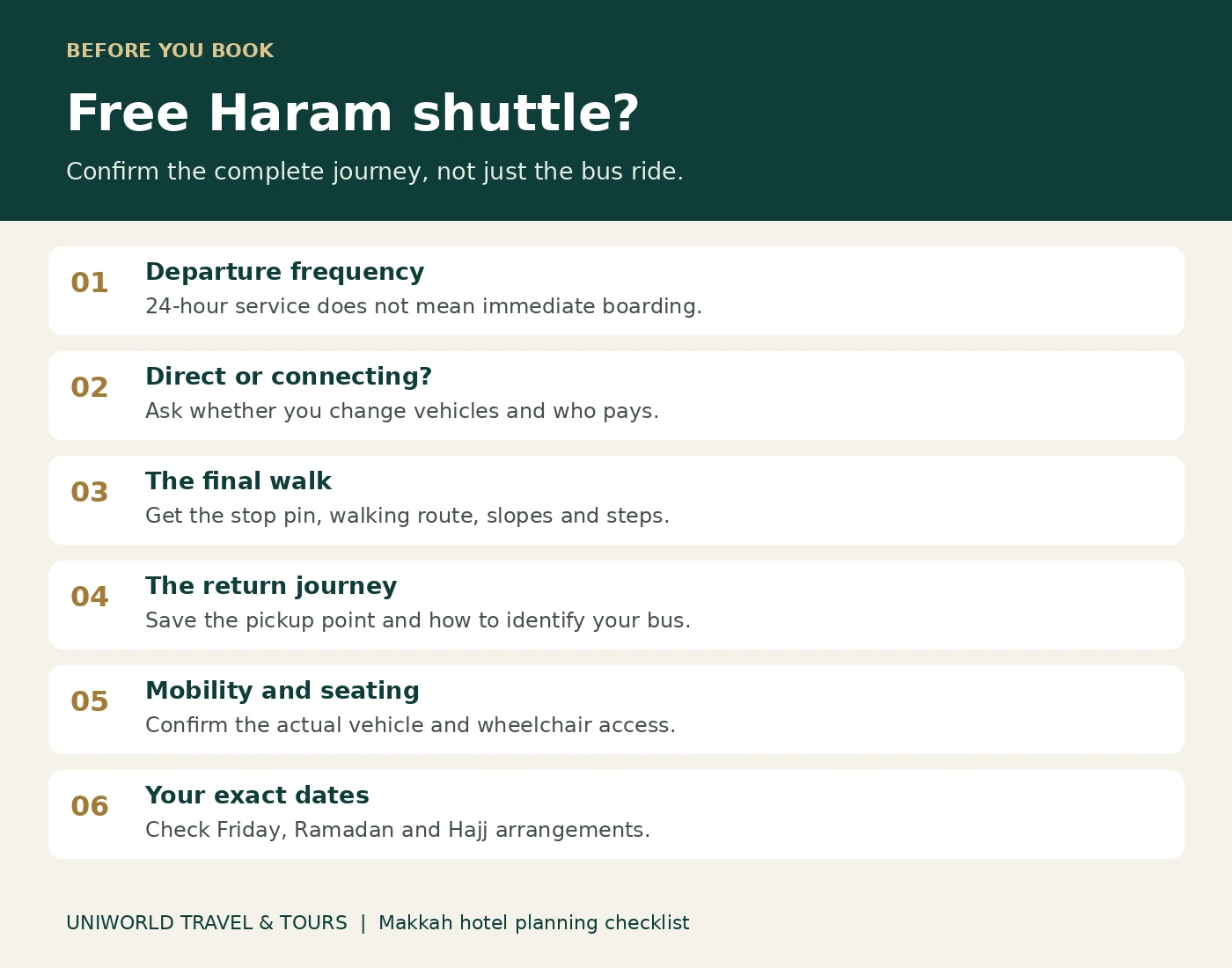
Twelve Questions to Ask Before Booking
Use this checklist for every shortlisted hotel:
- Is the Haram shuttle complimentary for every guest on our reservation?
- What are its operating hours and departure intervals for our exact dates?
- Where do we board at the hotel?
- Is the journey direct, or must we change vehicles?
- If there is a connection, who operates it and is it included?
- Can you send a map pin for the final passenger stop?
- What walking route remains, including steps, slopes and crossings?
- Where is the return boarding point, and how do we recognise the bus?
- What happens when the first vehicle is full?
- What changes apply on Fridays, in Ramadan or during Hajj?
- Can the actual vehicle accommodate our wheelchair or stroller requirements?
- What practical alternative is available if we cannot use the service?
Request the answers in a written reservation message. Keep them with your hotel voucher, along with the cancellation deadline, so you can resolve an unsuitable arrangement before your booking becomes harder to change.
Your First-Day Shuttle Check
At check-in, obtain the current timetable rather than relying on an older screenshot. Confirm both stops, the last or overnight departure arrangements, identification requirements and the contact number for assistance.
When practical, make your first route check without placing the whole family under a tight deadline. Record how long it takes to reach boarding, where the vehicle stops and how the return works.
Use the actual experience to refine the next day’s plan. If the final walk is unsuitable for a parent or child, speak to reception or your travel organiser promptly instead of repeating a difficult journey throughout the stay.
Keep the plan simple enough to remember when tired. A written stop name, map pin and hotel number are more useful than relying on a landmark you only vaguely recognise.
Frequently Asked Questions
Which Makkah hotels clearly advertise a free Haram shuttle?
Official pages reviewed for this guide explicitly describe complimentary services at voco Makkah and Mercure Makkah Aziziah. Novotel Makkah Thakher City and M Hotel Makkah by Millennium advertise Haram shuttles, but the cited wording needs further confirmation about the free element. Confirm all arrangements for your dates.[1][2][3][4]
Does a free shuttle drop passengers at a Haram gate?
Do not assume it does. Ask for the actual stop and the remaining pedestrian route. A service described as going to the Haram may involve a designated transport point or a connection, and the return location may require separate instructions.
Is a shuttle hotel suitable for elderly parents?
It can be, if it reduces difficult walking without replacing it with prolonged standing or awkward boarding. Check the vehicle, seat availability, queue arrangements and final walk against your parents’ needs. A closer hotel with suitable access may be preferable when those details remain unresolved.
Is a 24-hour shuttle available whenever I want to leave?
Round-the-clock operation does not guarantee immediate departure. Obtain the timetable or operating pattern, including any pauses, and ask what happens when a vehicle is full. Your useful departure is the one your group can actually board.
Can wheelchair users use a hotel Haram shuttle?
That depends on the actual vehicle and the passenger’s requirements. Accessible hotel rooms do not answer the transport question. Confirm boarding equipment, wheelchair space, any required seat transfer and the accessibility of all connecting stages before booking.
Is staying near the Haram always better?
It is often more convenient for frequent room returns, but its value depends on the usable route, room suitability and price. A confirmed shuttle can offer a worthwhile alternative when the savings are meaningful and the daily journey suits your group.
Can I walk one way and take the shuttle back?
Potentially, provided the pedestrian route is suitable and you know the return boarding arrangements. Check both independently. Do not assume a vehicle route is walkable or choose a one-way walk without first confirming how you will return.
How much should I budget for backup transport?
There is no single reliable amount for every hotel and family. Request date-specific estimates, consider group size and vehicle requirements, and decide how many additional trips you may need. Treat any sample allowance in a guide as a planning example, not a current fare.
Does the Haram shuttle include airport pickup?
Not automatically. Hotel-to-Haram transport and airport transfers are separate services. Your quotation should specify each inclusion, the meeting arrangements and any extra charge. voco Makkah’s official transport page makes this distinction explicitly.[1]
What should my travel agent confirm about a shuttle hotel?
Ask for the exact property, room arrangement, free-service eligibility, timetable, route, stops, final walk and date-specific restrictions. If travelling with children or someone with reduced mobility, have those requirements addressed explicitly rather than relying on a general assurance that transport is available.
Choose the Journey You Can Comfortably Repeat
A shuttle hotel is a good choice when the whole arrangement works: a suitable room, useful savings, manageable boarding, an acceptable final walk and a return trip your family understands.
A walking hotel earns its premium when its actual route gives you the flexibility and rest you need. The right comparison is the journey you will repeat throughout your stay, including the evening when everyone is tired.
Before booking, share your dates, group size, room preferences, mobility needs and intended daily routine. Ask for one suitable walking option and one confirmed shuttle option, with complete transport details beside the prices. That comparison will tell you far more than the phrase “free shuttle to Haram.”
Sources and Verification Notes
Hotel-specific statements were checked against the following public pages on 15 October 2026. Operational details not established by those pages are framed as questions to confirm, rather than promises. The calculations, comparison method and family planning checklists are original editorial analysis.
- IHG: voco Makkah parking and transportation — complimentary 24-hour Haram transport via Kudai Parking, Hajj limitations and separate airport-shuttle information.
- Accor: Mercure Makkah Aziziah — explicitly complimentary 24-hour shuttle and the hotel’s advertised access-time description.
- Accor: Novotel Makkah Thakher City — around-the-clock shuttle to and from the Haram; no blanket free-service claim inferred from the reviewed wording.
- Millennium: M Hotel Makkah by Millennium offers — advertised 24/7 Haram buses; pricing and complete routing need confirmation.
- IHG: voco Makkah overview — generic local-area shuttle FAQ conflicts with the detailed transport page.
- Marriott: Le Méridien Towers Makkah — illustrates why an airport-section shuttle statement must be read in context.