Last updated: October 2026. Fares and policies on the Haramain train change with the season and are set by the operator; the ranges below were checked against published sources on 16 October 2026 and should be confirmed on the official HHR app or website before you pay.
Quick answer: which option fits which pilgrim
For most Pakistani pilgrims the Makkah to Madinah train, the Haramain High Speed Railway, is the best way to make the journey: about two to two and a half hours, a published fare you can see before you book, and no 450 km highway leg. It stops being the best choice in three cases. If you are a family of five or more with full luggage and Zamzam, a private seven-seat car or van is usually cheaper per person once you add the two station taxis. If someone in the group cannot manage stairs, queues and a 15–20 minute taxi at each end, a door-to-door car is kinder. And if your Umrah package already includes the intercity transfer by bus, the real question is not which is cheapest but whether the bus’s timing and comfort are acceptable for your group, because you have already paid for it.
The rest of this guide explains the trade-offs in enough detail to make that call yourself, with worked cost examples in rupees, the station-to-hotel step that most guides skip, and the questions to ask your agent before you decide.
Why this decision deserves more thought than it usually gets
The Makkah–Madinah leg is roughly 450 km, and almost every Umrah itinerary from Pakistan crosses it once. Most pilgrims decide how to cross it by one number: the ticket price. That number is misleading, because the train journey is not two hours; it is two hours plus a taxi to the station, plus check-in, plus a taxi from Madinah station to your hotel. A private car is not four and a half hours; it is four and a half hours plus a rest stop, plus the risk of a driver who is tired at hour four. A package bus is not free; it is paid for inside your package, which means its cost is invisible but its schedule is not yours.
A good decision is the one that still looks right after the hidden steps are counted. For this leg, those hidden steps are the last mile at each end, the luggage you are carrying, and who in your group will find the journey hardest.
The Makkah to Madinah train: what the Haramain journey actually involves
Route, time and frequency
The Haramain High Speed Railway (HHR) runs Makkah – Jeddah (Al Sulaymaniyah) – King Abdulaziz International Airport – King Abdullah Economic City – Madinah. The scheduled Makkah–Madinah time is about 2 hours 20 minutes on direct services and closer to 3 hours on trains that stop at every station. The network ran more than 140 trips a day at the Ramadan 2026 peak, according to the Pilgrim Experience Program (pep.gov.sa), and ordinary-season frequency is lower but still many departures a day in each direction. Exact timetables are only reliable on the HHR app, because the operator adds and removes services by season.
Fares and how they move
HHR fares are dynamic. The same Makkah–Madinah Economy seat has been quoted at anything from SAR 150 to about SAR 225 one way across 2024–2026 sources, and Business from about SAR 250 to SAR 455. The operator says prices vary with travel date and how full the train is, which is why a Friday evening before Ramadan costs more than a Tuesday morning in Safar.
| HHR fare rule (Makkah–Madinah, one way) | What published sources show | Confirm before paying |
|---|---|---|
| Economy adult | Roughly SAR 150–225 depending on date and demand | Live price on HHR app |
| Business adult | Roughly SAR 250–455 | Live price on HHR app |
| Child 2–11 | About 50% off Economy, 40% off Business | Age cut-off at time of travel |
| Infant under 2 | About 90% off on an adult’s lap | Whether the infant must be added to the booking |
| Passenger with a disability | 50% discount with eligible ID | Whether a companion discount applies |
| Taxes and fees | Sources differ on whether quoted fares include VAT | Final checkout amount |
Treat the table as a planning band, not a price list. Two further rules matter for Pakistani families: all passengers on one booking must travel in the same class, and the only wheelchair bays on each train are in the Business coach, which we return to below.
Booking, documents and check-in
Tickets are sold on the HHR website and app, at station counters and kiosks, and through the operator’s call centre. Tickets are issued per named passenger against a passport or ID, and ID is checked at the station, so a ticket cannot be passed to another family member. Tickets bought at station counters are reported to be non-refundable, so book online if there is any chance your plans will shift.
On the day, allow 45–60 minutes at the station. There is airport-style security screening on entry, boarding typically opens about an hour before departure, and gates close about ten minutes before the train leaves. Arriving at the gate at departure minus five minutes means watching the train go.
Change and refund rules: the one thing not to trust a blog on
Published guides disagree on HHR change and cancellation fees. Two widely read sources give fee tables that contradict each other on which class gets free changes. What they agree on is the structure: changes and refunds are tiered by how far before departure you act, and nothing is possible in the final minutes before the train leaves. Read the conditions shown at checkout on the HHR app for the class you are buying; do not rely on a percentage you saw online, including anything you read here.
Haramain train luggage allowance: the 25 kg rule and the Zamzam question
The published HHR allowance is one bag per passenger up to 25 kg and no larger than 65 × 55 × 35 cm, plus one hand item such as a backpack or handbag. Bags travel in the coach with you; there is no checked-baggage hold. Excess or oversized luggage is not carried on the train; stations have Saudi Post (SPL) desks that ship it separately for a fee. Enforcement at the gate is reported to vary, which tempts people to gamble. Do not: a family turned back at security with four oversized suitcases has no good options at that point.
Zamzam is the question Pakistani pilgrims ask most and the one no public source answers clearly. Nothing in the published rules mentions Zamzam specifically; a sealed 5-litre pack that fits inside your one-bag-plus-one-hand-item allowance is the safest assumption, but the railway has not published a rule and we could not verify one. Ask at the station before you check in, and if you are buying Zamzam for the flight home, buy it in the city you fly out of rather than carrying it across on the train.
Ihram on the Madinah to Makkah leg
Travelling from Madinah to Makkah, the miqat is Dhul Hulaifah (Abyar Ali), about 14 km from Masjid an-Nabawi. The train does not stop there. The practical approach, and the one Pakistani group leaders generally use, is to bathe and put on ihram clothing before leaving the hotel, then make the intention as the train passes the miqat shortly after departure. If your group prefers to make niyyah physically at the miqat mosque, a car is the only option that stops there. Going Makkah to Madinah there is no miqat issue.
Makkah train station to the Haram: the last mile at each end
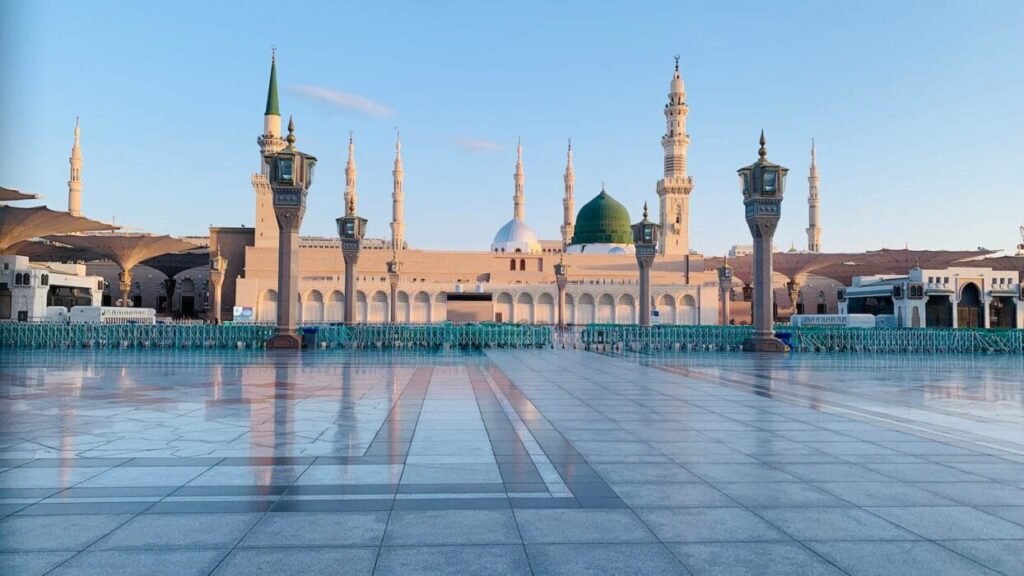
This is the part most comparisons leave out. Neither HHR station is near the Haram.
| Station | Distance to the Haram | Typical taxi time | Typical taxi cost (indicative) |
|---|---|---|---|
| Makkah station | Published figures range from about 3.5 km to 6 km, depending on which Haram gate and route is measured | 10–20 minutes outside prayer times; longer around Maghrib and Isha | About SAR 30–50 by metered or app taxi |
| Madinah station | Published figures range from about 5 km to 10 km from Masjid an-Nabawi | 15–20 minutes | About SAR 30–50 |
Add it all up. A 2-hour-20-minute train becomes a door-to-door journey of roughly 3 hours 45 minutes to 4 hours 15 minutes once you include an hour at the departure station and the taxi at each end. A private car from your Makkah hotel to your Madinah hotel is 4 to 5 hours with one stop. The train is still faster and far more predictable, but the gap is smaller than the ticket makes it look, and for a family with eight bags and two taxis at each end, the difference in effort can run the other way.
Makkah to Madinah by taxi or private car: paying for door-to-door
What it costs
Intercity fares in Saudi Arabia are negotiated, not metered, and they rise sharply in Ramadan and the Hajj weeks. Across 2025–2026 sources the Makkah–Madinah bands for the whole vehicle, not per person, are:
| Vehicle | Seats with luggage | Indicative one-way fare (SAR) | Best for |
|---|---|---|---|
| Sedan (Camry, Sonata) | 3 adults, limited bags | 350–700 | Couples, small groups with light luggage |
| 7-seat MPV or SUV | 5 adults or a family of 6 with children | 500–900 | Families who need their luggage with them |
| 12-seat van (Hiace or similar) | 9–10 adults with bags | 700–1,400 | Two families travelling together; small private groups |
| GMC Yukon or similar | 5–6 adults in comfort | 700–1,400 | Elderly parents who need a smooth, reclining ride |
Vendor websites tend to quote the top of these bands; agency-arranged cars are often lower. Agree the fare, the vehicle, the number of stops and the drop-off point at the hotel door before anyone loads a bag.
When a car wins
- Groups of five or more. Divide a SAR 700 seven-seat vehicle among six people and you are under SAR 120 each, with no station taxis and no luggage limit. The train’s per-person price rarely beats that for a full vehicle.
- Elderly or mobility-limited pilgrims. A car collects them from the hotel lobby and delivers them to the next lobby. No security queue, no platform, no lifting a 25 kg bag onto a rack.
- Ziyarat on the way. Badr is about 150 km from Madinah and off the direct highway, and a stop there turns the transfer into a half-day. Only a car or an organised bus can do this.
- Awkward departure times. If your Makkah hotel checkout is at noon and your Madinah hotel check-in is at 4 pm, a 12:30 pm car should arrive around check-in time. The train may force an early checkout and a long wait at the other end.
When a car is the wrong choice
Four to five hours on Highway 15 is tiring for a driver and for passengers, and road safety is the one risk the train removes entirely. Children get restless. In Ramadan the fare can double. And a car booked through a stranger at the hotel entrance carries a quality risk the train does not: you will not know until hour three whether the air conditioning holds or the driver respects speed limits. If you go by car, book it through your agent or hotel, not at the kerb.
Package bus: the option you have already paid for
Most group Umrah packages sold in Pakistan include “Makkah–Madinah transfer” or “intercity transport” as a shared air-conditioned bus or coaster, travelling with your group leader. On a group package it is included; on a private land-only package the intercity leg is often a private car instead, so check the wording. Uniworld’s October 2026 group departure, for example, lists the transfer and ziyarat in Makkah, Madinah and Badr among its inclusions, while the private 10-day 3-star package provides private transport for the airport and intercity legs.
The bus is slower than both alternatives, in our experience 5 to 7 hours including a rest stop and often a Badr ziyarat, and the departure time is set for the group rather than for you. What it offers is no logistics at all: the group leader handles luggage loading, timing and the hotel handover at the other end, and your bags travel under the bus without a weight limit you need to think about. For first-time pilgrims and for groups with elderly members who are travelling with a leader anyway, that simplicity is worth more than two hours saved.
The real test for the bus is not “is it the cheapest” but “would I rather pay SAR 150–450 per person on top of what I have already paid, in exchange for arriving three hours earlier and arranging my own taxis?” For some families the answer is yes; for most on a group package it is no.
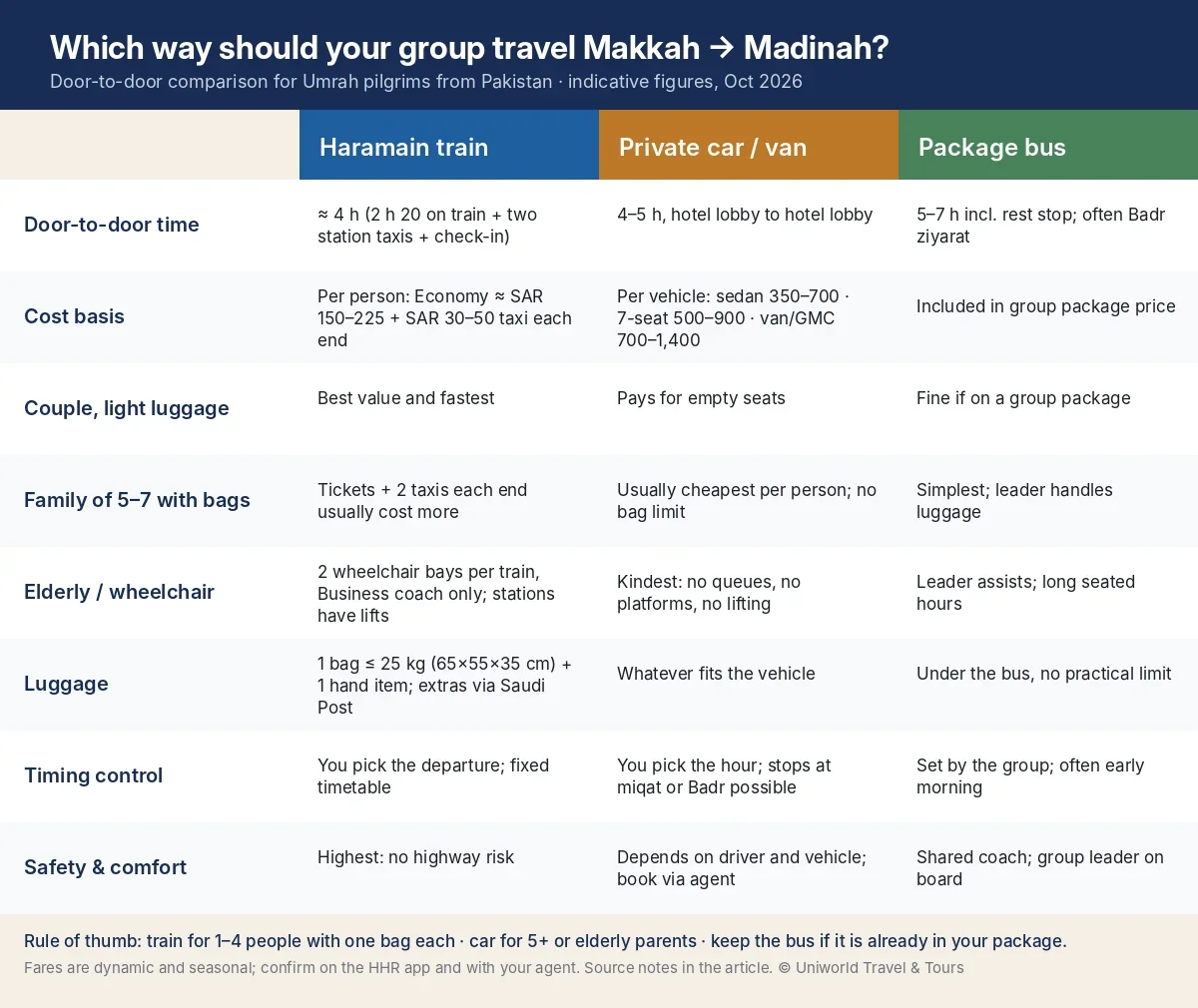
Decision framework: match the mode to your group
Start from the row that describes your group, not from the fare.
| Your situation | Recommended | Why | Watch out for |
|---|---|---|---|
| Solo traveller or couple, one bag each | Train, Economy | Cheapest per person and fastest | Station taxis at peak prayer times |
| Family of 3–4 with children under 12 | Train if luggage fits the one-bag rule; otherwise 7-seat car | Child fares cut the train cost; luggage is the deciding factor | Same-class booking rule; ask how a stroller is counted |
| Family or group of 5–7 with full luggage | Private 7-seat or 12-seat vehicle | Per-person cost falls below the train once station taxis are counted; no luggage limit | Agree fare and stops in advance; avoid kerbside drivers |
| Elderly parents, limited walking | Private car (GMC or MPV), or Business class on the train if a wheelchair bay is needed and a car is unaffordable | Door-to-door removes queues, platforms and lifting | Train wheelchair bays are only in Business and only two per train |
| On a group package with a group leader | Package bus | Already paid; leader handles everything | Fixed timing; 5–7 hours; ask whether Badr is included |
| Want to perform ziyarat at Badr en route | Private car or package bus | Train cannot stop | Adds roughly 1–2 hours including the stop (estimate) |
| Madinah to Makkah, wish to enter ihram at the miqat mosque | Private car | Only a car stops at Dhul Hulaifah | Train passengers must wear ihram before boarding |
| Tight connection to a flight from Madinah or Jeddah | Train | Predictable timing; KAIA has its own station | Allow for the station taxi and 60-minute check-in |
What it really costs: three worked examples in rupees
These are illustrative calculations, not quotes. Rate used: 1 SAR ≈ PKR 74, rounded, mid-October 2026. Train fares are taken at mid-band Economy (SAR 185); the station taxi at SAR 40 each end for a standard car, or SAR 60 where a larger vehicle is needed (an estimate above the SAR 30–50 band); the sedan at the lower-middle of its band and the MPV at mid-band. Your actual numbers will differ with the date, so use the method, not the totals.
Scenario 1: a couple, one bag each
| Option | Working | Total SAR | Approx. PKR | Door to door |
|---|---|---|---|---|
| Train Economy | 2 × 185 + 2 taxis × 40 | 450 | 33,300 | About 4 hours |
| Sedan | Whole car | 500 | 37,000 | 4.5–5 hours |
The train wins on price and time. The car wins only if one of the two cannot manage the stations.
Scenario 2: a family of six (two adults, two children aged 6 and 9, two grandparents)
| Option | Working | Total SAR | Approx. PKR | Door to door |
|---|---|---|---|---|
| Train Economy | 4 adults × 185 + 2 children × 92.50 + 2 larger taxis × 60 each end (two cars needed for six people with bags) | 1,165 | 86,200 | About 4.5 hours with two taxi loads |
| 7-seat MPV | Whole vehicle, mid-band | 700 | 51,800 | 4.5–5 hours, lobby to lobby |
The car is cheaper by roughly PKR 34,000 on these assumptions, carries all the luggage, and spares the grandparents two stations. This is the typical Pakistani family case, and it is the one most “train vs car” articles get wrong by comparing a single ticket to a whole car.
Scenario 3: a group of ten on a Uniworld group package
The bus is included. Upgrading all ten to the train would add roughly 10 × 185 + taxis at both ends in three or four vehicles, about SAR 2,100 or PKR 155,000, to save three hours and lose the Badr stop. Few groups make that trade.
Timing the transfer around hotel checkout and check-in
Makkah hotels generally check out at noon and Madinah hotels check in at 3 or 4 pm, so a transfer that leaves Makkah around midday and arrives mid-afternoon fits both ends. For the train, that means a departure between about 11 am and 1 pm; arriving at Madinah station by 3:30 pm usually puts you at the hotel as rooms open. An early-morning train means either packing the night before and skipping breakfast, or paying for late checkout, and it often means waiting in a Madinah lobby for a room. Ask your Makkah hotel to hold luggage after checkout if your train is later in the day; most do, and it lets you pray Zuhr in the Haram before leaving. Our Makkah hotel booking guide covers check-in and checkout rules in more detail.
Travelling with elderly parents or a wheelchair user
The official HHR guidance is specific and worth knowing before you book. Each train has two wheelchair bays, and they are located in the Business coach. You request special-needs assistance by ticking the option at the end of the booking. Because every passenger on one booking must be in the same class, a family that wants Economy seats for itself and a wheelchair bay for a parent must make two separate bookings, and should do so early, since there are only two bays per train. Stations have wheelchairs and lifts, and staff will help a passenger who cannot transfer from a wheelchair into a regular seat, but the walk from taxi drop-off to platform and the security screening still take time and energy.
For a parent who walks slowly but does not use a wheelchair, the decision usually comes down to this: the train asks them for two station visits and a 25 kg bag lifted twice; the car asks them for four and a half hours in a seat. In our experience most families with parents over 75 choose the car and treat the extra cost, often PKR 5,000–40,000 depending on the vehicle, as the cheapest part of the trip. If you are planning the whole journey around an elderly parent, our guide on where to stay in Madinah explains which hotel areas keep the walk to the mosque flat and short.
Common mistakes and what they cost
- Comparing one train ticket to one car. The right comparison is total group cost including station taxis against the whole vehicle. In our experience families of five or more often overpay by choosing the train on a per-ticket instinct.
- Booking the train before the hotels are confirmed. A changed hotel date means a changed train, and change fees may apply close to departure. Fix hotels first, then book the train.
- Arriving at the station 20 minutes before departure. Security, ticket checks and gate closure 10 minutes out mean a missed train and, with a counter-bought ticket, no refund.
- Packing for the flight, not the train. Airline allowances are often 30 kg or more; the train allows one 25 kg bag. Pilgrims who bought gifts in Makkah find out at the gate.
- Carrying Zamzam across without checking. Buy it where you fly out; carry it on the train only if the station confirms it is allowed.
- Taking a kerbside driver because the hotel’s quote seemed high. The saving is usually SAR 100–150; the risk is the vehicle, the speed and an unplanned “stop” at a shop the driver is paid by.
- Forgetting the miqat on the return leg. Madinah to Makkah by train means ihram before boarding. A group that realises this on the platform cannot fix it.
- Assuming the package bus leaves after Zuhr. In our experience group buses often leave early in the morning to reach Madinah for Asr. Ask for the departure time when you book, not the night before.
Questions to ask your agent before you decide
- Is the Makkah–Madinah transfer included, and is it a shared bus, a private car or the train?
- What time does the group bus leave, and is Badr ziyarat included on the way?
- If I want to upgrade the group to the train, who books it, and are station taxis included?
- Is late checkout in Makkah or early check-in in Madinah arranged to match the transfer?
- For a private car, what vehicle exactly, how many stops, and is the fare fixed in writing?
- Is there a wheelchair bay booked for my parent, and in which class?
- Will the group leader travel with us on the transfer, or meet us in Madinah?
- What happens to our luggage if the train allowance is exceeded?
Pre-transfer checklist
- Hotel dates in both cities confirmed in writing before any train booking.
- Train tickets booked online under each passenger’s exact passport details, same class for everyone on one booking.
- Special-needs assistance requested at booking for anyone who needs it.
- One bag per person at or under 25 kg, no larger than 65 × 55 × 35 cm, plus one hand item.
- Zamzam plan decided: carried only if confirmed, otherwise bought at the departure city.
- Ihram worn before boarding on the Madinah to Makkah direction.
- Station taxi arranged or Careem/Uber installed (our Saudi apps guide covers setup).
- Makkah hotel asked to hold luggage if the departure is after noon.
- Arrival at the train station 60 minutes before departure.
- For a car: fare, vehicle, stops and drop-off point agreed before loading.
How Uniworld handles this leg
On our group Umrah packages from Karachi the Makkah–Madinah transfer travels with the group leader and typically includes ziyarat at Badr; on the 10-day private package the intercity leg is a private vehicle. If your family would rather take the train, or needs a GMC for elderly parents, we arrange it as an add-on and align hotel checkout and check-in with it. Full package listings are on our Umrah packages page.
Frequently asked questions
How much is the Haramain train from Makkah to Madinah?
Economy has been published at roughly SAR 150–225 one way and Business at SAR 250–455 in 2024–2026 sources; fares are dynamic and change by date and demand. Check the live fare on the HHR app before booking.
How long does the train take between Makkah and Madinah?
About 2 hours 20 minutes on direct services and up to about 3 hours on all-stops trains. Door to door, including station taxis and check-in, plan for roughly 4 hours.
Does the train stop near Masjid al-Haram or Masjid an-Nabawi?
No. Makkah station is roughly 3.5–6 km from the Haram, and Madinah station is about 5–10 km from Masjid an-Nabawi. Both need a 10–20 minute taxi; our Madinah hotels page shows which hotels sit close to the mosque for a short last mile.
How much luggage can I take on the Haramain train?
One bag up to 25 kg and 65 × 55 × 35 cm, plus one hand item. Extra or oversized bags are not carried; stations have Saudi Post desks that ship them separately for a fee.
Can I carry Zamzam water on the train?
The railway has not published a specific Zamzam rule. A sealed pack within your bag allowance is the common assumption, but confirm at the station; the safer plan is to buy Zamzam in the city you fly home from.
Is a private car cheaper than the train?
For one or two people, no. For five or more with luggage, usually yes: a 7-seat vehicle at SAR 500–900 for the whole car often costs less than five or six train tickets plus four station taxis.
Can elderly pilgrims use the Haramain train?
Yes. Stations have lifts and wheelchairs and staff assist, but the only wheelchair bays are in the Business coach, two per train, and must be requested at booking. For parents who struggle with queues, a door-to-door car is often the kinder option.
Do I need to wear ihram on the train from Madinah to Makkah?
Yes, before boarding. The train passes the miqat at Dhul Hulaifah shortly after leaving Madinah and does not stop, so pilgrims wear ihram at the hotel and make the intention as the train passes.
Is there a public bus from Makkah to Madinah?
Intercity bus services exist through SAPTCO/Alsa and Northwest Bus, but as of October 2026 we could not verify a direct Makkah–Madinah public route; most routes run via Jeddah and take 5–8 hours. For pilgrims this is rarely practical compared with the package bus, the train or a car.
What is included in a package’s “Makkah–Madinah transfer”?
On group packages, usually a shared air-conditioned bus with the group leader, often with a Badr ziyarat stop. On private land-only packages, usually a private car. Ask your agent which it is and what time it departs.
Can I change or cancel a Haramain ticket?
Online tickets can be changed or refunded in tiers depending on how far before departure you act; counter-bought tickets are reported to be non-refundable. Published fee percentages conflict, so read the conditions at checkout on the HHR app.
Which is safest?
The train. It removes the 450 km highway leg, driver fatigue and night driving, which is the strongest reason to choose it for anyone travelling alone or with children when luggage allows.
The decision in one paragraph
Choose the train when your group is small, your luggage fits the one-bag rule and everyone can manage two stations; it is faster, safer and usually cheapest. Choose a private car when there are five or more of you with full luggage, when an elderly parent needs a lobby-to-lobby journey, or when you want to stop at Badr or the miqat. Keep the package bus when you are on a group package with a leader; you have paid for it and the simplicity is real. Whatever you choose, decide it when you book the hotels, not the night before, because the transfer is the one part of Umrah where the cheapest-looking option and the most suitable one are so often different things. If you would like us to price all three for your dates and group, message Uniworld Travel & Tours on WhatsApp.