
Quick answer: Hajar al-Aswad (the Black Stone) is a dark stone in a silver frame, set in the eastern corner of the Kaaba in Masjid al-Haram, Makkah, about 1.5 metres above the ground. Every round of Tawaf begins and ends in line with it. Muslims kiss, touch or point to it because the Prophet ﷺ did so, not because the stone has any power of its own.
Pakistani pilgrims also know it as Hajr-e-Aswad, Hajre Aswad or Sang-e-Aswad. In Arabic it is al-Hajar al-Aswad (الحجر الأسود), meaning “the Black Stone”. This guide covers where it is, its recorded history and what authentic hadith say about it. It also separates weak narrations and popular myths from sound reports, and explains how to approach the Stone safely during Tawaf.
Hajar al-Aswad at a Glance
| Detail | What we know |
|---|---|
| Location | Eastern corner of the Kaaba, called al-Rukn al-Aswad (the corner of the Black Stone) |
| Height | About 1.5 m above the Mataf floor |
| What you see | About eight small fragments in an oval silver frame. The largest is roughly the size of a date; the rest of the stone sits inside the Kaaba wall |
| Role in worship | Start and end point of each of the seven rounds of Tawaf |
| Set in place by | Prophet Muhammad ﷺ, around 605 CE, five years before the first revelation |
| Kissing it | Sunnah when it can be done without harming anyone; not obligatory |
| Custodian today | General Presidency for the Affairs of the Grand Mosque and the Prophet’s Mosque, Saudi Arabia |
What Is Hajar al-Aswad?
Hajar al-Aswad is the only stone Muslims are taught to kiss as part of worship. The Quran does not mention it by name. It does describe the Kaaba as the first House of worship set up for mankind (Surah Al Imran 3:96–97), and Prophet Ibrahim and his son Ismail, peace be upon them, raising its foundations (Surah al-Baqarah 2:127).
Islamic historical reports say Ibrahim (AS) set the Stone in the corner to mark where circling the House should begin. That detail comes from historical narrations, not from the Quran, so it is best described as tradition. What is certain is that the Prophet ﷺ began and ended his Tawaf at the Stone, which is why every Tawaf today still starts there.
Where Exactly Is the Black Stone?
The Black Stone is set in the Kaaba’s eastern corner, close to the door. Of the Kaaba’s four corners, only two are touched during Tawaf:
- Al-Rukn al-Aswad: the Black Stone corner, in the east.
- Al-Rukn al-Yamani: the Yemeni corner, the last corner you pass before you reach the Black Stone again.
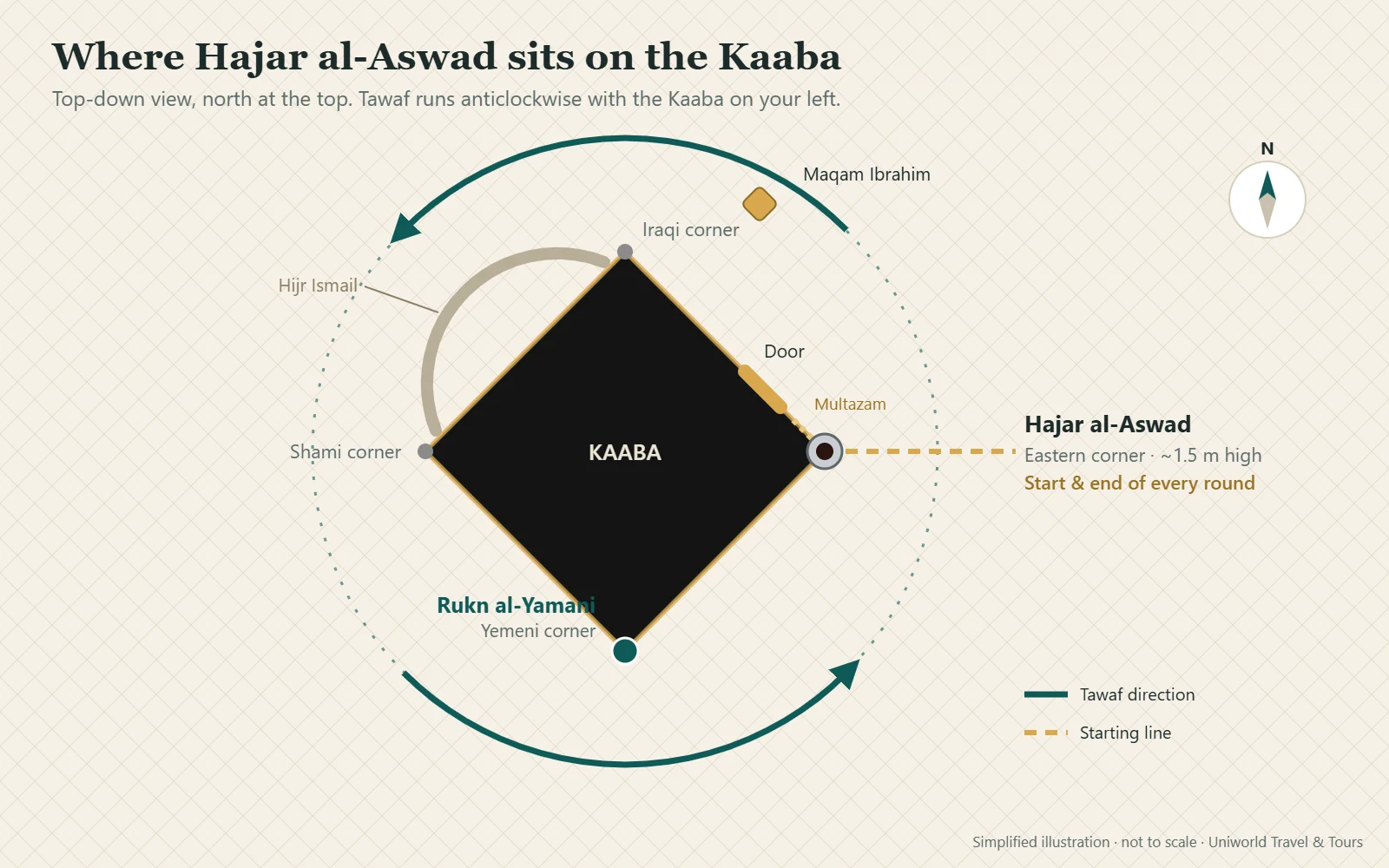
These two are called “the two Yemeni corners”. Abdullah ibn Umar (RA) said he never stopped touching the Yemeni corner and the Stone after he saw the Prophet ﷺ do so (Sahih Muslim 1268). The other two corners, the Iraqi and the Shami, are not touched. The wall between the Black Stone and the Kaaba door is known as the Multazam.
How to find the starting point today
- A brown marble line once ran across the Mataf floor from the Stone. It was removed because pilgrims stopping on it caused congestion.
- On the upper floors, green lights mark the Black Stone corner, according to Saudi Arabia’s Ministry of Hajj and Umrah.
- Gold-embroidered markers on the Kiswah above the Stone also help pilgrims count their rounds.
You do not need to hit the exact centimetre. Scholars explain that if you start and finish in line with the Stone to the best of your ability, your Tawaf is valid. Starting somewhere else entirely, such as at the Kaaba door, invalidates the first round.
The History of Hajar al-Aswad
The Stone’s recorded history includes a famous act of peacemaking, a siege, a theft that lasted two decades, and centuries of careful repair.
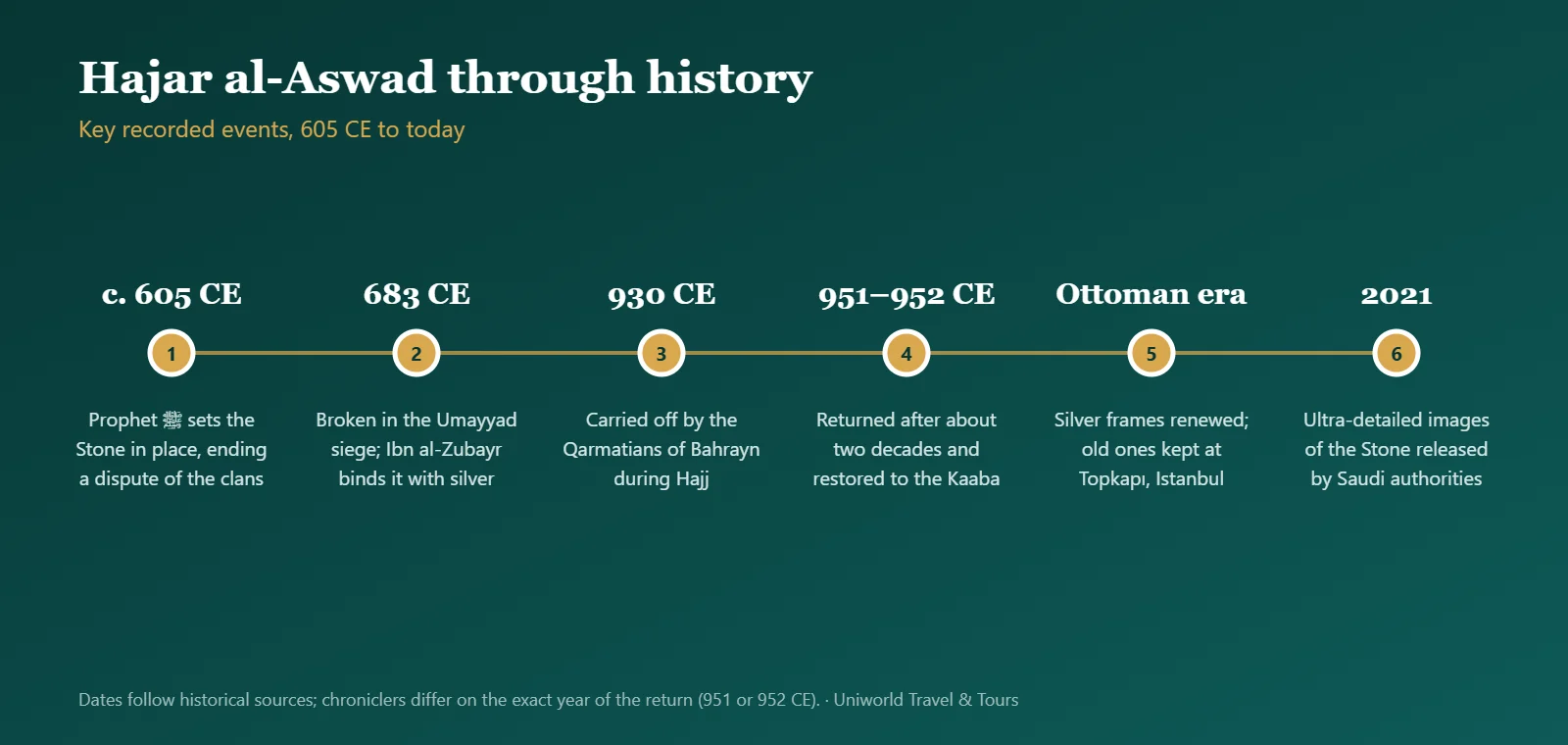
| Period | What happened | Basis |
|---|---|---|
| Time of Ibrahim (AS) | Ibrahim and Ismail raise the foundations of the Kaaba; tradition links the Stone’s placement to this time | Quran 2:127 (building); historical reports (Stone) |
| c. 605 CE | Quraysh rebuild the damaged Kaaba and the clans nearly fight over who will lift the Stone back. Muhammad ﷺ, then 35, settles it | Al-Sirah al-Nabawiyyah of Ibn Ishaq |
| 683 CE (64 AH) | During the Umayyad siege of Makkah a catapult strike breaks the Stone. Abdullah ibn al-Zubayr (RA) joins the pieces with silver | Early chronicles |
| January 930 CE (317 AH) | The Qarmatians of Bahrayn, led by Abu Tahir al-Jannabi, attack Makkah during Hajj and carry the Stone away | Widely recorded |
| 951–952 CE (c. 339 AH) | The Stone is returned, left at the Great Mosque of Kufa and restored to the Kaaba. Chroniclers differ on the exact year | Historical accounts |
| 11th century | A man reportedly sent by the Fatimid ruler al-Hakim strikes the Stone; the damage is slight | Historical report |
| Ottoman era | Sultans renew the silver frame; worn frames are kept at Topkapı Palace, Istanbul | Museum and historical records |
| May 2021 | Saudi authorities publish 49,000-megapixel images of the Stone, made from 1,050 photos taken over seven hours | General Presidency release |
The arbitration of 605 CE
When Quraysh rebuilt the Kaaba, every clan wanted the honour of setting the Black Stone back in place. The dispute grew so heated that violence seemed close. They agreed to let the next man through the gate decide, and it was Muhammad ﷺ, already known as al-Amin (the trustworthy).
He spread a cloth, placed the Stone on it, and asked one leader from each clan to hold an edge. They lifted it together, and he set it in the wall with his own hands. Every clan shared the honour and no blood was shed. About five years later, the first revelation came to him in the cave of Hira on Jabal al-Noor.
Why is the Stone in pieces?
The fragments you see today are a result of that history. The stone was shattered in 683 CE and damaged again in later centuries. Each time it was pieced together and secured in a silver frame, which Saudi authorities still maintain today.
Why Is It Called the Black Stone?
The Prophet ﷺ said the Black Stone came down from Paradise whiter than milk, and the sins of the children of Adam turned it black (Jami’ at-Tirmidhi 877; graded hasan). Scholars treat this as a matter of the unseen and draw a lesson from it: if sin can darken a stone, it can darken a heart.
Physically, the high-resolution images released in 2021 show a stone that is reddish-black and polished rather than uniformly black. You may read that it is a meteorite. The Stone has never been scientifically tested and geologists consider that theory doubtful, so treat it as speculation, not fact.
Why Do Muslims Kiss the Black Stone?
Muslims kiss the Black Stone only because the Prophet ﷺ kissed it. Umar ibn al-Khattab (RA) made this clear in a statement recorded by both al-Bukhari and Muslim. He kissed the Stone and said: “I know that you are a stone and can neither benefit anyone nor harm anyone. Had I not seen Allah’s Messenger ﷺ kissing you, I would not have kissed you” (Sahih al-Bukhari 1597).
This is the key to understanding the Stone. Worship belongs to Allah alone. The Stone is honoured because Allah’s Messenger ﷺ honoured it, in the same way Muslims face the Kaaba in prayer without worshipping its walls.
Two authentic reports describe the reward attached to it:
- It will testify. The Prophet ﷺ said Allah will raise the Stone on the Day of Resurrection with eyes and a tongue, and it will bear witness for everyone who touched it sincerely (Tirmidhi 961; hasan).
- Touching it removes sins. Ibn Umar (RA) heard the Prophet ﷺ say that touching the Black Stone and the Yemeni corner is an expiation for sins (Tirmidhi 959; hasan).
Kissing the Stone is a Sunnah of Tawaf, not one of the obligatory acts of Umrah. Your Umrah is complete even if you never get close to it.
Authentic, Weak or Unsupported? Common Claims Checked
Many popular claims about the Stone come from weak narrations or from no source at all. This table separates them.
| Claim you may hear | Status | Reference |
|---|---|---|
| It came from Paradise whiter than milk and was blackened by sins | Accepted (hasan) | Tirmidhi 877 |
| It will testify for those who touched it sincerely | Accepted (hasan) | Tirmidhi 961 |
| Touching it and the Yemeni corner expiates sins | Accepted (hasan) | Tirmidhi 959 |
| Umar: “You are a stone that cannot benefit or harm” | Authentic (sahih) | Bukhari 1597; Muslim 1270 |
| The Stone and Maqam Ibrahim are gems of Paradise whose light was removed | Weak (da’if) | Tirmidhi 878 |
| “The Black Stone is Allah’s right hand on earth” | Chains attributing it to the Prophet ﷺ are weak. Some scholars accept a version as Ibn Abbas’s own words and explain it as a figure of speech for renewing one’s pledge to Allah | Musnad Ahmad; al-Hakim |
| “This is the place where tears are shed” | Very weak | Ibn Majah 2945 |
| “Whoever kisses it enters Paradise without reckoning” | No such narration found in the hadith collections | IslamQA 247163 |
| “It floats on water and does not heat in fire” | A later anecdote with no basis from the Prophet ﷺ | – |
| “It is a meteorite” | Never scientifically tested; unproven | – |
| “You must kiss it in every round” | Incorrect: it is Sunnah, and pointing is enough in crowds | Bukhari 1613 |
At the Black Stone During Tawaf: The Sunnah, Step by Step
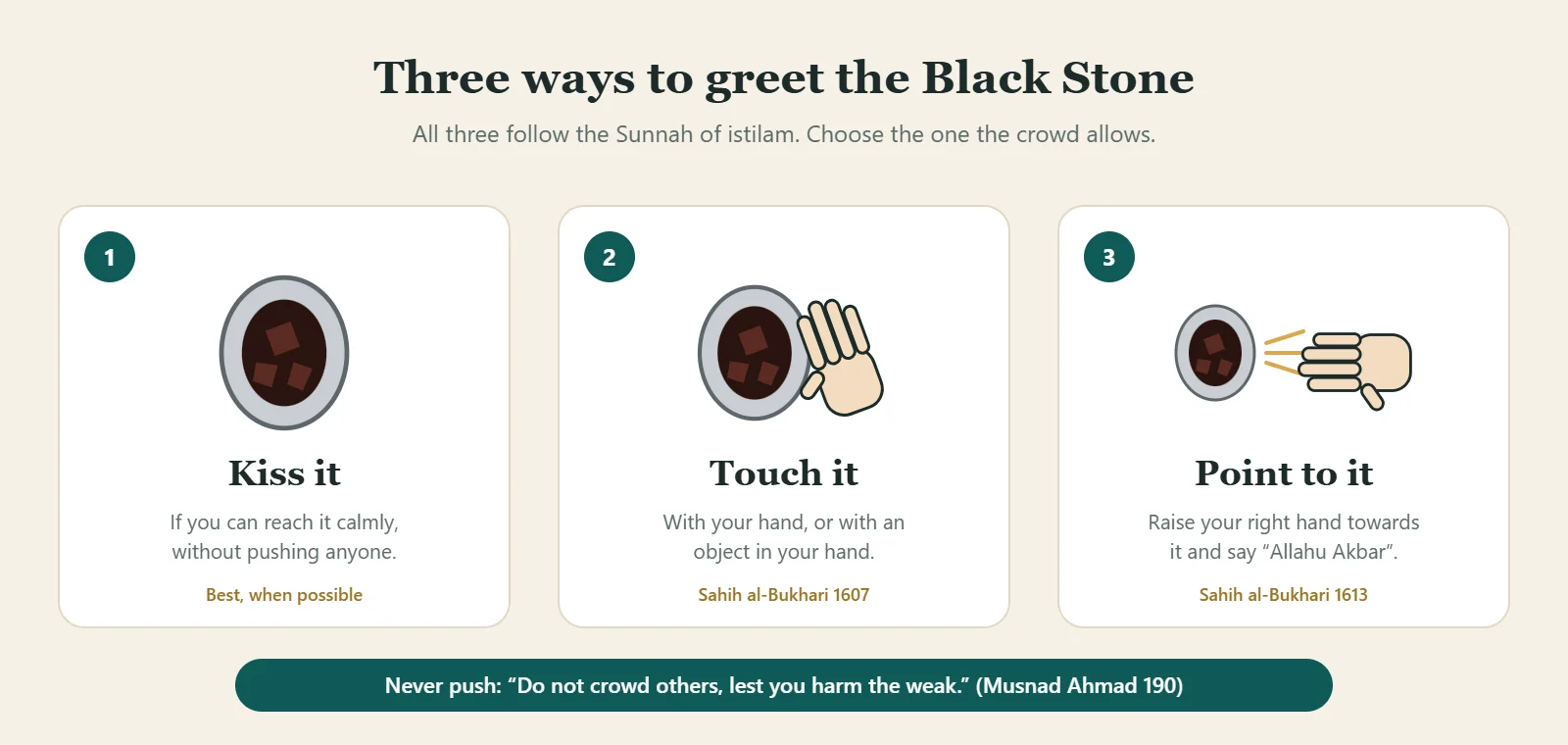
The Prophet ﷺ showed three levels of istilam (greeting the Stone). All three fulfil the Sunnah. Which one you use depends on the crowd, and choosing the safest leaves nothing lacking.
- Line up with the Stone. Begin your first round at the Black Stone corner (look for the green lights or the Kiswah marker), keeping the Kaaba on your left. For the full sequence of rituals, see our step-by-step guide on how to perform Umrah.
- Kiss it, if you can reach it calmly. This is what the Prophet ﷺ did, and what Umar (RA) followed.
- Otherwise, touch it with your hand, or with something in your hand. The Prophet ﷺ once touched the Stone with a bent-headed stick while performing Tawaf on his camel (Bukhari 1607).
- Otherwise, point to it. Face the Stone, raise your right hand towards it and say Allahu Akbar. The Prophet ﷺ pointed to the corner and said “Allahu Akbar” each time he passed it (Bukhari 1613). Then keep walking.
- Repeat at the start of every round. Greet the Stone in all seven rounds, at whichever level is possible as you pass. Your seventh round ends when you reach it again.
Do not push. The Prophet ﷺ told Umar (RA): “You are a strong man. Do not crowd others to touch the Black Stone, lest you harm the weak. If you find a gap, touch it; otherwise face it and say La ilaha illallah and Allahu Akbar” (Musnad Ahmad 190; hasan). Hurting another pilgrim to perform a Sunnah turns the act on its head.
At the Yemeni corner: touch it with your right hand if you can, without kissing it. If you cannot, carry on, since kissing is only for the Black Stone. Between the Yemeni corner and the Black Stone, the Prophet ﷺ recited: Rabbana atina fid-dunya hasanah, wa fil-akhirati hasanah, wa qina ‘adhaban-nar (Sunan Abi Dawud 1892).
If you are in Ihram
The Kaaba, the Black Stone and the Kiswah are regularly perfumed. Perfume is prohibited in Ihram, so take care if the scent is fresh and could rub off on your hand or clothes. Scholars from the different schools agree on the caution but differ on whether a penalty is due if it transfers. If you are unsure, point to the Stone instead, and ask your group’s scholar.
Women, elderly pilgrims and families
Kissing the Black Stone is a Sunnah for women as well as men, as long as it is done without pushing or mixing in a crush of men. Aishah (RA) performed Tawaf apart from the men (Bukhari 1618). In a crowd, pointing gives women, elderly pilgrims and parents with children the full Sunnah without the risk.
The area near the Stone is usually most crowded in Ramadan, the Hajj season and around the five daily prayers. If being close to it matters to you, our month-by-month guide to the best time for Umrah can help you choose quieter dates.
Planning Your Umrah from Pakistan
To see the Black Stone in person, plan for more than a single Tawaf. A longer stay lets you perform several Tawafs at different times of day, when the Mataf is calmer. Uniworld’s Umrah packages from Pakistan include visa, flights, hotels and transport, from short 7-day trips for those with limited leave to longer stays. A 15 Days Umrah Package leaves time for unhurried worship in both Makkah and Madinah.
Frequently Asked Questions
Where is Hajar al-Aswad located?
Hajar al-Aswad is set in the eastern corner of the Kaaba inside Masjid al-Haram, Makkah. It sits about 1.5 metres above the ground, near the Kaaba’s door, in an oval silver frame.
Is it compulsory to kiss Hajar al-Aswad during Umrah?
No. Kissing the Black Stone is a Sunnah, not an obligation. If you cannot reach it without pushing, point to it with your right hand and say Allahu Akbar. Your Tawaf and Umrah remain complete.
Do Muslims worship the Black Stone?
No. Muslims worship Allah alone. Umar (RA) said the Stone can neither benefit nor harm, and that he kissed it only because he saw the Prophet ﷺ do so (Sahih al-Bukhari 1597).
Who placed the Black Stone in the Kaaba?
The Prophet Muhammad ﷺ set it in place around 605 CE, when Quraysh rebuilt the Kaaba. He had a leader from each clan lift it together on a cloth, which ended their dispute peacefully. Islamic tradition links its original placement to Prophet Ibrahim (AS).
Why is the Black Stone broken into pieces?
It was shattered during the siege of Makkah in 683 CE and damaged again in later centuries. The fragments were joined and secured in a silver frame, which has been renewed many times.
Was the Black Stone ever stolen?
Yes. The Qarmatians of Bahrayn took it from Makkah in January 930 CE (317 AH). It was returned about 21 to 22 years later, around 951–952 CE.
Can women touch or kiss Hajar al-Aswad?
Yes, it is a Sunnah for women too, as long as they avoid pushing and crowding among men. In busy periods, pointing to the Stone is the safer way to follow the Sunnah.
Is the Black Stone a meteorite?
Nobody knows. The Stone has never been examined with modern scientific methods, so the meteorite idea is a popular theory, not an established fact.
Banner photo: The Ka’ba, Great Mosque of Mecca by Richard Mortel, CC BY 2.0, via Wikimedia Commons (cropped). Other illustrations by Uniworld Travel & Tours.