Quick answer: Winter (December to February) is better for comfort. Makkah’s average daytime high drops to about 30–32°C, compared with about 43°C in summer. Summer (June to September) is better for space and value: Saudi figures show far fewer foreign pilgrims arrive in July–September than in October–December. Choose winter if you are travelling with elderly parents or anyone with a health condition. Choose summer if you are fit, flexible, and want a quieter Haram or need your children’s school holidays.
Most advice on this question stops at “winter is cooler, summer is cheaper”. That is true, but it leaves out the two things that decide the trip for most Pakistani families: how hot summer really is, and how busy winter really is. This guide uses official climate records and Saudi pilgrim statistics to answer both, then matches each season to the kind of traveller it suits.
Summer vs Winter Umrah at a Glance
| Summer (June–September) | Winter (December–February) | |
|---|---|---|
| Makkah average daytime high | 42.7–43.9°C | 30.5–32.2°C |
| Makkah average night low | 28.8–29.6°C | 18.8–20.4°C |
| Madinah | About 43°C by day, 29°C at night | Much colder nights; can fall to about 2°C in cold spells |
| Foreign pilgrims (2024) | 3.35 million in July–September | 5.28 million in October–December |
| Prices | Usually lower (lower demand) | Usually higher, rising further towards Ramadan |
| Pakistani school holidays | Long summer break | Short December break only |
| Best suited to | Fit adults, budget travellers, families tied to school holidays | Elderly pilgrims, first-timers, anyone sensitive to heat |
Makkah: 1985–2013 Saudi meteorological station data, analysed by Umm Al-Qura University. Madinah: Saudi National Center for Meteorology (NCM). Pilgrim numbers: Saudi General Authority for Statistics (GASTAT). Sources are linked in the sections below.
How Hot Is Makkah in Summer, and How Cool Is It in Winter?
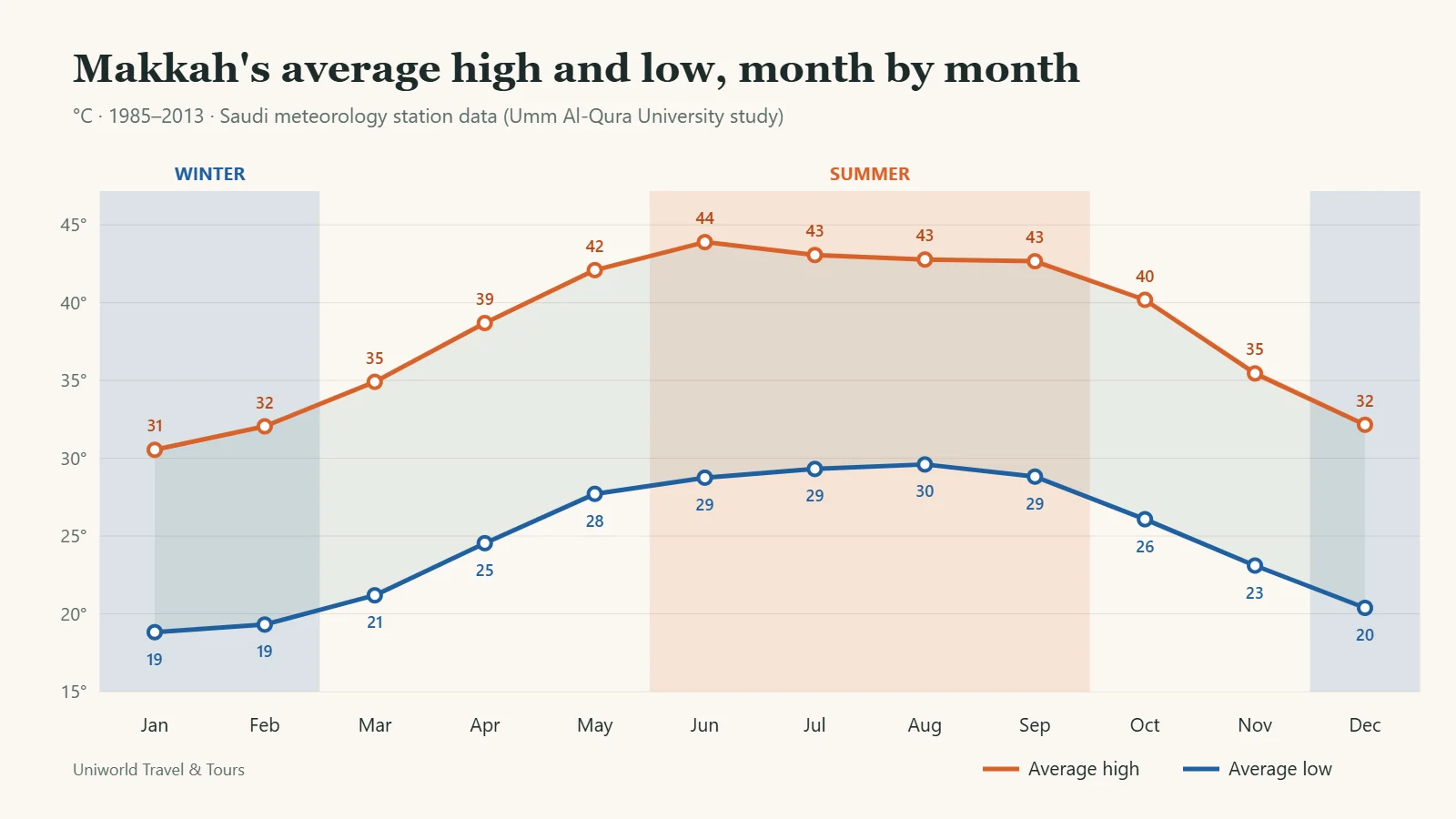
Summer in Makkah is extreme. From June to September, average daytime highs sit between 42.7°C and 43.9°C, and nights average about 29°C. These figures come from a study of 1985–2013 Saudi meteorological records by Umm Al-Qura University’s Custodian of the Two Holy Mosques Institute for Hajj and Umrah Research. Saudi Arabia’s National Center for Meteorology gives a similar picture for the Hajj season, with an average maximum of 43.6°C in Makkah.
Winter in Makkah is warm rather than cold. From December to February, afternoons average 30.5–32.2°C and nights 18.8–20.4°C.
Madinah is different, and many travellers are caught out by it. In summer it is as hot as Makkah: the National Center for Meteorology puts Madinah’s Hajj-season average at about 43°C by day and 29°C at night. In winter, though, its nights are much colder. The NCM has warned that temperatures in Madinah’s suburbs can fall to about 2°C during cold spells. If your package includes Madinah in winter, pack a warm layer for Fajr and late-night prayers.
| Month | Makkah average high (°C) | Makkah average low (°C) |
|---|---|---|
| January | 30.5 | 18.8 |
| March | 34.9 | 21.2 |
| May | 42.1 | 27.7 |
| July | 43.1 | 29.3 |
| September | 42.7 | 28.8 |
| November | 35.5 | 23.1 |
Monthly mean of daily maximum and minimum temperatures, 1985–2013, from the Saudi Presidency of Meteorology and Environment’s Makkah station. Source: A. Abdou, “Temperature Trend on Makkah, Saudi Arabia”, Custodian of the Two Holy Mosques Institute for Hajj and Umrah Research, Umm Al-Qura University.
Rain is rare in both seasons, and most of it falls in the cooler months. On its 1991–2020 records, the National Center for Meteorology lists November as Saudi Arabia’s second-wettest month. A brief shower is possible in winter but should not change your plans.
Is Winter Umrah More Crowded? What the Numbers Show
Yes. Winter brings far more foreign pilgrims than summer. Several travel blogs claim the opposite, but figures from Saudi Arabia’s General Authority for Statistics (GASTAT) are clear. In 2024, foreign Umrah performers by quarter were:
| Quarter (2024) | Foreign Umrah performers | What drives it |
|---|---|---|
| January–March | 5.79 million | Winter season, plus the start of Ramadan in March |
| April–June | 2.38 million | Umrah visas pause before Hajj |
| July–September | 3.35 million | Peak summer heat |
| October–December | 5.28 million | Cooler months and year-end holidays |
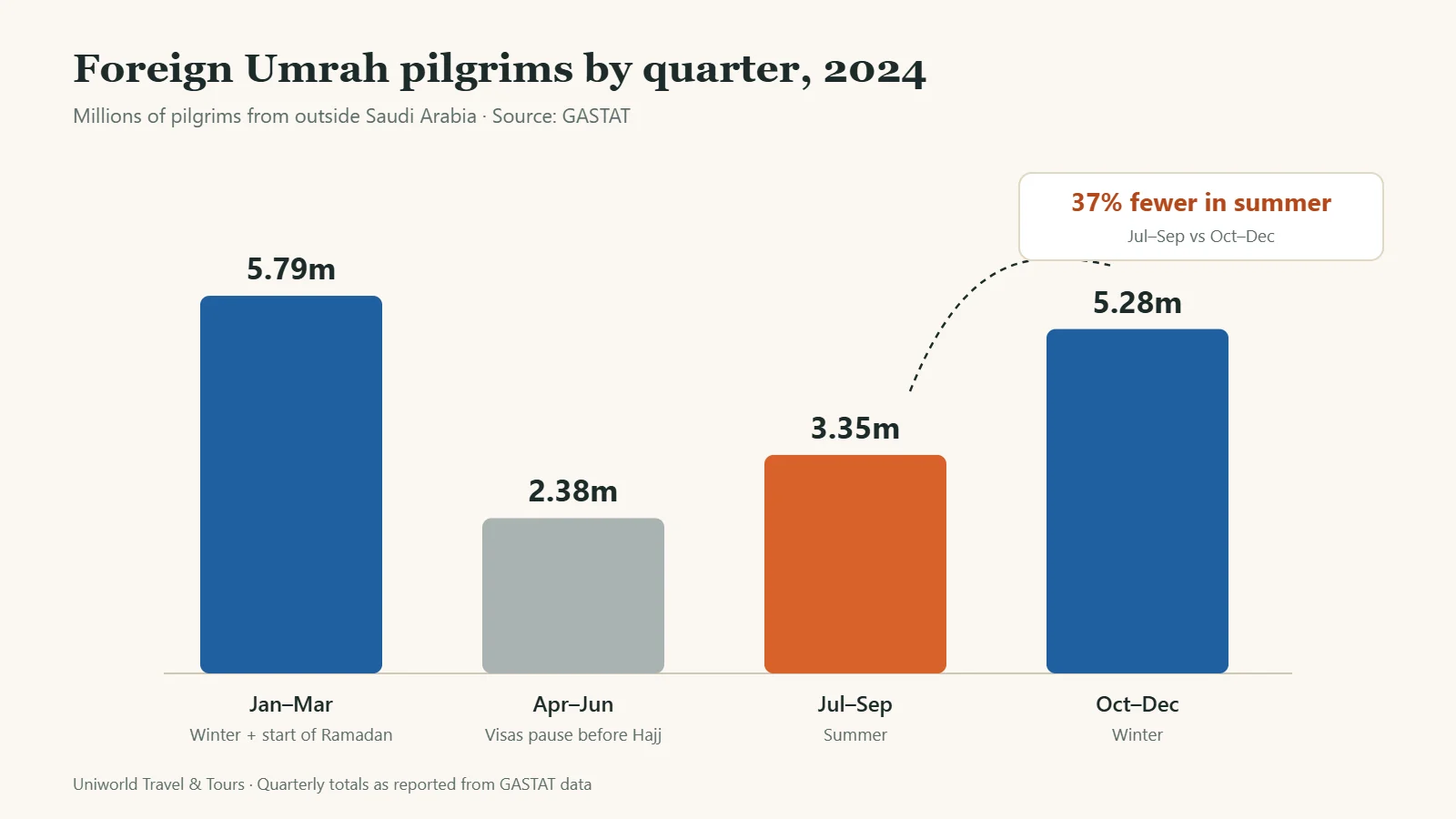
That means the summer quarter had about 37% fewer foreign pilgrims than October–December. GASTAT’s quarterly reports also show where the winter peaks fall:
- December accounted for 38.2% of foreign pilgrims in the last quarter of 2024.
- January accounted for 36.5% of foreign pilgrims in the first quarter of 2025.
Quarterly totals: GASTAT data as reported by Argaam. The July–September figure (3,348,512) is confirmed in GASTAT’s Q3 2024 report.
Fewer pilgrims in summer means more space in the Mataf and an easier chance of praying close to the Kaaba. Busy winter weeks mean more planning, especially in late December and early January.
What Changes in 2026–27: Winter Overlaps Ramadan
The Islamic calendar moves about 11 days earlier each year, so “winter Umrah” is not the same every year. In 2027, Ramadan 1448 is expected to start around 8 February and end around 8 March, according to International Astronomical Center calculations. The exact dates depend on the moon sighting. That puts the second half of winter into the busiest, most expensive period of the year.
The current Umrah season also has fixed deadlines. Saudi Arabia’s Ministry of Hajj and Umrah announced them through the Saudi Press Agency:
- 9 March 2027 (1 Shawwal 1448): last date for issuing Umrah visas
- 23 March 2027: last date for pilgrims to enter the Kingdom
- 7 April 2027: final departure date for Umrah pilgrims
In practice, this leaves three winter windows for 2026–27:
- November to mid-December: cooler weather, before the year-end peak.
- Late December to January: coolest weather, but the busiest weeks for foreign pilgrims.
- February to early March: Ramadan Umrah, with high demand and prices. If you are considering this option, compare it in our guide to Ramadan Umrah vs regular Umrah.
Summer 2027 also comes with a gap. Umrah visas close before Hajj, and in 2026 the new season reopened on 31 May, after Hajj. If the same pattern holds, summer Umrah in 2027 would begin around late May or June, once the 1449 calendar is announced.
Which Season Suits Your Situation?
The right season depends less on the weather than on who is travelling. Use this table as a starting point.
| If you are… | Better choice | Why |
|---|---|---|
| Travelling with elderly parents | Winter (November–January) | Daytime heat in summer adds serious strain to Tawaf and Sa’i |
| Managing a health condition (heart, diabetes, blood pressure) | Winter, after a check-up | Lower heat risk; ask your doctor before travelling in any season |
| A family tied to school holidays | Summer, with a night-time plan | It is the only long break; plan the rituals for after Isha or before Fajr |
| A first-time pilgrim with flexible dates | November or January | Comfortable weather while you learn the rituals |
| Looking for the lowest package cost | Summer | Lower demand usually means lower hotel and package rates |
| Hoping for a quieter Haram | Summer | Roughly a third fewer foreign pilgrims than in October–December |
| Wanting Ramadan in the Haram | Late winter 2027 (Ramadan) | Book well ahead; it is the busiest period of the year |
Pakistan’s school calendar narrows the choice for many families. In 2026, Punjab’s summer vacations ran from 22 May to 23 August and Sindh’s from 1 June to 31 July. Sindh’s winter break for 2026 is set for 21–31 December, only long enough for a short trip such as a 7-day package. Check your province’s 2027 notification before booking.
Planning a Summer Umrah: How to Manage the Heat
Summer Umrah is very achievable if you plan your day around the sun.
- Perform Umrah at night. Start Tawaf after Isha or in the hours before Fajr, when the open courtyard has cooled. Sa’i between Safa and Marwah takes place inside the mosque building.
- Carry an umbrella. Saudi Arabia’s Ministry of Health says an umbrella can lower the temperature around you by about 10°C and reduces the risk of heat exhaustion and heatstroke.
- Drink steadily. Drink water and Zamzam regularly, not only when thirsty, and rest between arriving and starting your Umrah.
- Choose your hotel carefully. A hotel within walking distance means less time in the midday sun. If you stay further out, check the shuttle schedule; our guide to Makkah hotels with a free Haram shuttle explains how these work.
- Know the warning signs. Heavy sweating, dizziness, headache, nausea or confusion can signal heat exhaustion. Move somewhere cool, drink water and get help. The Ministry of Health’s 937 call centre runs 24 hours a day and answers in Urdu, among other languages.
If summer is your only option, the case for a July Umrah covers its spiritual side, including the start of the Islamic new year.
Planning a Winter Umrah: Crowds, Cold Nights and Booking Early
Winter’s challenge is not the weather but the demand.
- Book early. Hotels near the Haram fill first in late December, January and the run-up to Ramadan. Our guide on when to book Makkah hotels shows how prices move through the year.
- Pack for Madinah nights. Bring a light jacket or shawl for Madinah’s cold winter nights.
- Know the Ihram rules. Men in Ihram cannot wear stitched garments such as shirts, trousers or hooded cloaks (Sahih al-Bukhari 1542). They may wrap an extra shawl or blanket around themselves for warmth, as long as it is not worn like a garment and the head stays uncovered. Hanafi and other scholars agree on this (SeekersGuidance, IslamQA 41140). Women may wear their usual modest clothing, including warm layers.
- Expect queues. Allow extra time for Tawaf, security entry and hotel lifts during peak weeks.
So, Which Is Better?
For most families, winter is better, especially November and January, because comfort matters more over a full Umrah than a quieter courtyard. Summer is the better choice for healthy adults who want more space, lower costs, or need school holidays, as long as they perform the rituals at night and take heat seriously.
For a month-by-month breakdown of crowds, weather and prices beyond these two seasons, see our guide to the best time to perform Umrah. When you have chosen your season, compare Uniworld’s Umrah packages from Pakistan for dates, hotel categories and durations.
Frequently Asked Questions
Can Umrah be performed in any month?
Yes, Umrah can be performed at any time of year. Foreign pilgrims, however, need an Umrah visa, and visa issuance pauses before Hajj. For the 1448 season, the last visa date is 9 March 2027, and pilgrims must leave by 7 April 2027.
Which is the coolest month for Umrah?
January. In Makkah, January averages a high of about 30.5°C and a low of about 18.8°C, and Madinah is colder still at night.
Is it safe to take children for Umrah in summer?
It can be, with careful planning. Keep children out of the midday sun, perform the rituals at night, carry water and an umbrella, and use a stroller or wheelchair service for long distances. Speak to your child’s doctor if they have a health condition.
Is summer Umrah cheaper than winter Umrah?
Usually, yes. Fewer pilgrims travel in summer, so hotels and packages tend to cost less than in the December–January peak or Ramadan. Exact prices depend on your dates, hotel category and flights.
Does it rain in Makkah in winter?
Occasionally. Most of Saudi Arabia’s limited rain falls in the cooler months, and the National Center for Meteorology lists November as the second-wettest month nationally. Showers in Makkah are usually brief and rarely affect a trip.
Figures and dates checked in November 2026. We review this guide when the 1449 Umrah calendar and the 2027 school-holiday notices are announced.
Banner photo: The Kaaba in Masjid al-Haram by Tab59, Public Domain Mark 1.0, via Wikimedia Commons (cropped). Charts and illustration by Uniworld Travel & Tours.