
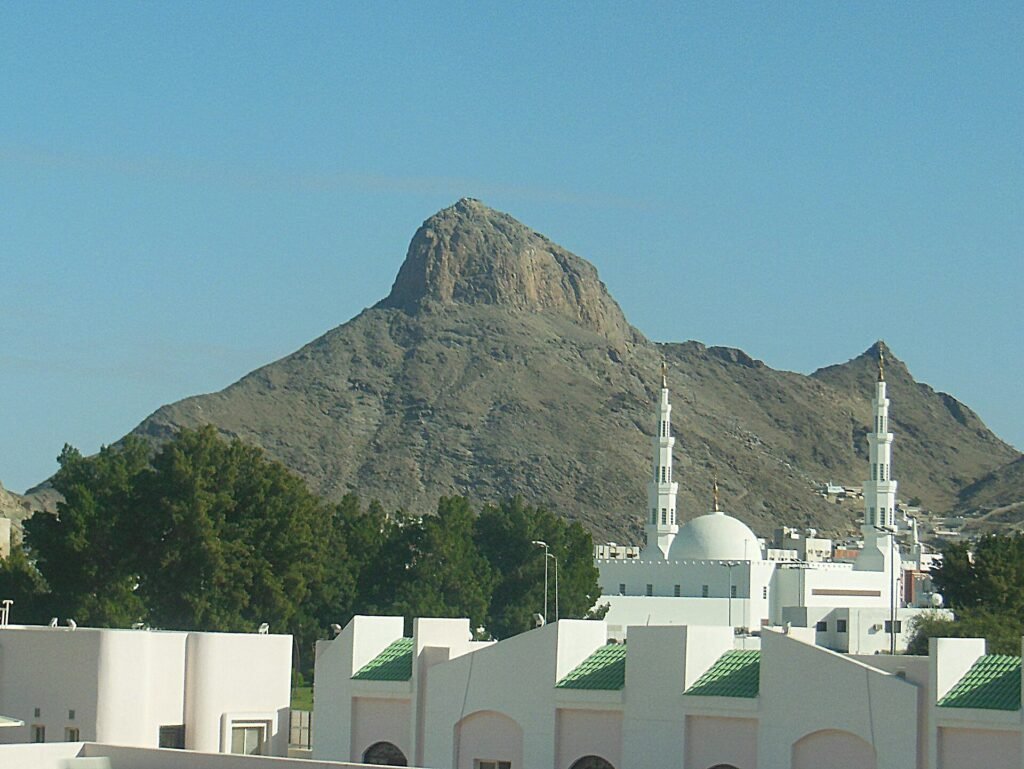
Ghar-e-Hira (the Cave of Hira) is a small cave near the top of Jabal al-Noor, a mountain about 4 km north-east of Masjid al-Haram in Makkah. It is where Prophet Muhammad ﷺ used to retreat in worship, and where the first verses of the Quran were revealed to him through the angel Jibreel (AS).
For pilgrims from Pakistan, it is one of the most moving ziyarat in Makkah and also the most physically demanding. This guide covers what happened there, what is firmly established and what is not, and how to plan the climb during your Umrah trip.
Ghar-e-Hira at a Glance
| Detail | What to know |
|---|---|
| Other names | Cave of Hira, Ghar Hira, Hira Cave |
| Mountain | Jabal al-Noor (“Mountain of Light”), also called Jabal Hira |
| Location | About 4 km north-east of Masjid al-Haram, Makkah. Some sources give up to 5 km |
| Mountain height | 634 to 642 m above sea level (about 2,080 to 2,106 feet), depending on the source |
| Cave size | About 3.5 to 4 m long, 1.3 to 1.6 m wide and 2 m high. Room for four to six people |
| Why it matters | Site of the first revelation, Surah al-Alaq 96:1-5 |
| Climb | Roughly 1,200 to 1,750 steps. 45 minutes to 2 hours up |
| Entry | The path to the cave is free and open 24 hours |
| At the base | Hira Cultural District, with the Revelation Exhibition and Holy Quran Museum |
| Part of Umrah? | No. It is an optional visit |
Figures such as the height and number of steps differ between sources because they were measured from different starting points. This guide gives the range instead of picking one.
Where Is Ghar-e-Hira Located?
The cave sits just below the summit of Jabal al-Noor, on the side of the mountain that looks toward Makkah. The mountain stands beside the old road to Mina and Arafat, and is easy to recognise from a distance because its peak resembles a camel’s hump.
Makkah has grown around it. For most of its history the mountain stood outside the city. Today residential streets reach its foot, and the drive from hotels near the Haram takes 15 to 25 minutes depending on traffic.
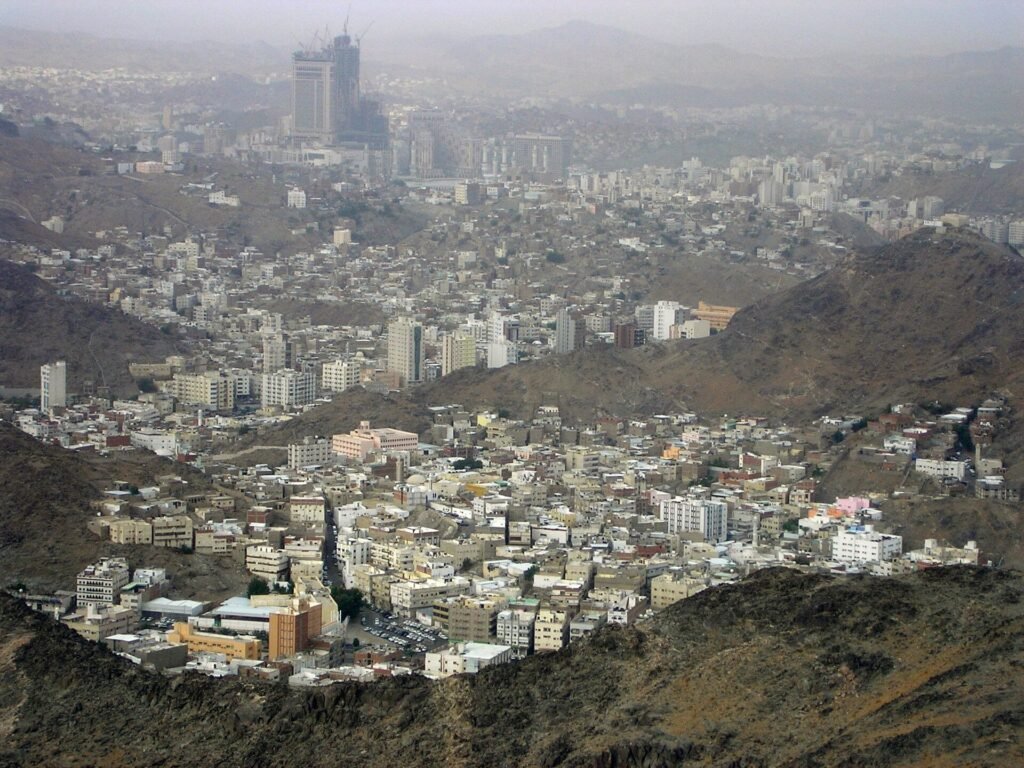
The name Jabal al-Noor means “Mountain of Light”, a reference to the light of revelation that began here.
What Does Ghar-e-Hira Look Like Inside?
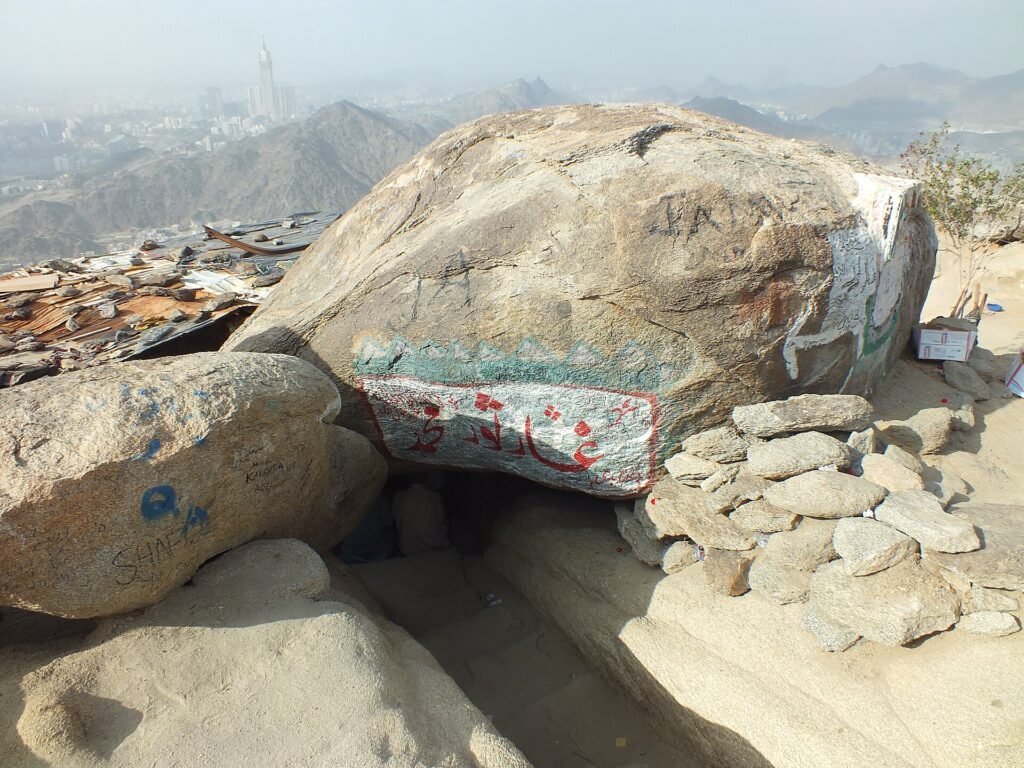
Ghar-e-Hira is smaller than most visitors expect. It is a narrow gap formed by large slabs of rock leaning against each other, open at the front and with a small opening at the far end.
A grown adult can stand in it, and only a handful of people fit at once. To reach it from the summit, you walk down a short, steep section and squeeze through a tight passage between boulders.
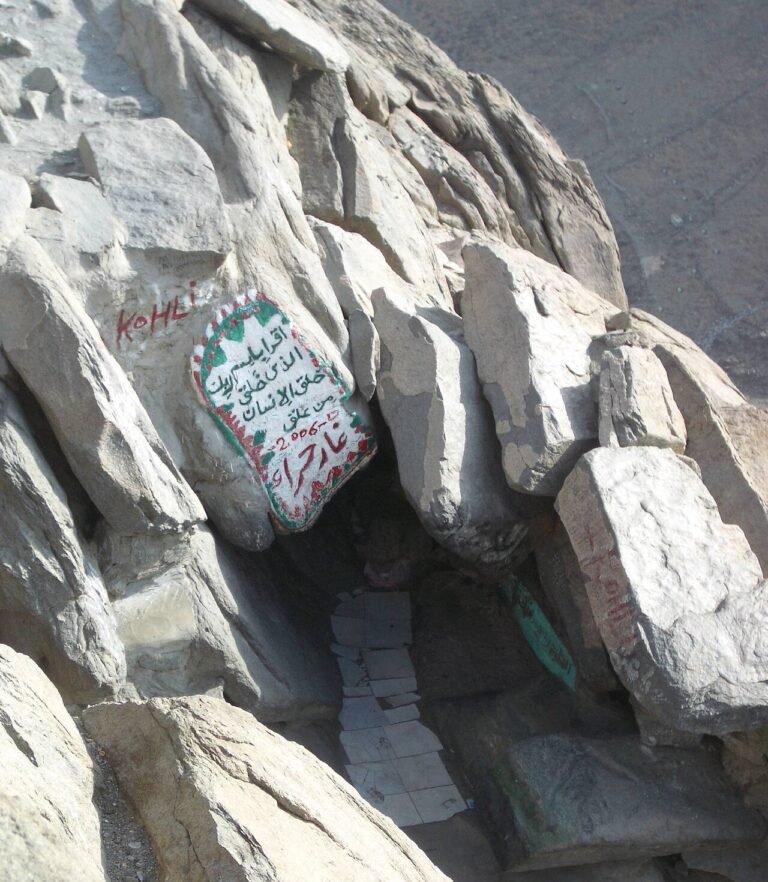
Many accounts note that the cave’s opening is aligned toward the Kaaba. In the Prophet’s time, before tall buildings, the House of Allah could be seen from this spot. The cave is also noticeably cooler than the path outside.
Why Did Prophet Muhammad ﷺ Go to Ghar-e-Hira?
Before prophethood, Muhammad ﷺ was known in Makkah as al-Amin, the trustworthy. He took no part in idol worship and was troubled by the injustice around him.
Sayyidah Aisha (RA) narrates that the first sign of revelation was true dreams, which came true “like the break of dawn”. After that, seclusion became dear to him. He would go to the cave of Hira and devote himself to worship for a number of nights, then return to Sayyidah Khadijah (RA) for provisions and go back again (Sahih al-Bukhari 3).
This practice of withdrawing for worship is called tahannuth. Early seerah writers, including Ibn Ishaq, add that he spent the month of Ramadan there each year. The cave suited the purpose: it was quiet, hard to reach and faced the Kaaba.
The First Revelation in Ghar-e-Hira
The most authentic account comes from Sayyidah Aisha (RA) in Sahih al-Bukhari (hadith 3) and Sahih Muslim (hadith 160). In summary:
- The angel appeared while the Prophet ﷺ was in the cave and said, “Read.” He replied that he was not one who could read.
- The angel embraced him firmly until he could bear it no more, released him, and repeated the command. This happened three times.
- The first verses were revealed. After the third embrace the angel recited the opening of Surah al-Alaq: a command to read in the name of the Lord who created, who created man from a clinging clot, the Most Generous, who taught by the pen and taught man what he did not know (Quran 96:1-5).
- He returned home trembling and said to Khadijah (RA), “Cover me, cover me.” When the fear passed, he told her what had happened.
- Khadijah (RA) comforted him. She said Allah would never disgrace him, because he kept ties of kinship, carried the burdens of the weak, helped the poor, honoured guests and stood by those in hardship.
- She took him to Waraqah ibn Nawfal, her elderly cousin who knew the earlier scriptures. He said this was the same angel who had come to Musa (AS), and warned that his people would one day drive him out.
The first word revealed was Iqra, “Read”. The message of Islam began with a call to knowledge.
When did the first revelation happen?
Three points are well established. The Quran says its revelation began in the month of Ramadan (2:185), on Laylat al-Qadr (97:1), and the Prophet ﷺ was about 40 years old. Historians place it around 610 CE.
The exact night is not confirmed by any authentic text, and scholars hold different views. Safiur-Rahman Mubarakpuri, in his well-known seerah, calculated Monday 21 Ramadan, which he matched to 10 August 610. Other writers give the 17th or another odd night of the last ten. Any article that states one date as certain is going beyond the evidence.
What happened after the first revelation?
Revelation then paused for a time. Scholars differ on how long this pause lasted.
Jabir ibn Abdullah (RA) narrates that the Prophet ﷺ was walking when he heard a voice from the sky. He looked up and saw the same angel who had come to him at Hira, seated between the sky and the earth. He went home and asked to be wrapped up, and Allah revealed the opening verses of Surah al-Muddaththir, commanding him to arise and warn (Sahih al-Bukhari 4). After this, revelation came regularly.
Mount Hira in another hadith
The mountain appears again later in the Prophet’s life. Abu Hurairah (RA) narrates that the Prophet ﷺ was on Hira with Abu Bakr, Umar, Uthman, Ali, Talhah and Zubair (RA) when the rock moved. He said, “Be still, for there is none upon you but a Prophet, a Siddiq or a martyr” (Sahih Muslim 2417).
Is Visiting Ghar-e-Hira Part of Umrah?
No. Climbing Jabal al-Noor is not a rite of Umrah or Hajj. Your Umrah is complete without it, and no specific prayer or reward for visiting the cave is reported in authentic hadith.
Scholars differ on how the visit should be viewed:
- Saudi fatwa bodies and scholars such as Shaykh Ibn Uthaymeen hold that the visit is not Sunnah. They permit going to see the place and learn its history, and they object to treating the climb itself as an act of worship.
- Many scholars in the Subcontinent regard visiting places linked to the Prophet’s life as a source of love, reflection and reminder, while agreeing it is not obligatory.
If you are unsure, ask a scholar you trust before you travel. What every view agrees on is conduct at the site: do not rub or kiss the rocks, do not write on them, and do not push others to reach the cave.
How to Visit Ghar-e-Hira: Practical Guide
Getting there from the Haram
Jabal al-Noor is about 4 km from Masjid al-Haram. Take a taxi or a ride-hailing app and ask for “Jabal al-Noor” or “Hira Cultural District”. One 2025 traveller account put the taxi fare at about SAR 25 one way in normal season. Expect more during Ramadan and Hajj season, and agree the fare before you get in.
Many group ziyarat tours stop at the foot of the mountain only briefly. If you want to climb, arrange your own transport and ask the driver to wait or return at a fixed time.
The Hira Cultural District at the base
The foot of the mountain has changed completely in recent years. The Hira Cultural District, inaugurated in January 2023 on about 67,000 square metres, is now the starting point for the climb. The official site reports more than four million visitors from 132 countries.
| Facility | Details |
|---|---|
| Path to the Cave of Hira | Free. Open 24 hours. Visitor centre along the route |
| Revelation Exhibition | Interactive halls on the story of revelation and the prophets. Tickets listed at SAR 25 to 30 |
| Holy Quran Museum | Rare Quranic manuscripts and artefacts from different Islamic eras. Tickets listed at SAR 25 to 30 |
| Museum hours | Saturday to Wednesday 7:30 am to 11:30 pm. Thursday 7:30 am to 1:00 am. Friday 3:30 pm to 1:00 am |
| Other services | Cafés, shops, prayer areas, family spaces |
Hours and prices were checked in November 2026 and can change, especially in Ramadan. Confirm on the Hira Cultural District website before you go.
A cable car to make the ascent easier has been discussed for some time. It was not operating at the time of writing, so do not plan your visit around it.
The climb
The route begins as a paved path of about 1 km from the district, then becomes steep stone steps cut into the mountain. Counts of the steps range from about 1,200 to 1,750.
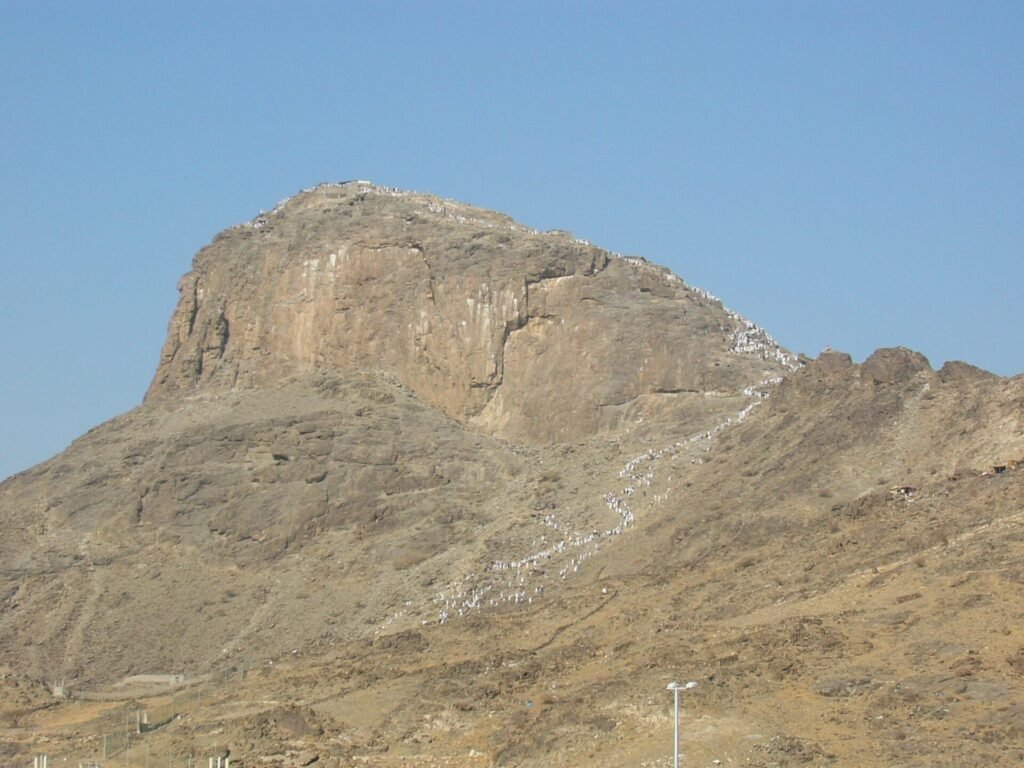
- Time up: 45 minutes to 2 hours, depending on fitness, heat and crowds.
- Time down: 30 to 45 minutes.
- Total visit: allow 2 to 3 hours, plus travel.
- Gradient: moderate at first, very steep near the top.
- On the way: rest points and small stalls selling water and tea. There is little shade.
- At the top: a short descent on the far side and a narrow squeeze between rocks to reach the cave. Expect a queue.
Best time to go
The best time is straight after Fajr. The air is cool, the crowd is thin, and you are down before the sun is strong. Late afternoon after Asr is the second choice, but you will descend in the dark, so carry a torch.
Avoid the hours between 10 am and 4 pm. From June to September, go only in the very early morning. November to February is the most comfortable season, which suits the winter Umrah trips many Pakistani families prefer.
What to carry
- At least one litre of water per person
- Shoes with good grip. Avoid loose sandals and slippers
- A phone torch for early morning or evening
- A small backpack, so both hands are free for the railings
- Light snacks, and small change if you wish to buy from stalls
- A cap or scarf for the sun on the way down
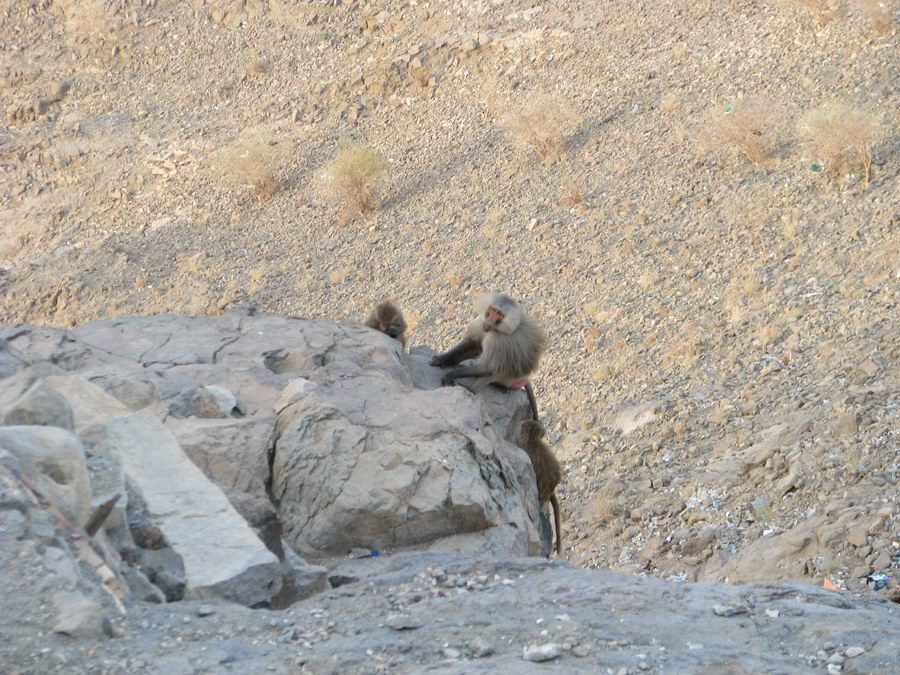
Keep bags zipped and food out of sight near the summit. The monkeys there are used to people and will grab loose items. Do not chase them.
Who should not climb
Be honest about your health. The climb is hard on the heart, lungs and knees. People with heart disease, breathing problems, uncontrolled blood pressure, knee or hip pain, and anyone recovering from illness should not attempt it. Very young children and frail elderly relatives are also better kept at the base.
They do not have to miss out. The Revelation Exhibition and Quran Museum at the foot of the mountain tell the same story in comfort, and the mountain itself is clearly visible from the plaza.
One more caution: do not climb before you have completed your Umrah. Arriving for tawaf and sa’i with exhausted legs is a common regret.
Etiquette at the cave
- Keep your visit inside the cave short so that others get a turn.
- Speak quietly. Many people come here to reflect.
- Take your litter back down with you.
- Let women, elderly visitors and children pass on narrow sections.
- Spend your time at the top in dua and in remembering what began here.
Ghar-e-Hira and Ghar-e-Sor: What Is the Difference?
Pilgrims often confuse the two caves. Both are near Makkah and both are tied to the Prophet’s life, but to different events.
| Ghar-e-Hira | Ghar-e-Sor (Cave of Thawr) | |
|---|---|---|
| Mountain | Jabal al-Noor | Jabal Thawr |
| Direction from the Haram | North-east | South |
| Event | First revelation of the Quran | The Prophet ﷺ and Abu Bakr (RA) took shelter here for three nights during the Hijrah |
| Quran reference | Surah al-Alaq 96:1-5 | Surah at-Tawbah 9:40 |
| Climb | Hard | Longer and harder |
Planning Ghar-e-Hira Into Your Umrah Trip
How easily the climb fits depends on how many days you have in Makkah.
On a 7-day Umrah package, time in Makkah is short. Complete your Umrah first, rest for a day, and keep one early morning free for Jabal al-Noor. Skip the climb if it would leave you too tired for prayers in the Haram.
A 15-day Umrah package or longer gives you more room. You can visit the exhibition one evening, climb on a separate morning, and still have rest days.
Where you stay matters too. Hotels on the north-eastern side of the Haram are closer to the mountain. Our guide to the best area to stay in Makkah compares the main hotel zones.
Ghar-e-Hira is usually combined with other ziyarat on the same side of the city, such as Jannat al-Mualla, Mina, Muzdalifah and Arafat. For the full list, see our guide to places to visit in Makkah and Madinah during Umrah. In Madinah, the mountain most pilgrims visit is covered in our article on Jabal-e-Uhud and the Battle of Uhud.
Frequently Asked Questions
What is the height of Ghar-e-Hira in feet?
Jabal al-Noor rises to about 2,080 to 2,106 feet (634 to 642 m) above sea level. The cave is just below the summit. The actual ascent on foot from the starting point is roughly 200 to 270 m.
How far is Ghar-e-Hira from Makkah?
It is inside the modern city, about 4 km north-east of Masjid al-Haram. The drive takes 15 to 25 minutes.
Is there a ticket for Ghar-e-Hira?
No. The path and the cave are free, and no permit is needed. Only the museums in the Hira Cultural District charge for entry.
Can women and children climb Jabal al-Noor?
Yes. Families climb together every day. Children should be old enough to manage steep steps and must be kept close near the top.
Can I pray inside Ghar-e-Hira?
Space is very limited and there is usually a queue. No particular prayer is prescribed for the cave. Many visitors make dua and move on so others can enter.
How many days did the Prophet ﷺ stay in Ghar-e-Hira?
He did not live there continuously. The hadith of Aisha (RA) says he would stay for a number of nights, return home for provisions, and go back. Seerah sources add that he spent Ramadan there each year before prophethood.
A Small Cave With the Greatest Beginning
Ghar-e-Hira has no dome, no courtyard and no decoration. It is a gap between rocks on a bare mountain. What draws people up 1,200 or more steps is what began there: the first word of the Quran and the start of the Prophet’s mission.
If your health allows, the climb is a memorable part of an Umrah journey. If it does not, the story is just as close at the foot of the mountain.
Uniworld Travel & Tours arranges Umrah packages from Pakistan with time for Makkah ziyarat built in. Tell our team that you want to visit Ghar-e-Hira and we will plan your days in Makkah around it.
Featured image: Photo: Richard Mortel, CC BY 2.0, via Wikimedia Commons.