It was a Monday in Makkah, in the month of Rabi al-Awwal.
In a modest house in a narrow valley east of the Kaaba, a young widow named Aminah bint Wahb gave birth to a son. His father, Abdullah, had died months earlier, before he could ever hold him. Earlier that same year, Abraha’s army and its elephant had marched on the Kaaba and been destroyed, an event Allah describes in Surah al-Fil.
Ibn Ishaq, the earliest biographer of the Prophet ﷺ, records that Aminah sent word to the child’s grandfather, Abdul Muttalib. The old chief of Makkah came, lifted the baby, and carried him into the Kaaba, where he stood and thanked Allah for the gift.
That child was Muhammad ﷺ.
Fourteen and a half centuries later, pilgrims from Karachi, Lahore and every corner of the world walk out of Masjid al-Haram and look for the birthplace of Prophet Muhammad ﷺ. What they find is a quiet, two-storey building standing alone on a wide stone plaza. This is its story, and how you can see it on your own Umrah.
The birthplace of Prophet Muhammad ﷺ at a glance
- Where: Shi’b Bani Hashim, just east of Masjid al-Haram in Makkah
- What stands there now: the Makkah Al Mukarramah Library, also called Bayt al-Mawlid (the House of the Birth)
- Can you go in? No. The building is closed; you can see it from outside.
- How sure are we? Makkah’s historians have identified this house for more than 1,100 years. That is a strong tradition, but the exact spot of birth inside the house can no longer be known.
Where was Prophet Muhammad ﷺ born?
He ﷺ was born in Makkah, in Shi’b Bani Hashim, the narrow valley where his clan lived, below the slopes of Jabal Abu Qubays. In later centuries the neighbourhood was called Suq al-Layl, and the lane outside the house became known as Zuqaq al-Mawlid, the Lane of the Birthplace.
The house had belonged to his father. Today, the Makkah Al Mukarramah Library stands over the place Makkah has always pointed to as the birthplace of Prophet Muhammad ﷺ.
From the Hadith
When the Prophet ﷺ was asked about fasting on Mondays, he replied that it was the day he was born and the day revelation came to him. (Sahih Muslim 1162)
This is the only detail of his birth that he ﷺ confirmed himself: the day. It is also the one Sunnah connected to his birth, fasting on Mondays.
How do we know this was the house?
No plaque survived from the 6th century, and no one drew a map. What survives is something Makkah valued just as highly: its own memory, written down by its own historians.
In the 3rd century AH, al-Azraqi, a Makkan whose family had lived in the city for generations, wrote the oldest history of the city that survives, Akhbar Makkah. He names this house and traces its owners. Over the next 600 years, Makkah’s later historians, from al-Fakihi to al-Fasi, repeat the same identification. They also record the few rival opinions (a house near Safa, a place called al-Radm, even Usfan on the road to Madinah) and set them aside as weak.
An authentic hadith fits this account. When the Prophet ﷺ returned to Makkah years later, he was asked whether he would stay in his old house. He answered: “Has Aqil left any property or house?” His cousin Aqil had taken over the family’s homes after the Hijrah and sold them (Sahih al-Bukhari 1588).
Honest note: Because of this unbroken local tradition, scholars call the library the traditionally identified birthplace. It is the best answer history can give, but it is not something revealed in the Quran or Sunnah, and the exact room where he ﷺ was born cannot be pinpointed today.
His first years in Shi’b Bani Hashim
The birthplace of Prophet Muhammad ﷺ was only the beginning of his story in this valley. As was the custom of Makkah’s leading families, Abdul Muttalib looked for a wet nurse from the desert tribes, and the child was entrusted to Halimah of Banu Sa’d, who raised him in the clean air of the open desert.
He returned to his mother when he was about four or five. Around the age of six, Aminah took him to Yathrib (Madinah) to visit his father’s relatives. On the way home she fell ill and died at al-Abwa. The orphaned boy came back to the valley and into the care of his grandfather, Abdul Muttalib. After his grandfather’s death, when he was about eight, he moved into the home of his uncle Abu Talib, in the same quarter.
So the lanes around the house were not just where he was born. They were where he grew up, where his clan protected him in the early years of Islam, and where Banu Hashim endured the boycott. That is why this small plot matters so much to Muslims, whatever stands on it today.
Stories about his birth: what is authentic?
Many of us grew up hearing beautiful stories about the night he ﷺ was born. It helps to know how strong each one is.
- Authentic: he ﷺ was born on a Monday (Sahih Muslim 1162), in Makkah, into Banu Hashim of Quraysh.
- Reported in the Seerah: Aminah’s account of a light that lit up the palaces of Busra in Syria, and Abdul Muttalib carrying the newborn into the Kaaba. Ibn Ishaq records these, and scholars grade the chains of such reports differently.
- Weak or unsupported: later stories that Kisra’s palace shook, the sacred fire of Persia went out, or idols fell on the night of his birth. Many hadith scholars have judged these weak, so careful writers mention them, if at all, with that warning.
None of this lessens the event. The Quran says it plainly: Allah sent him as “a mercy to the worlds” (Quran 21:107).
Fourteen centuries in one small plot
Few pieces of land have changed hands, and shapes, as often as the birthplace of Prophet Muhammad ﷺ.
The family home (6th–7th century). The Prophet ﷺ grew up in this valley. Years later, during the boycott of Banu Hashim, his family endured three hard years in the same valley. After the Hijrah, Aqil ibn Abi Talib took over the house.
A governor’s mansion (Umayyad era). Aqil’s heir sold the house to Muhammad ibn Yusuf, brother of the Umayyad governor al-Hajjaj, who folded it into his large mansion. For a time, Makkans simply called it Dar Ibn Yusuf.
A small mosque (late 2nd century AH). Al-Khayzuran, mother of Caliph Harun al-Rashid, came on pilgrimage, separated the birth room from the mansion and turned it into a mosque. For roughly the next eleven centuries it stayed a place of prayer and remembrance. In 1183 CE the Andalusian traveller Ibn Jubayr found it opened to visitors on Mondays in Rabi al-Awwal. Under the Ottomans it gained a dome.
Demolished, then rebuilt as a library (20th century). The domed mosque was taken down in the 1920s, after Makkah came under King Abdulaziz ibn Saud. In 1370 AH (1951), Makkah’s mayor, Sheikh Abbas Qattan, received royal approval to build a public library on the site, funded by a woman of his family, Fatimah bint Yusuf Qattan. The court deed made it a waqf (endowment) for all Muslims: never to be sold, rented or used for any other purpose.
Today. The library once held manuscripts and the private book collections of Makkah’s scholars. As the Haram expanded, every house around it was cleared away. It now stands alone on open paving, its doors closed, the last link to the old Banu Hashim quarter.
Birthplace of Prophet Muhammad ﷺ: myths vs facts
Much of what’s online about the birthplace of Prophet Muhammad ﷺ is wrong. Here is what holds up.
- Myth: The library is open daily for visitors. Fact: Recent reports describe it as closed to the public. You can see it only from outside.
- Myth: The “Monday” hadith is in Sahih al-Bukhari. Fact: It is in Sahih Muslim (1162).
- Myth: We know the exact spot where he ﷺ was born. Fact: History identifies the house; the spot inside it has been lost to centuries of rebuilding.
- Myth: Everyone agrees he ﷺ was born on 12 Rabi al-Awwal. Fact: The 12th is the best-known date, but scholars also hold the 8th and 9th. The astronomer Mahmud Pasha calculated 9 Rabi al-Awwal, 20 April 571 CE.
- Myth: There is a special prayer or du’a to read at the birthplace. Fact: No authentic narration prescribes one.
- Myth: The original house is still standing. Fact: It became a mosque, was rebuilt several times, was demolished, and is now under the library.
How to find the birthplace of Prophet Muhammad ﷺ from Masjid al-Haram
The birthplace of Prophet Muhammad ﷺ is close enough to fit between two prayers, and you don’t need a taxi.
- Head to the Mas’a side. After your prayer, make your way to the Safa–Marwah gallery on the eastern side of the Haram.
- Exit through the eastern gates. Use the gates around Bab as-Salam, towards the Marwah end, and step out onto the open eastern plaza.
- Look for the lone building. The library is a low, pale building with a small dome, standing by itself with the royal palace on Jabal Abu Qubays rising behind it. It is the only older building in view.
- Walk across the plaza. One recent visitor guide puts the walk at about ten minutes from the eastern gates. If you’re unsure, search “Makkah Al Mukarramah Library” in Google Maps.
- Stay a few minutes, then move on. Take in the building and the view back towards the Haram, and let others step in.
Family tip: the open plaza is easy to get separated on. The library itself makes a simple, unmistakable meeting point.
Best time: after Fajr or in the late afternoon. Midday heat on the stone plaza can be punishing for most of the year. Expect big crowds around 12 Rabi al-Awwal, when police keep people moving.
Visiting with the right intention
Standing at the birthplace of Prophet Muhammad ﷺ can move even the most seasoned pilgrim. Let that feeling lead you to the right actions:
- Don’t pray towards or at the building. No act of worship is prescribed for this site, and visitor reports describe signs asking people not to pray there.
- Do send salawat on the Prophet ﷺ. It is encouraged everywhere, and many find this a fitting moment.
- Reflect on his life. An orphan born in a small house became the Mercy to the Worlds. That lesson needs no ritual.
- Take the Sunnah home. The one practice he ﷺ tied to his birth is fasting on Mondays.
Scholars have long differed on visiting such historic places. Some early Makkan writers encouraged it, and others held that it was never part of the Sunnah. Saudi practice follows the second view. Either way, a respectful look and a quiet reflection are welcome; rituals are not.
Did you know? The house of Khadijah (RA), where the Prophet ﷺ lived for years after his marriage, lay only a short distance away, in the area now under the plaza towards Marwah. Jannat al-Mu’alla, where she is buried, is to the north.
Make it part of your Makkah Ziyarat
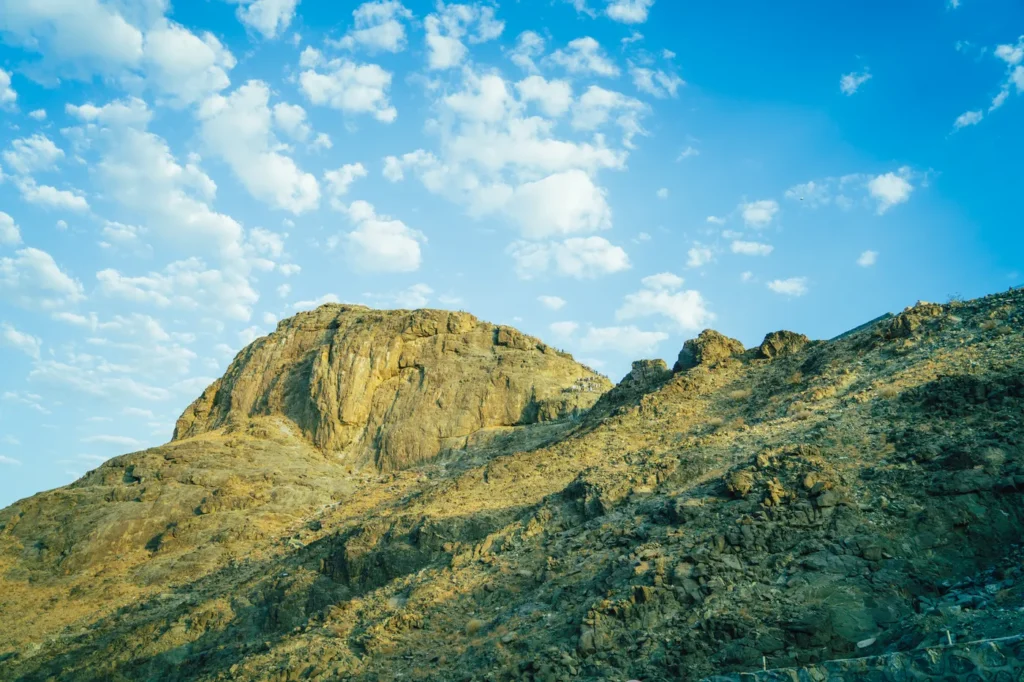
The birthplace of Prophet Muhammad ﷺ pairs naturally with the other places of the Prophet’s ﷺ Makkan life: Jabal al-Noor and the Cave of Hira, Jabal Thawr, and Jannat al-Mu’alla. Our guide to the top places to visit in Makkah and Madinah during Umrah maps them into a simple route. For more of the Haram’s history, read the story of Hajar al-Aswad, the Black Stone.
Visiting in Rabi al-Awwal: what Pakistani pilgrims should know
Many families from Pakistan hope to be in Makkah during Rabi al-Awwal, the month of the Prophet’s ﷺ birth. It is a deeply moving time to visit, but it pays to plan for it.
- Expect crowds near the 12th. The eastern plaza around the birthplace of Prophet Muhammad ﷺ gets busy, and police keep visitors moving. Choose another day if you want a quiet moment.
- Book your hotel early if your dates fall around the 12th, when the area east of the Haram is at its busiest.
- Keep the Sunnah at the centre. Fast on Monday, send abundant salawat, and give your best hours to the Haram itself. Nothing is organised at the library site, so there is no event to plan around.
Planning your Umrah from Pakistan
Many pilgrims fly home wishing they’d had one more unhurried morning in Makkah. If places like the birthplace of Prophet Muhammad ﷺ matter to you, plan for that time:
- Stay on the eastern side. It puts the birthplace, Marwah and Jannat al-Mu’alla within walking distance. Compare areas in our guide to the best areas to stay in Makkah for Umrah.
- Give yourself enough days. Most first-time families find the 15 Days Umrah Package leaves room for worship and Ziyarat. If you want long, quiet stretches in Makkah, the 21-day Umrah package is a better fit.
Browse all Uniworld Umrah packages from Pakistan. Each includes the visa, flights, hotels and transport, so you can focus on the journey itself.
Frequently Asked Questions
Where was Prophet Muhammad ﷺ born?
In Makkah, in his father’s house in Shi’b Bani Hashim, just east of the Kaaba. The Makkah Al Mukarramah Library now marks the birthplace of Prophet Muhammad ﷺ.
Is the Makkah Library the exact birthplace of Prophet Muhammad ﷺ?
It stands on the house that Makkan historians have identified since at least the 3rd century AH. The precise spot inside that house can no longer be identified.
Can I go inside the library?
No. The library over the birthplace of Prophet Muhammad ﷺ is reported closed to the public, and visitors see it only from outside.
On what date was the Prophet ﷺ born?
On a Monday in Rabi al-Awwal, in the Year of the Elephant (about 570–571 CE). The 12th is the best-known date; the 8th and 9th are also held by scholars.
Is there a special du’a for the birthplace of Prophet Muhammad ﷺ?
No authentic narration prescribes one. Send salawat on the Prophet ﷺ, and fast on Mondays, the Sunnah he linked to his birth.
How far is it from Masjid al-Haram?
The birthplace of Prophet Muhammad ﷺ is just beyond the Haram’s eastern gates, across the open plaza. Visitor guides describe it as a walk of about ten minutes.
Why was the birthplace of Prophet Muhammad ﷺ turned into a library?
After the domed mosque was removed in the 1920s, Makkah’s mayor, Sheikh Abbas Qattan, sought permission to protect the site with a building of public benefit. A library, endowed as a waqf for all Muslims, preserved the birthplace of Prophet Muhammad ﷺ from being built over while avoiding a shrine.
Can women visit the birthplace of Prophet Muhammad ﷺ?
Yes. Men and women can both see the building from the open plaza on the Haram’s eastern side, following the same dress and crowd rules as the rest of the Haram.
References for this guide to the birthplace of Prophet Muhammad ﷺ: Sahih Muslim 1162; Sahih al-Bukhari 1588; Ibn Ishaq, Sirat Rasul Allah; al-Azraqi, Akhbar Makkah; al-Fasi, Shifa’ al-Gharam; the 1951 Al-Bilad report and court records published by Okaz.