A Pakistani pilgrim’s honest guide to picking the right ten days of Ramadan balancing reward, crowds, cost and comfort.
| Quick answer
There is no single best Ashra for Umrah all three are blessed, and Umrah in any part of Ramadan carries the reward of a Hajj performed alongside the Prophet ﷺ. The right choice depends on you: • First Ashra (Days 1–10, Mercy): smoother start, moderate crowds ideal for first-timers and families. • Second Ashra (Days 11–20, Forgiveness): the calmest and most affordable window ideal for budget-conscious, focused worship. • Third Ashra (Days 21–30, Salvation): contains Laylatul Qadr and I’tikaf highest reward, but the most crowded and expensive. |
Every year, thousands of Pakistani pilgrims plan their Ramadan Umrah and hit the same wall: which part of the month should I go? Ramadan is divided into three Ashras the Arabic word ‘ashrah simply means ten and each ten-day block carries its own spiritual character, its own crowd pattern, and its own price tag. Choosing between them is not only a religious decision; it is a travel-planning decision too.
This guide breaks the choice down honestly across three lenses that actually matter to a family flying from Karachi, Lahore or Islamabad: spiritual reward, crowds and comfort, and cost. If you are still deciding between Ramadan and a normal off-season trip in the first place, start with our comparison of Ramadan Umrah vs Regular Umrah, then come back here to fine-tune the exact dates.
What Are the Three Ashras of Ramadan?
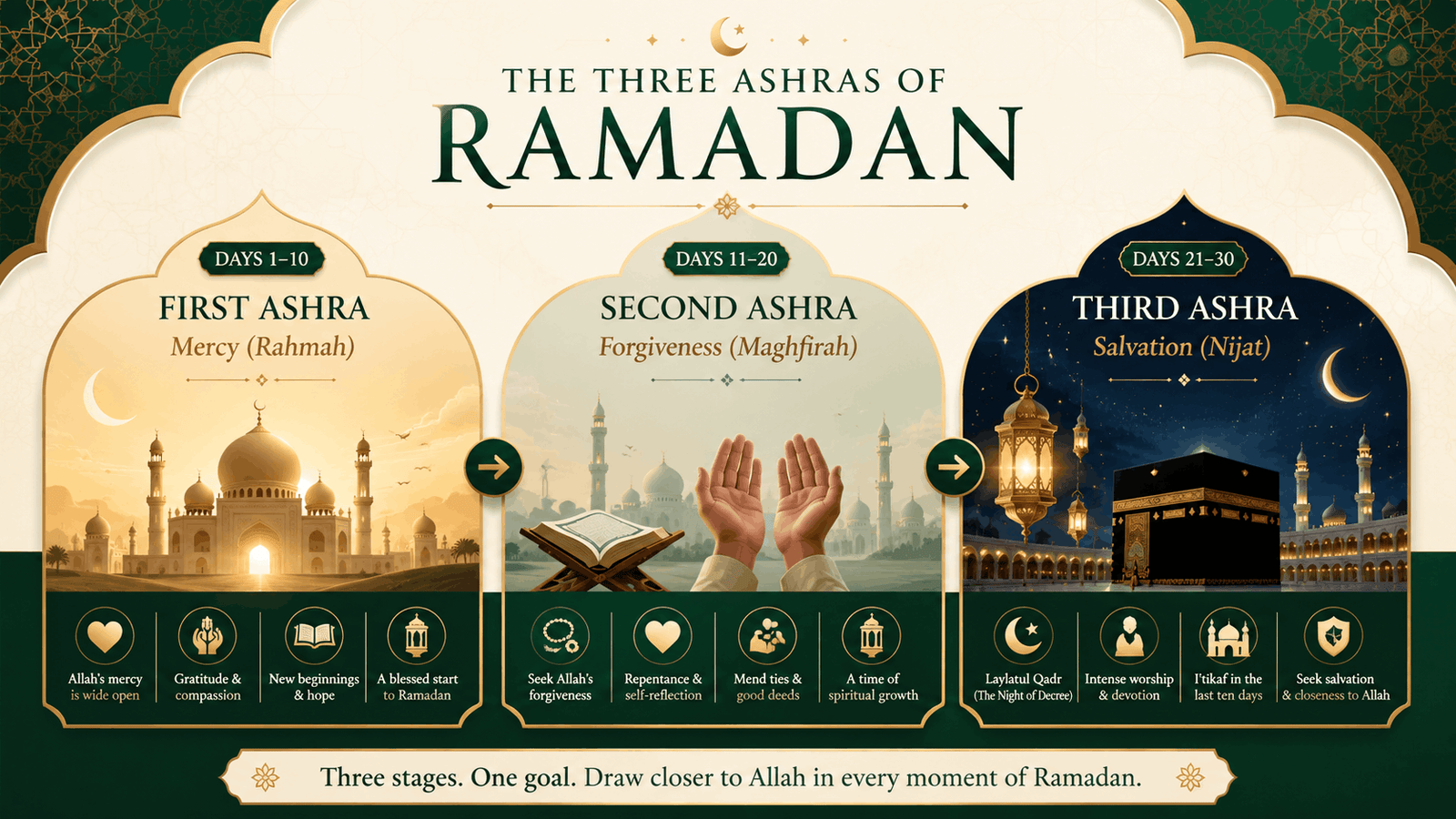
The division comes from a well-known narration in which the Prophet Muhammad ﷺ described Ramadan as a month “whose beginning is mercy, whose middle is forgiveness, and whose end is emancipation from the Fire.” Scholars have long used this to map the month into three spiritual stages:
- First Ashra Days 1 to 10 Rahmah (Mercy). The doors of Allah’s mercy are wide open; pilgrims focus on gratitude and compassion.
- Second Ashra Days 11 to 20 Maghfirah (Forgiveness). A window for sincere repentance (istighfar) and mending relationships.
- Third Ashra Days 21 to 29/30 Nijat (Salvation). The most intense stretch, containing Laylatul Qadr the Night of Decree, described in the Qur’an as better than a thousand months and the practice of I’tikaf.
| Ramadan 2026 dates (plan around these)
Ramadan 1447 AH is expected to begin around 18 February 2026 and end around 19 March 2026, with Eid-ul-Fitr on or about 20 March 2026 (subject to the moon sighting in Saudi Arabia). First Ashra: ~18–27 Feb | Second Ashra: ~28 Feb–9 Mar | Third Ashra: ~10–19 Mar Laylatul Qadr is most sought on the odd nights of the third Ashra the 21st, 23rd, 25th, 27th and 29th with the 27th night the most anticipated. Always confirm final dates with your travel agent, because a one-day shift changes every hotel booking. |
First Ashra Umrah (Days 1–10): The Days of Mercy
The spiritual case
The opening ten days set the tone for the entire month. The atmosphere in the Haram is one of hope and renewal, and the first Friday and first Taraweeh of Ramadan in Masjid al-Haram are unforgettable. For pilgrims who want to arrive settled and ease into the rhythm of fasting in Makkah before the peak rush, this Ashra is a gentle on-ramp.
Crowds, cost and comfort
- Crowds: Busier than the second Ashra but far lighter than the last ten days.
- Cost: On the higher side. Prices rise the moment Ramadan begins and stay elevated.
- Best suited to: First-time pilgrims, elderly travellers and families with children who benefit from a calmer, less physically demanding start.
If this is your first pilgrimage, pair this section with our step-by-step walkthrough on how to perform Umrah step by step so the rituals are second nature before you land.
Second Ashra Umrah (Days 11–20): The Days of Forgiveness
The spiritual case
The middle Ashra is the quiet heart of Ramadan a stretch dedicated to istighfar, self-accounting and repentance. Ironically, it is also the most overlooked by travellers, which is exactly what makes it special. With smaller crowds, you can complete Tawaf and Sa’i with more space, pray closer to the Kaaba, and find room in the Haram that simply does not exist in the final ten days.
Crowds, cost and comfort
- Crowds: The lowest of the entire month the sweet spot for a peaceful Umrah.
- Cost: Typically the most affordable Ramadan window; flights and hotels dip before the end-of-month surge.
- Best suited to: Budget-conscious pilgrims, those who value calm and focused worship, and anyone who struggles in dense crowds.
| Insider tip
Many pilgrims book a longer package that begins in the second Ashra and rolls straight into the third you enter during the calm, affordable window and are already in Makkah when Laylatul Qadr arrives, avoiding the last-minute price spike. Our 28-day Umrah package is built for exactly this kind of stay-through-the-peak plan. |
Third Ashra Umrah (Days 21–30): The Days of Salvation
The spiritual case
The final ten days are, for most scholars, the most rewarding of the year. They contain Laylatul Qadr a single night of worship greater than a thousand months and this is when the Prophet ﷺ intensified his own devotion and performed I’tikaf, secluding himself in the mosque. Performing Umrah and spending these nights in the Haram of Makkah is, for many, the pinnacle of a lifetime.
Crowds, cost and comfort
- Crowds: The highest of the year. The Haram fills hours before Maghrib, and the odd nights are shoulder-to-shoulder.
- Cost: Peak pricing. Flights, visas-in-season and especially hotels near the Haram reach their most expensive.
- Best suited to: Reward-focused pilgrims in good physical health who are ready for intensity and have booked well in advance.
Because rooms near the Haram sell out months ahead for these dates, timing your reservation is critical read our guide on the best time to book hotels in Makkah before you commit. Travelling in a group also eases the crowd pressure and the cost; our Umrah group package is a popular choice for the last ten nights.
First vs Second vs Third Ashra: Side-by-Side Comparison

Here is the whole decision on one screen. Use it to match the Ashra to your priorities rather than chasing a mythical “best” one.
| Factor | First Ashra (Days 1–10) | Second Ashra (Days 11–20) | Third Ashra (Days 21–30) |
| Theme | Mercy (Rahmah) | Forgiveness (Maghfirah) | Salvation (Nijat) |
| Laylatul Qadr | No | No | Yes odd nights |
| Crowd level | Moderate | Lowest of the month | Highest (peak) |
| Typical cost | High | Lowest in Ramadan | Highest in Ramadan |
| Hotel availability | Good | Best | Very limited |
| I’tikaf possible | No | No | Yes |
| Best for | First-timers, families | Budget & calm worship | Maximum reward seekers |
How to Choose the Right Ashra for You
Instead of asking which Ashra is best, ask which pilgrim you are. Match yourself to one of these profiles:
- “It’s my first Umrah / I’m travelling with elders or kids.” Choose the first Ashra. A calmer start and moderate crowds make the experience manageable and memorable.
- “I’m on a budget and want peace.” Choose the second Ashra. Lowest costs, smallest crowds, and unmatched space for worship.
- “I want maximum reward and can handle intensity.” Choose the third Ashra and book early. This is where Laylatul Qadr and I’tikaf live.
- “I want the best of all worlds.” Book a longer stay spanning the second and third Ashras, entering during the calm window and staying through the peak nights.
Whichever you choose, prepare spiritually as well as logistically. Refresh the Farz, Wajib, and Sunnah acts of Umrah, keep a list of beautiful duas to recite during your journey ready, and plan a ziyarah of the top places to visit in Makkah and Madinah to round out your journey. For the bigger picture of month-by-month timing across the whole year, our guide to the best time to perform Umrah puts Ramadan in context against Rajab, Shaban and the off-season.
A Note on Budget: Why Ashra Timing Moves the Price
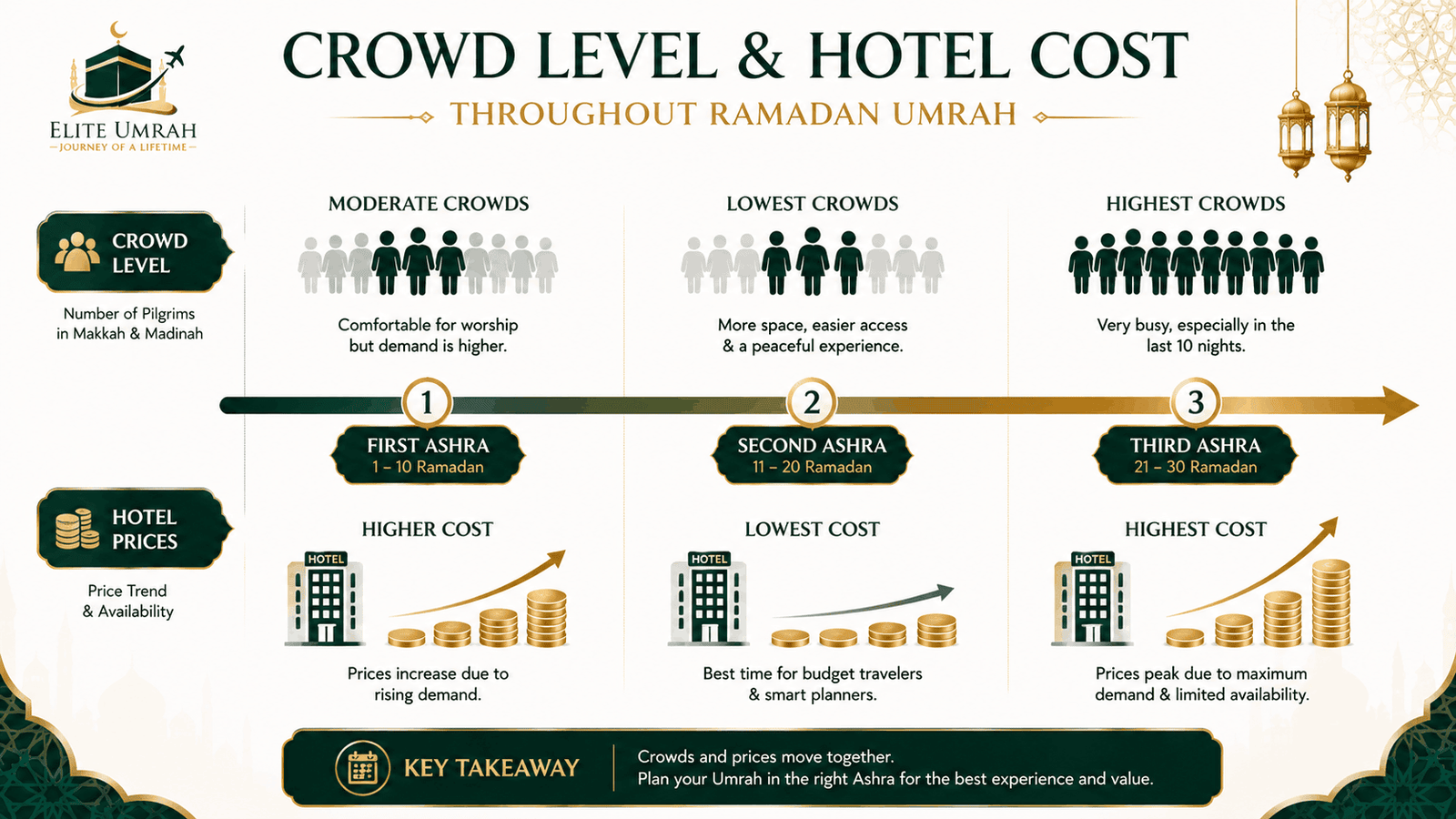
The single biggest cost driver in a Ramadan Umrah is not the visa or the airfare it is the hotel, and hotel rates track the crowd curve almost perfectly. That is why the second Ashra is usually the cheapest and the last ten days the most expensive. If a tight budget is your main constraint, shifting your dates by even a week can save a meaningful amount without changing the reward of your Umrah. For a full breakdown of every line item, see our guide to Umrah cost from Pakistan in 2026.
Frequently Asked Questions
Which Ashra of Ramadan is best for Umrah?
No Ashra is objectively “best” Umrah in any part of Ramadan carries immense reward. The third Ashra is considered the most rewarding because it contains Laylatul Qadr, but it is also the most crowded and expensive. The second Ashra is the calmest and most affordable, and the first suits first-timers and families. The best Ashra is the one that fits your health, budget and goals.
Is Umrah in the third Ashra better than the first or second?
In terms of potential reward, the third Ashra is often ranked highest because of Laylatul Qadr and I’tikaf. But “better” depends on your circumstances. A peaceful, well-performed Umrah in the second Ashra can be more spiritually beneficial for someone who cannot cope with extreme crowds than a rushed, exhausting one in the last ten days.
When is Laylatul Qadr in Ramadan 2026?
Laylatul Qadr falls in the third Ashra, on one of the odd nights the 21st, 23rd, 25th, 27th or 29th of Ramadan. The 27th night is the most widely anticipated. In 2026 this corresponds to roughly mid-March; confirm exact dates with your agent as they depend on the moon sighting.
Which Ashra is cheapest for Umrah?
The second Ashra (days 11–20) is typically the most affordable Ramadan window, because crowds and hotel demand dip before the end-of-month surge. Prices climb sharply for the last ten days.
Can I perform Umrah across two Ashras?
Yes. Many pilgrims book a longer package such as a 21 or 28-day stay that spans the second and third Ashras. You arrive during the calmer, cheaper window and are already settled in Makkah when Laylatul Qadr arrives.
Do the three Ashras change the actual rituals of Umrah?
No. The rites of Umrah Ihram, Tawaf, Sa’i and cutting the hair are identical regardless of the Ashra. What changes is the atmosphere, the crowd level and the cost, not the ritual itself.
Final Word
All three Ashras of Ramadan are gateways to immense reward the mercy of the first, the forgiveness of the second, and the salvation of the third. There is no wrong choice, only the right choice for your family, your health and your budget. Decide which pilgrim you are, book your dates accordingly, and let the rest fall into place.
| Ready to plan your Ramadan Umrah?
Uniworld Travel & Tours arranges Ramadan Umrah for pilgrims across Pakistan, with flexible stays timed to whichever Ashra suits you. Explore our Umrah packages or talk to our Umrah consultants to build a plan around your dates, budget and group size. |