Most families can complete the main Madinah ziyarat in about four hours by car. The ziyarat places in Madinah that pilgrims most want to see fall into two groups: Jabal Uhud, Masjid al-Qiblatain and the Seven Mosques lie 4–5 km north and north-west of Masjid an-Nabawi and work as one loop, while Masjid Quba is a separate 3–3.5 km hop to the south. Jannat al-Baqi is next to the mosque and is best visited on foot after Fajr or Asr rather than squeezed into the car trip.
The route below groups the sites by geography, fits them around the prayer times, and tells you what changes when your group includes a toddler, an elderly parent or a wheelchair. If that sounds like a lot for one outing, the split plan further down covers the same sites across two shorter slots.
Researched: 27 October 2026. Distances and stop allowances are taken from Visit Madinah (the official destination authority) and Saudipedia, linked where they appear. Journey times and costs are planning estimates, not guaranteed figures; confirm local conditions, prayer times and transport quotes on the day.
In This Guide
- Madinah Ziyarat at a Glance
- Is Half a Day Enough?
- Ziyarat Places in Madinah: The Five Sites and Where They Are
- The Half-Day Route, Step by Step
- Which Plan Fits Your Family?
- Getting Around: Ride-Hailing, Private Car, Bus or Organised Ziyarat
- Visiting with Children, Elderly Parents or a Wheelchair
- Jannat al-Baqi and the Rawdah: What Is Separate from the Car Trip
- Best Time of Day and Season
- Common Planning Mistakes
- What to Take
- Planning Madinah Ziyarat with Uniworld
- Frequently Asked Questions
Madinah Ziyarat at a Glance
| Planning question | Practical answer |
|---|---|
| How long does it take? | About 3.5–4.5 hours door to door by car for Uhud, Qiblatain, the Seven Mosques and Quba, including prayer at each mosque; about 2 hours for the northern loop alone |
| What is the best order? | Northern loop first (Uhud → Qiblatain → Seven Mosques), then Quba; or Quba on its own in a second slot |
| Is it part of Umrah? | No. Ziyarat is a voluntary visit to historical sites; the Umrah rites are performed in Makkah |
| Do I need a permit? | Not for these five sites. The Rawdah inside Masjid an-Nabawi needs a Nusuk time slot and is a separate visit |
| Can children come? | Yes to all five sites. Visit Madinah states Baqi is open to men and children; women generally view it from outside |
| Best time of day? | After Fajr and breakfast in cool months; after Asr only for a shorter leg, because the winter Asr-to-Maghrib window is about 2¼ hours |
| Rough cost? | Ride-hailing hops are priced live in the app; a private car with waiting for the half-day was quoted at roughly SAR 150–350 per vehicle on operator listings reviewed on 27 October 2026 |
Is Half a Day Enough?
Yes, for the five sites most pilgrims want. Visit Madinah’s own car itinerary allows 30 minutes at Uhud Martyrs Square, 20 at Masjid al-Qiblatain, 30 at the Seven Mosques and 20 at Masjid Quba (Visit Madinah, 12 hours around Madinah). Those are brisk tourist allowances; a family that prays two rak’ahs at each mosque, finds toilets and regroups will take longer. Add roughly an hour of driving and boarding across the two legs and the programme comes to 3.5–4.5 hours door to door.
What half a day is not enough for is everything. Sites such as Wadi al-Jinn (about 30 km out), the museums and Badr belong to a separate day. Keeping the list short is what makes the outing manageable with children.
Ziyarat Places in Madinah: The Five Sites and Where They Are
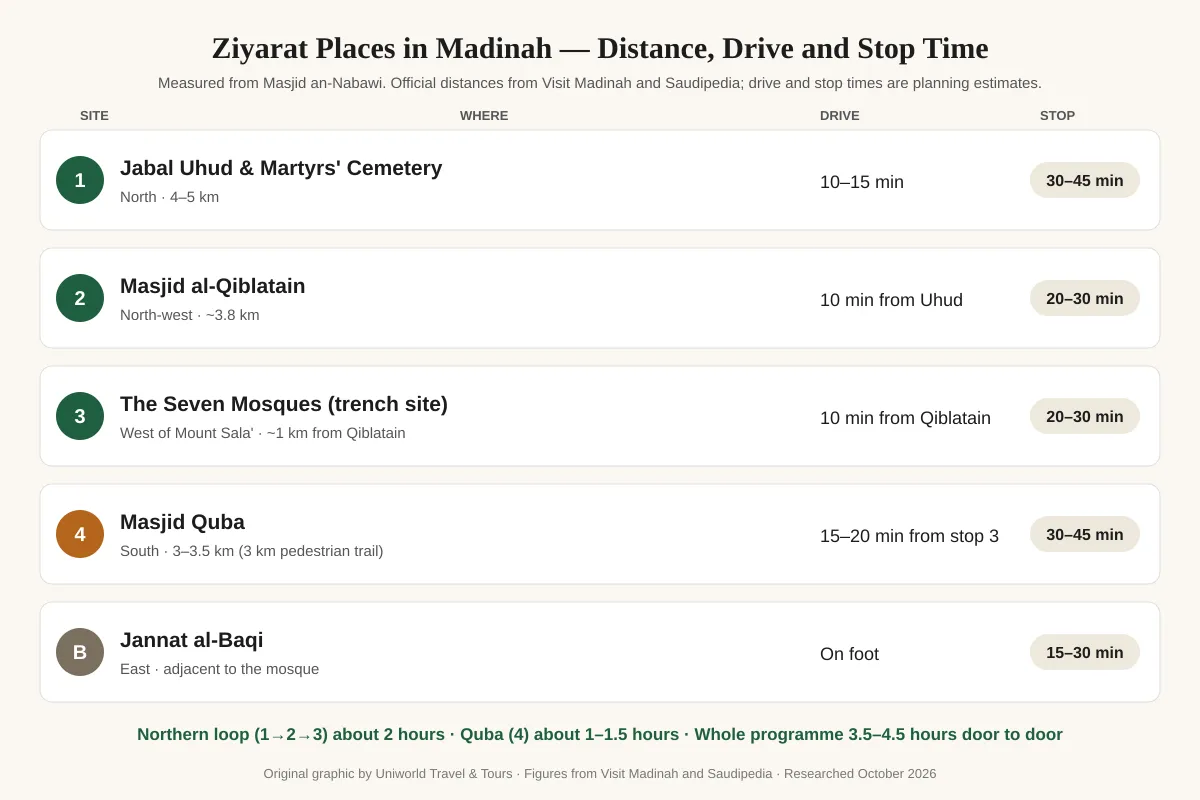
The geography is the whole secret. Three sites cluster to the north and north-west; one is south; one is next to the mosque. Distances are between the mosque area and each site; your hotel’s side of Masjid an-Nabawi adds or saves a few minutes.
| Site | Where (from Masjid an-Nabawi) | Drive | Stop |
|---|---|---|---|
| Jabal Uhud (Mount Uhud) and the Martyrs’ Cemetery | North, 4–5 km | 10–15 min | 30–45 min |
| Masjid al-Qiblatain | North-west, about 3.8 km | 10 min from Uhud | 20–30 min |
| The Seven Mosques (trench site) | West of Mount Sala’, about 1 km from Qiblatain | 10 min from Qiblatain | 20–30 min |
| Masjid Quba | South, 3–3.5 km | 15–20 min from the Seven Mosques | 30–45 min |
| Jannat al-Baqi | East, adjacent | On foot | 15–30 min |
Sources: Visit Madinah gives Mount Uhud as about 4 km north and Uhud Martyrs Square as 5 km north (Mount Uhud, Uhud Martyrs Square); Masjid al-Qiblatain about 3.8 km north-west (Visit Madinah); the Quba pedestrian trail 3 km (Visit Madinah); the Seven Mosques about 1 km from Qiblatain (Saudipedia); Baqi east of the mosque (Visit Madinah). If you have not booked a hotel yet, our guide to the best area to stay in Madinah for Umrah explains which side of the mosque suits families and women’s gates.
The Half-Day Route, Step by Step
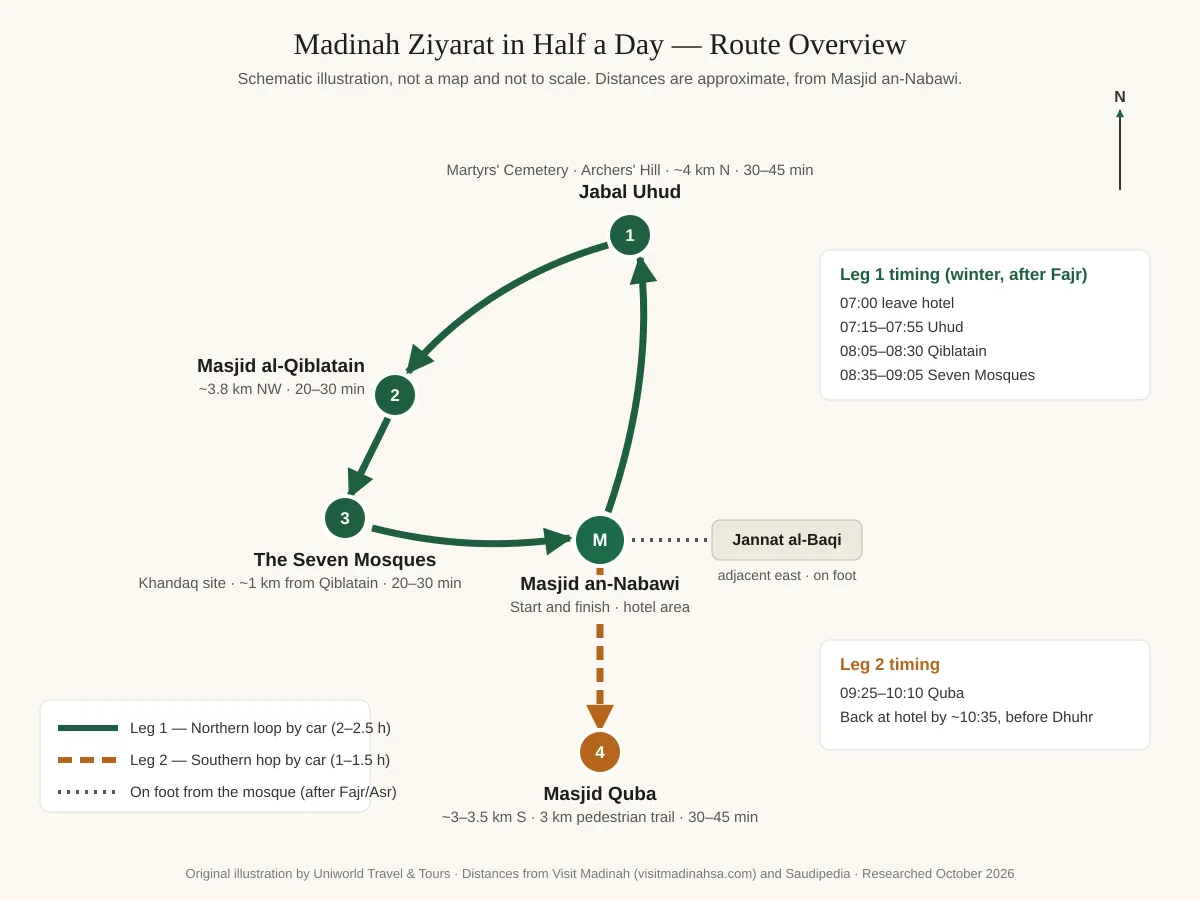
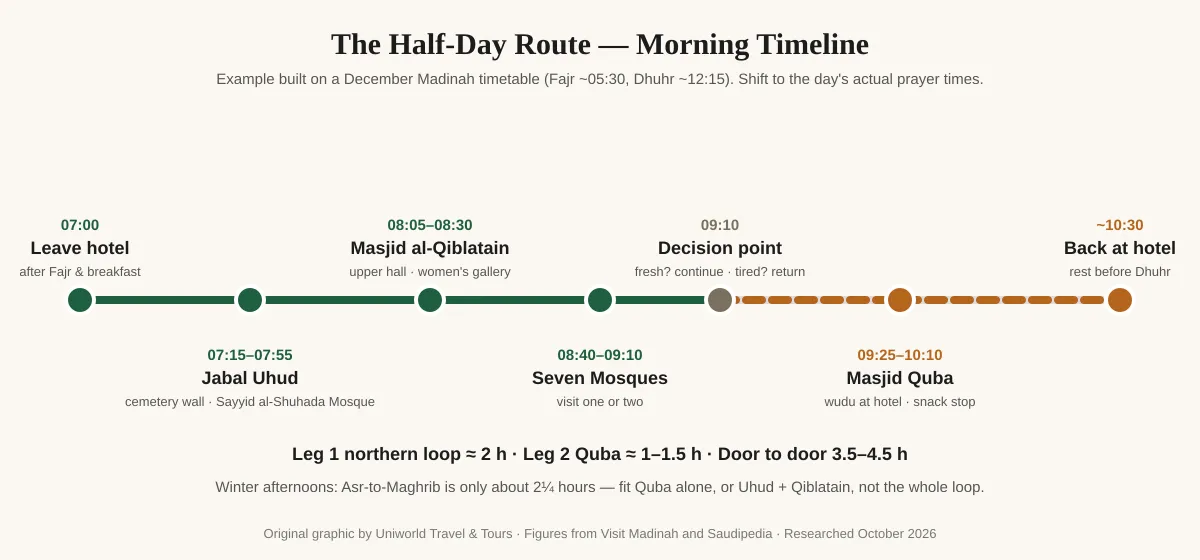
This is the single-outing version for a group that can walk short distances, travelling in the cooler months. Times assume a December timetable in Madinah with Fajr around 05:30 and Dhuhr around 12:15; shift everything to the day’s actual prayer times. Door to door it runs about 3 hours 35 minutes at a steady pace, and closer to 4.5 hours if your family prays unhurriedly and takes a snack break.
Leg 1: The northern loop (about 2 hours)
- 07:00 — Leave after breakfast. Pray Fajr in the mosque, eat, and have everyone use the hotel toilets. Book one car for the whole loop rather than three separate rides; the stops are close and a waiting driver saves boarding time with children.
- 07:15–07:55 — Jabal Uhud and the Martyrs’ Cemetery. The graves are behind a boundary wall and visitors stand outside it, so plan for standing and a short walk on paved ground. Uhud Martyrs Square has Sayyid al-Shuhada Mosque, parking, a pedestrian walkway and an organised area of vendors selling food and gifts (Visit Madinah), so toilets and shade are available at the mosque even though the cemetery wall itself is in the open. Keep children off the slopes and quiet near the wall.
- 08:05–08:30 — Masjid al-Qiblatain. A ten-minute drive west. The mosque has an upper prayer hall and a women’s gallery (Visit Madinah), so families separate for prayer and meet in the courtyard afterwards; agree the meeting spot before anyone goes in. Two rak’ahs and a one-sentence telling of the qibla change is enough for children.
- 08:40–09:10 — The Seven Mosques. Ten minutes further, at the foot of Mount Sala’. These are small mosques on the site of the Battle of the Trench: Saudipedia lists six on the site with Masjid al-Qiblatain customarily counted as the seventh, while Visit Madinah now lists five after one was demolished (Saudipedia; Visit Madinah). Masjid al-Fath, the largest, sits on a hillock on the western slope and is typically approached by steps; confirm the approach on the day if anyone in your group uses a wheelchair. Visit one or two of the mosques rather than all of them.
Why these three matter, in one breath each. Uhud is where about 70 companions, including Hamza رضي الله عنه, were martyred in 3 AH (Visit Madinah); the small hill opposite the cemetery is Archers’ Hill (Jabal al-Rumah), where the archers’ withdrawal turned the battle, and the Prophet ﷺ described Uhud as a mountain that loves us and that we love (Sahih al-Bukhari 4084). Qiblatain is where the qibla turned from Jerusalem to the Ka’bah during Dhuhr in 2 AH (Qur’an 2:144). The Seven Mosques mark where the trench was dug to defend Madinah in the Battle of the Confederates. Our history of the Battle of Uhud is worth reading with older children the night before.
09:10 — Decision point. Everyone fresh? Continue to Quba. Anyone flagging? Return to the hotel and make Quba a separate slot.
Leg 2: Masjid Quba (about 1–1.5 hours)
- 09:25–10:10 — Masjid Quba. The drive south from the Seven Mosques crosses the city, so allow 15–20 minutes. The narration in Sunan Ibn Majah 1412 describes purifying at home, coming to Quba and praying there for a reward like an Umrah; it is graded Hasan on that page. Practically, this means making wudu at the hotel before leaving. The surrounding Quba trail area has shops, restaurants and food stalls (Visit Madinah), which makes Quba the natural snack stop.
10:10 — Leave Quba; back at the hotel by about 10:30, with time to rest before Dhuhr.
If you would rather walk to Quba than drive, the 3 km pedestrian trail is lined with shops and seating; our guide to getting to Masjid Quba from Masjid an-Nabawi covers the walk, the return taxi and who should not attempt it in heat.
The afternoon version
After Asr suits families whose children nap at midday, but the window is short in winter: in Madinah in November and December Asr falls around 15:15 and Maghrib around 17:35, roughly 2¼ hours. After praying and boarding, that fits Quba on its own, or Uhud plus Qiblatain, not the full northern loop. In summer an afternoon start still means temperatures above 40 °C at the cemetery wall, so choose early morning.
Which Plan Fits Your Family?
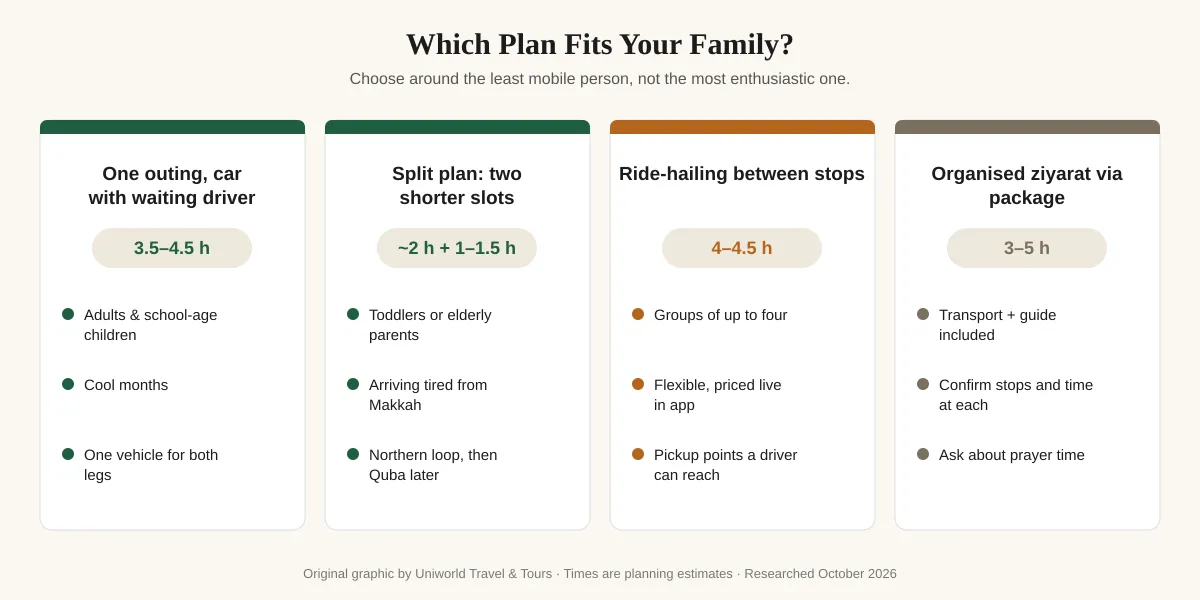
| Plan | Best suited to | Time needed | What to arrange |
|---|---|---|---|
| One outing, car with waiting driver | Adults and school-age children in cool months | 3.5–4.5 hours | One vehicle for both legs; agree waiting at each stop |
| Split plan: northern loop one morning, Quba another slot | Families with toddlers or elderly parents; anyone arriving tired from Makkah | About 2 h + 1–1.5 h | Two shorter bookings; Quba can be a walk-and-ride |
| Ride-hailing between stops | Small groups of up to four who want flexibility | 4–4.5 hours | Charged phone, app set up, pickup points a driver can reach |
| Organised ziyarat through your package | Groups wanting transport and a guide included | Usually 3–5 hours | Confirm the actual stops, time at each and whether prayer time is allowed |
Choose the plan around the least mobile person, not the most enthusiastic one.
Getting Around: Ride-Hailing, Private Car, Bus or Organised Ziyarat
Ride-hailing (Careem, Uber). Works well for the Quba hop and for a northern loop if you are happy to re-book between stops. Short rides within Madinah are priced live and are inexpensive compared with a private hire, but three or four separate pickups add waiting time with children. Set the apps up before travelling; our guide to Saudi apps every Umrah pilgrim should know explains which ones to install.
Private car with waiting. Quoted per vehicle, not per person, and usually the simplest option for a family of five or six. Operator listings reviewed on 27 October 2026 placed a private half-day ziyarat car roughly in the SAR 150–350 range depending on vehicle size and season; treat that as a starting point rather than a tariff, agree the total in writing or in the app, and confirm it covers waiting at every stop and the return to your hotel.
Hop-on hop-off bus. City Sightseeing lists Masjid an-Nabawi, Uhud, Qiblatain and Quba among its stops, runs from 05:30 to 23:59, and states its buses carry two wheelchairs (City Sightseeing Al Madinah). The operator does not publish bus frequency and has noted route changes, so it suits a relaxed full day more than a tight half-day; check the current timetable at the stop before relying on it.
Organised ziyarat. Guided tours run several hours and are priced per person; the Uhud and Seven Mosques tour listed on Visit Madinah, for example, is 5 hours at SAR 754 per person (Visit Madinah), which quickly exceeds a private car for a family. If ziyarat is included in your Umrah package it is normally a group bus with a guide; ask which sites are included and how long the group stays at each.
Visiting with Children, Elderly Parents or a Wheelchair
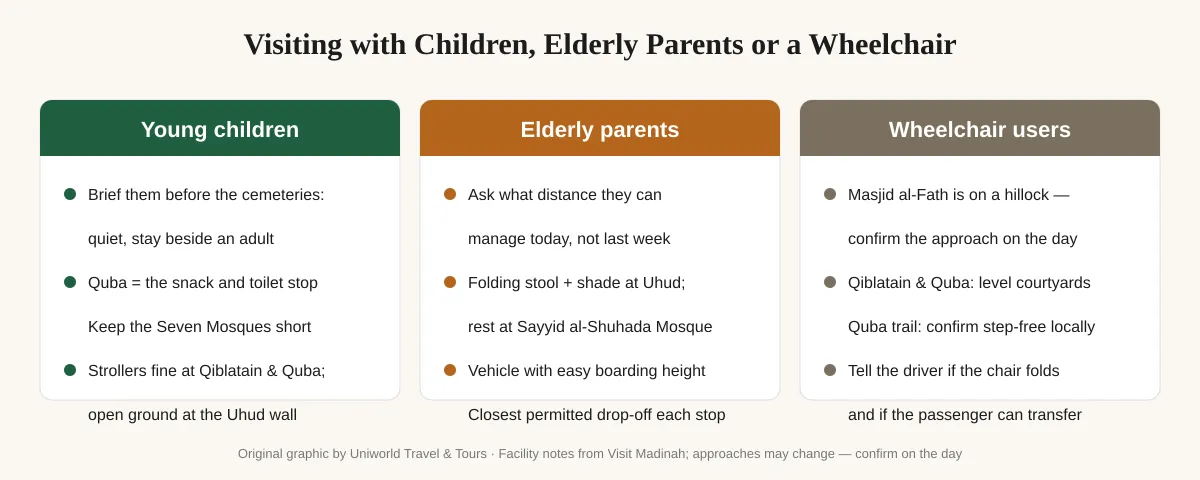
Young children. The cemeteries at Uhud and Baqi call for quiet, so brief children beforehand and keep one adult responsible for them while the other prays or reflects. Quba is the natural snack stop; keep the Seven Mosques short because the small spaces and the climb to Masjid al-Fath are the hardest part for a tired child. Strollers are fine in the courtyards at Qiblatain and Quba; at Uhud expect paved but open ground near the cemetery wall, with the mosque nearby for toilets and shade.
Elderly parents. Ask what distance they can manage today, not last week. Uhud involves standing in the open; bring a folding stool and shade, and use Sayyid al-Shuhada Mosque as the rest point. Choose a vehicle with a practical boarding height and ask the driver for the closest permitted drop-off at each site. If the morning loop tires them, Quba can be a short car visit the next day.
Wheelchair users. All four car-trip sites have vehicle access to the gate area, but the final approach differs: Masjid al-Fath at the Seven Mosques is on a hillock, while Qiblatain and Quba have level courtyards. Visit Madinah describes the Quba pedestrian trail as suitable for all members of society and all age groups but lists no step-free features, so confirm locally. Tell the driver whether the chair folds and whether the passenger can transfer to a seat; an ordinary booked car may not take every wheelchair.
Jannat al-Baqi and the Rawdah: What Is Separate from the Car Trip
Jannat al-Baqi lies immediately east of Masjid an-Nabawi, so it belongs with your mosque visits, not the car route. Visit Madinah states that around 10,000 companions are buried there, that visiting is available to men and children, that the best time is after the obligatory prayers, that etiquette signs are posted inside, and that visitors should not throw grain to the pigeons (Visit Madinah, Baqi’ Al-Gharqad). Pilgrims commonly report the gates opening after Fajr and Asr, and women generally view the cemetery from outside the wall; follow the direction of staff on the day. Aisha رضي الله عنها narrated that the Prophet ﷺ would go to Baqi at night, greet its people and ask forgiveness for them (Sahih Muslim 974a).
The Rawdah inside Masjid an-Nabawi is booked as a time slot through the Nusuk platform; the Ministry of Hajj and Umrah lists the service as free for citizens, residents and visitors (Ministry of Hajj and Umrah). Book it for a different window from your ziyarat so neither is rushed.
Best Time of Day and Season
Madinah’s mean daily maximum is about 24–31 °C from November to March and 35–44 °C from April to October (1991–2020 normals from the WMO and the Jeddah Regional Climate Center, via Wikipedia). In the cool months the route works at any daylight time; in the hot months start straight after Fajr and breakfast and be back before 10:00, or move one short leg to after Asr. Fasting visitors in Ramadan should keep the outing to one leg and finish well before iftar.
Friday is best avoided for the late-morning slot because the mosques fill for Jumu’ah. Saturday has a link with the Prophet’s ﷺ practice of visiting Quba, but any day is fine; pick the day your family is rested.
Common Planning Mistakes
- Zigzagging the city. Quba first and then Uhud puts the longest drive in the middle of the morning. Do the northern three together.
- Clashing with a fixed Rawdah slot. The slot is fixed; the ziyarat is not. Keep them in different windows.
- Doing ziyarat on arrival day. If you have just come from Makkah, settle in first; our comparison of the Haramain train, car and bus from Makkah to Madinah explains why the journey itself is tiring.
- Treating a quote as a tariff. Confirm per-vehicle versus per-person pricing, waiting time and the return trip before boarding.
- Trying to enter every one of the Seven Mosques. They are small; one or two is enough for a family.
- No meeting point. Men and women pray separately at Qiblatain and Quba; name a landmark before anyone enters.
What to Take
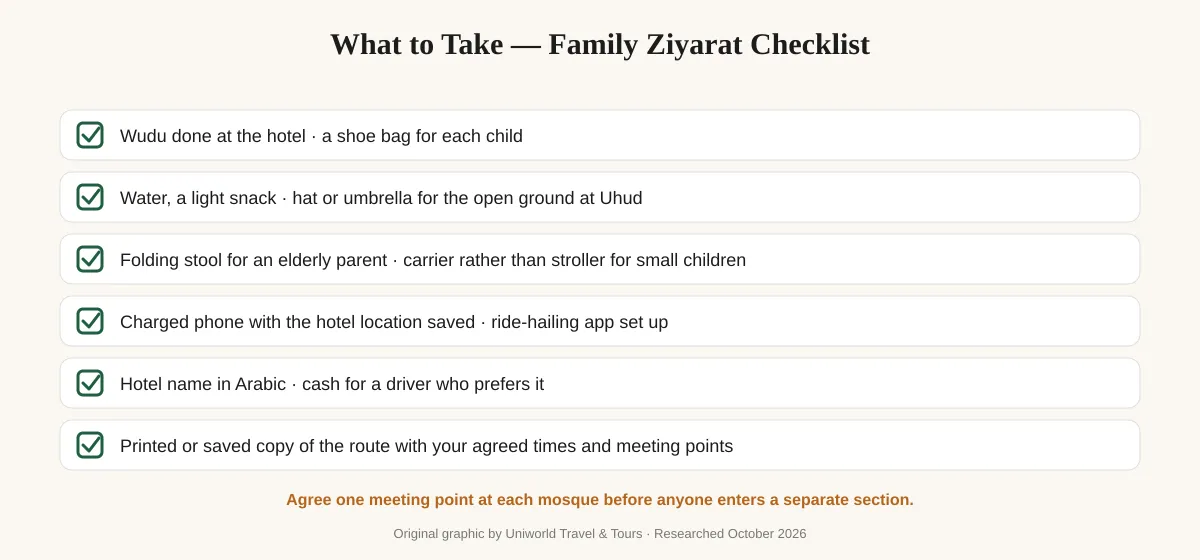
- Wudu done at the hotel; a shoe bag for each child.
- Water, a light snack, and a hat or umbrella for the open ground at the Uhud cemetery wall.
- A folding stool for an elderly parent; a carrier rather than a stroller if your child is small enough.
- Charged phone with the hotel’s location saved and the ride-hailing app set up.
- Hotel name in Arabic and cash for a driver who prefers it.
- A printed or saved copy of the route above with your agreed times.
Planning Madinah Ziyarat with Uniworld
When you compare Umrah packages from Pakistan, ask how many nights are in Madinah and whether ziyarat transport is part of the quoted price. Uniworld’s Umrah group packages include organised ziyarat excursions with transport; confirm which of the five sites are scheduled, how long the group stays at each and whether time for prayer is built in.
If you are travelling with elderly parents or a wheelchair user, say so before booking so the vehicle and stops can be planned around them. For accommodation that keeps the car pickup simple, see our selection of hotels in Madinah near Masjid an-Nabawi, or message the team on WhatsApp with your dates and group size.
Frequently Asked Questions
How long does Madinah ziyarat take?
About 3.5–4.5 hours door to door by car for Jabal Uhud, Masjid al-Qiblatain, the Seven Mosques and Masjid Quba, including prayer at each mosque. The northern loop alone takes about two hours; Quba alone takes one to one and a half hours by car.
Can you do the ziyarat in one day?
Yes. The five main sites fit into one half-day for a mobile group, and families can split them into a morning loop and a separate visit to Quba. Sites further out, such as Wadi al-Jinn, need a separate day.
Which ziyarat place is closest to Masjid an-Nabawi?
Jannat al-Baqi, which is immediately east of the mosque and reached on foot. Of the car-trip sites, Masjid Quba at 3–3.5 km south and Masjid al-Qiblatain at about 3.8 km north-west are the nearest.
Is ziyarat part of Umrah?
No. Umrah consists of the rites performed in Makkah. Visiting Madinah’s historical sites is a voluntary visit; it does not complete or replace any part of Umrah.
Do you need a permit for the ziyarat sites?
No permit is needed for Uhud, Qiblatain, the Seven Mosques, Quba or Baqi. The Rawdah inside Masjid an-Nabawi is the exception; it is booked as a time slot through Nusuk.
Can women visit Jannat al-Baqi?
Visit Madinah states that visiting is available to men and children. Women generally view the cemetery from outside the wall and may offer salam and dua from there; follow the direction of staff on the day.
Can children go to Jabal Uhud and the martyrs’ cemetery?
Yes. Children visit with their families; keep them beside you, off the slopes and quiet near the cemetery wall. Sayyid al-Shuhada Mosque at the square has toilets and shade.
How much does a ziyarat taxi cost in Madinah?
There is no fixed tariff. Ride-hailing hops between sites are priced live in the app; a private car with a waiting driver for the half-day was quoted at roughly SAR 150–350 per vehicle on operator listings reviewed on 27 October 2026. Confirm the total, the waiting time and the return trip before you set off.